
Ulid-Flake, A 64-bit ULID variant featuring Snowflake - the elixir implementation
Ulid-Flake is a compact 64-bit ULID (Universally Unique Lexicographically Sortable Identifier) variant inspired by ULID and Twitter's Snowflake. It features a 1-bit sign bit, a 43-bit timestamp, and a 20-bit randomness. Additionally, it offers a scalable version using the last 5 bits as a scalability identifier (e.g., machineID, podID, nodeID).
herein is proposed Ulid-Flake:
{:ok, new_flake} = UlidFlake.generate() # 14246757444195114
UlidFlake.to_string(new_flake) # 00CMXB6TAK4SA
Features
- Compact and Efficient: Uses only 64 bits, making it compatible with common integer types like
int64andbigint. - Scalability: Provides 32 configurations for scalability using a distributed system.
- Lexicographically Sortable: Ensures lexicographical order.
- Canonical Encoding: Encoded as a 13-character string using Crockford's Base32.
- Monotonicity and Randomness: Monotonic sort order within the same millisecond with enhanced randomness to prevent predictability.
Installation
This package can be installed by adding ulid_flake to your list of dependencies in mix.exs:
def deps do
  [
    {:ulid_flake, "~> 1.0.0"}
  ]
end
Documentation
Basic Usage
Erlang/OTP
iex -S mix

iex(1)> {:ok, _} = UlidFlake.start_link(nil)
{:ok, #PID<0.174.0>}
iex(2)> {:ok, flakeID} = UlidFlake.generate()
{:ok, %UlidFlake{value: 17089122411459096}}
iex(3)> UlidFlake.to_string(flakeID)
"00F5PEXFDQCGR"
Import
Import UlidFlake

# Start the Ulid-Flake process
{:ok, _} = UlidFlake.start_link(nil)

# Configure settings for stand-alone version
UlidFlake.Config.set_epoch_time(~U[2024-01-01 00:00:00Z]) # Custom epoch time, default 2024-01-01
UlidFlake.Config.set_entropy_size(2) # Custom entropy size, 1, 2 or 3, default 1

# Configure settings for scalable version
UlidFlake.Scalable.Config.set_epoch_time(~U[2024-01-01 00:00:00Z]) # Custom epoch time, default 2024-01-01
UlidFlake.Scalable.Config.set_entropy_size(2) # Custom entropy size, 1, 2 or 3, default 1
UlidFlake.Scalable.Config.set_scalability_size(4) # Custom scalability ID (e.g., machineID, podID, nodeID), 1~32, default 0

# Generate a new Ulid-Flake instance
{:ok, new_flake} = UlidFlake.generate()
IO.puts("Base32: #{UlidFlake.to_base32(new_flake)}")
IO.puts("Integer: #{UlidFlake.to_integer(new_flake)}")
IO.puts("Timestamp: #{UlidFlake.timestamp(new_flake)}")
IO.puts("Randomness: #{UlidFlake.randomness(new_flake)}")
IO.puts("Hex: #{UlidFlake.to_hex(new_flake)}")
IO.puts("Binary: #{UlidFlake.to_bin(new_flake)}")
# Base32:     00F2N078MDT7J
# Integer:    16981964897052914
# Timestamp:  16195263764
# Randomness: 452850
# Hex:        0x3C5501D146E8F2
# Bin:        0b111100010101010000000111010001010001101110100011110010
Monotonicity Testing
Stand-alone version:
Enum.map(1..5, fn _ ->
  {:ok, new_flake} = UlidFlake.generate()
  IO.puts("Base32: #{UlidFlake.to_base32(new_flake)}")
  IO.puts("Integer: #{UlidFlake.to_integer(new_flake)}")
  IO.puts("Timestamp: #{UlidFlake.timestamp(new_flake)}")
  IO.puts("Randomness: #{UlidFlake.randomness(new_flake)}")
  IO.puts("Hex: #{UlidFlake.to_hex(new_flake)}")
  IO.puts("Binary: #{UlidFlake.to_bin(new_flake)}")
  {:ok, new_flake}
end)

# Base32: 00F5MFHSEYXCM
# Integer: 17086945199879572
# Timestamp: 16295380782
# Randomness: 1013140
# Hex: 0x3CB47C72EF7594
# Binary: 0b111100101101000111110001110010111011110111010110010100

# Base32: 00F5MFHSEYXHB
# Integer: 17086945199879723
# Timestamp: 16295380782
# Randomness: 1013291
# Hex: 0x3CB47C72EF762B
# Binary: 0b111100101101000111110001110010111011110111011000101011

# Base32: 00F5MFHSFPCE0
# Integer: 17086945200648640
# Timestamp: 16295380783
# Randomness: 733632
# Hex: 0x3CB47C72FB31C0
# Binary: 0b111100101101000111110001110010111110110011000111000000

# Base32: 00F5MFHSFPCNY
# Integer: 17086945200648894
# Timestamp: 16295380783
# Randomness: 733886
# Hex: 0x3CB47C72FB32BE
# Binary: 0b111100101101000111110001110010111110110011001010111110

# Base32: 00F5MFHSFPCRA
# Integer: 17086945200648970
# Timestamp: 16295380783
# Randomness: 733962
# Hex: 0x3CB47C72FB330A
# Binary: 0b111100101101000111110001110010111110110011001100001010
scalable version:
Enum.map(1..5, fn _ ->
  {:ok, new_flake} = UlidFlake.Scalable.generate()
  IO.puts("")
  IO.puts("Base32: #{UlidFlake.Scalable.to_base32(new_flake)}")
  IO.puts("Integer: #{UlidFlake.Scalable.to_integer(new_flake)}")
  IO.puts("Timestamp: #{UlidFlake.Scalable.timestamp(new_flake)}")
  IO.puts("Randomness: #{UlidFlake.Scalable.randomness(new_flake)}")
  IO.puts("Hex: #{UlidFlake.Scalable.to_hex(new_flake)}")
  IO.puts("Binary: #{UlidFlake.Scalable.to_bin(new_flake)}")
  {:ok, new_flake}
end)

# Base32: 00F5MN1MCFT30
# Integer: 17087134008076384
# Timestamp: 16295560844
# Randomness: 16195
# Hex: 0x3CB4A868C7E860
# Binary: 0b111100101101001010100001101000110001111110100001100000

# Base32: 00F5MN1MCFVP0
# Integer: 17087134008078016
# Timestamp: 16295560844
# Randomness: 16246
# Hex: 0x3CB4A868C7EEC0
# Binary: 0b111100101101001010100001101000110001111110111011000000

# Base32: 00F5MN1MCFXA0
# Integer: 17087134008079680
# Timestamp: 16295560844
# Randomness: 16298
# Hex: 0x3CB4A868C7F540
# Binary: 0b111100101101001010100001101000110001111111010101000000

# Base32: 00F5MN1MCG0H0
# Integer: 17087134008082976
# Timestamp: 16295560844
# Randomness: 16401
# Hex: 0x3CB4A868C80220
# Binary: 0b111100101101001010100001101000110010000000001000100000

# Base32: 00F5MN1MCG5K0
# Integer: 17087134008088160
# Timestamp: 16295560844
# Randomness: 16563
# Hex: 0x3CB4A868C81660
# Binary: 0b111100101101001010100001101000110010000001011001100000
Creating Ulid-Flake Instances from other sources
From Integer
{:ok, ulid_flake} := UlidFlake.from_int(1234567890123456789)
fmt.Printf("From Int: %s\n", UlidFlake.to_string(ulid_flake))
From Base32 String
{:ok, ulid_flake} := UlidFlake.from_str("01AN4Z07BY79K")
fmt.Printf("From String: %s\n", UlidFlake.to_string(ulid_flake))
From Unix Epoch Time
{:ok, ulid_flake} := UlidFlake.from_unix_epoch_time(1672531200)
fmt.Printf("From Unix Time: %s\n", UlidFlake.to_string(ulid_flake))
Specification
Below is the default stand-alone version specification of Ulid-Flake.
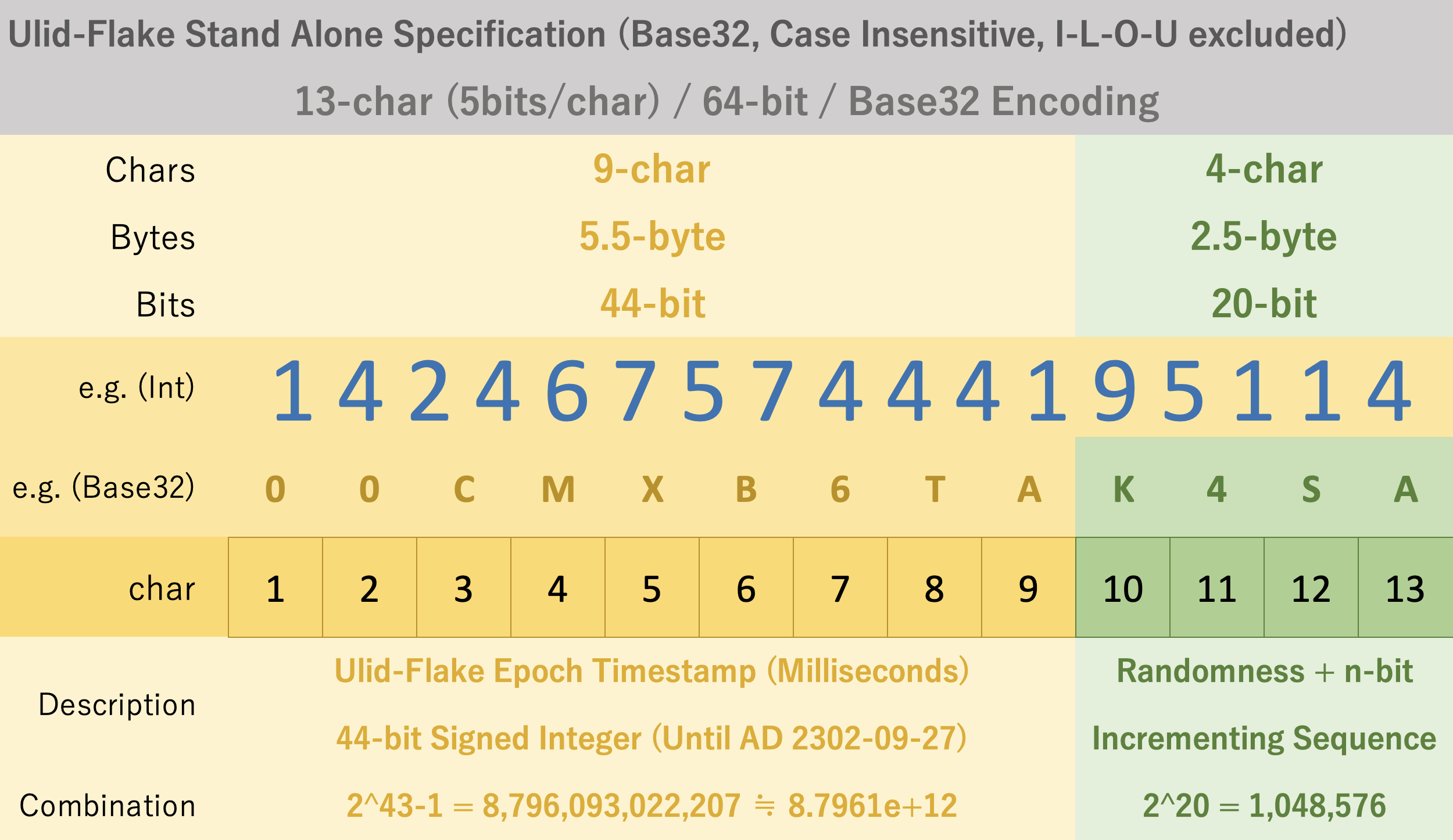
Note: a 1-bit sign bit is included in the timestamp.
Stand-alone version (default):

 00CMXB6TA      K4SA

|---------|    |----|
 Timestamp   Randomness
   44-bit      20-bit
   9-char      4-char
Also, a scalable version is provided for distributed system using purpose.
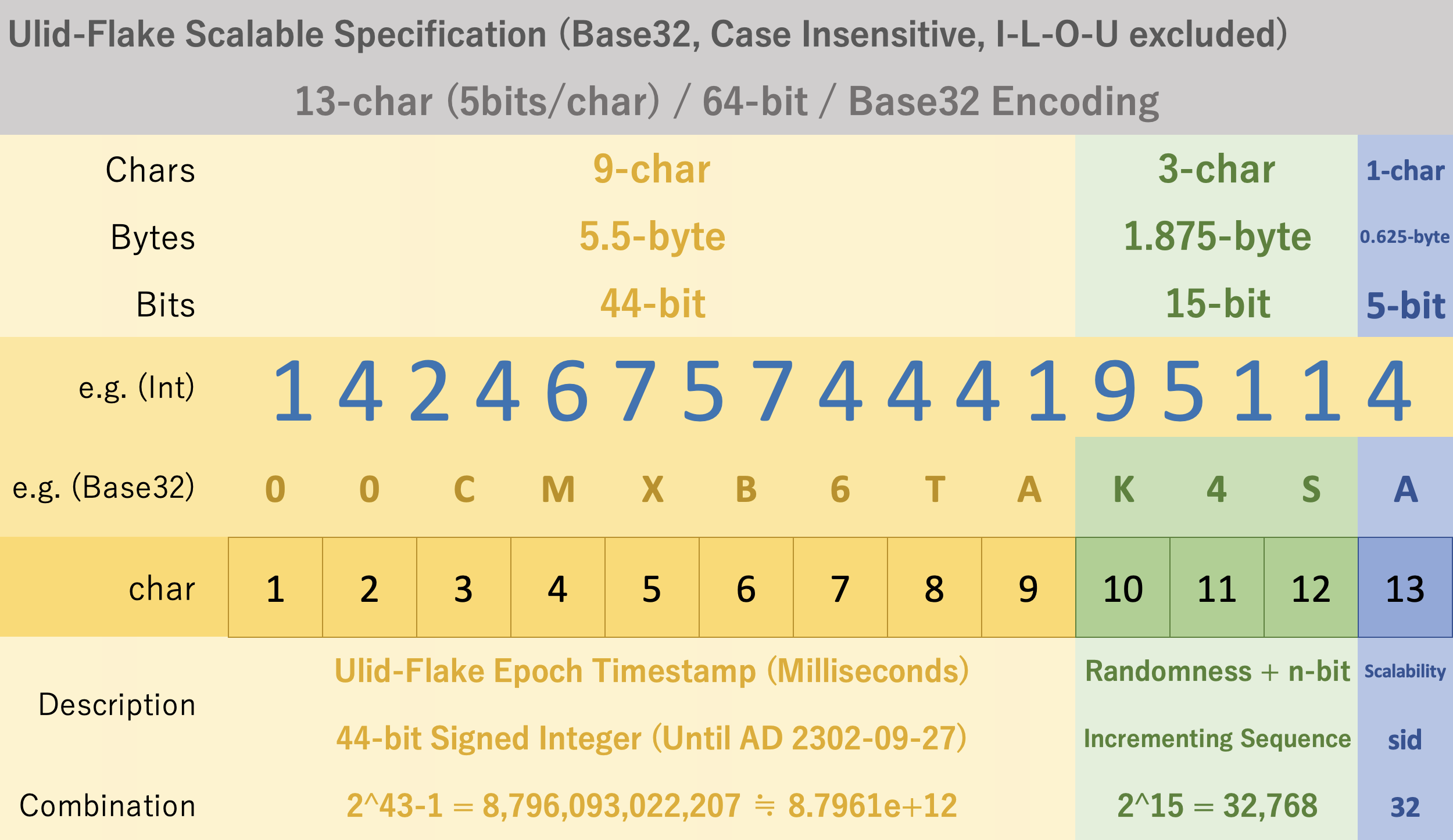
Note: a 1-bit sign bit is included in the timestamp.
Scalable version (optional):

 00CMXB6TA      K4S       A

|---------|    |---|     |-|
 Timestamp   Randomness  Scalability
   44-bit      15-bit    5-bit
   9-char      3-char    1-char
Components
Total 64-bit size for compatibility with common integer (long int, int64 or bigint) types.
Timestamp
-
The first
1-bitis a sign bit, always set to 0. -
Remaining
43-bittimestamp in millisecond precision. -
Custom epoch for extended usage span, starting from
2024-01-01T00:00:00.000Z. -
Usable until approximately
2302-09-27AD.
Randomness
20-bitrandomness for stand-alone version. Provides a collision resistance with a p=0.5 expectation of 1,024 trials. (not much)15-bitrandomness for scalable version.- Initial random value at each millisecond precision unit.
-
adopt a
+nbits entropy incremental mechanism to ensure uniqueness without predictability.
Scalability (Scalable version ony)
-
Provide a
5-bitscalability for distributed system using purpose. - total 32 configurations can be used.
Sorting
The left-most character must be sorted first, and the right-most character sorted last, ensuring lexicographical order. The default ASCII character set must be used.
When using the stand-alone version strictly in a stand-alone environment, or using the scalable version in both stand-alone or distributed environment, sort order is guaranteed within the same millisecond. however, when using the stand-alone version in a distributed system, sort order is not guaranteed within the same millisecond.
Note: within the same millisecond, sort order is guaranteed in the context of an overflow error could occur.
Canonical String Representation
Stand-alone version (default):

tttttttttrrrr

where
t is Timestamp (9 characters)
r is Randomness (4 characters)
Scalable version (optional):
tttttttttrrrs
where
t is Timestamp (9 characters)
r is Randomness (3 characters)
s is Scalability (1 characters)Encoding
Crockford's Base32 is used as shown. This alphabet excludes the letters I, L, O, and U to avoid confusion and abuse.
0123456789ABCDEFGHJKMNPQRSTVWXYZOptional Long Int Representation
1234567890123456789

(with a maximum 13-character length in string format)
Monotonicity and Overflow Error Handling
Randomness
When generating a Ulid-Flake within the same millisecond, the randomness component is incremented by a n-bit entropy in the least significant bit position (with carrying).
Thus, comparing just incremented 1-bit one time, the incremented n-bit mechanism cloud lead to an overflow error sooner.
when the generation is failed with overflow error, it should be properly handled in the application to wait and create a new one till the next millisecond is coming. The implementation of Ulid-Flake should just return the overflow error, and leave the rest to the application.
Timestamp and Over All
Technically, a 13-character Base32 encoded string can contain 65 bits of information, whereas a Ulid-Flake must only contain 64 bits. Further more, there is a 1-bit sign bit at the beginning, only 63 bits are actually carrying effective information. Therefore, the largest valid Ulid-Flake encoded in Base32 is 7ZZZZZZZZZZZZ, which corresponds to an epoch time of 8,796,093,022,207 or 2^43 - 1.
Any attempt to decode or encode a Ulid-Flake larger than this should be rejected by all implementations and return an overflow error, to prevent overflow bugs.
Binary Layout and Byte Order
The components are encoded as 16 octets. Each component is encoded with the Most Significant Byte first (network byte order).
Stand-alone version (default):

 0                   1                   2                   3
 0 1 2 3 4 5 6 7 8 9 0 1 2 3 4 5 6 7 8 9 0 1 2 3 4 5 6 7 8 9 0 1
+-+-+-+-+-+-+-+-+-+-+-+-+-+-+-+-+-+-+-+-+-+-+-+-+-+-+-+-+-+-+-+-+
|                      32_bit_int_time_high                     |
+-+-+-+-+-+-+-+-+-+-+-+-+-+-+-+-+-+-+-+-+-+-+-+-+-+-+-+-+-+-+-+-+
| 12_bit_uint_time_low  |          20_bit_uint_random           |
+-+-+-+-+-+-+-+-+-+-+-+-+-+-+-+-+-+-+-+-+-+-+-+-+-+-+-+-+-+-+-+-+
Scalable version (optional):
0 1 2 3
0 1 2 3 4 5 6 7 8 9 0 1 2 3 4 5 6 7 8 9 0 1 2 3 4 5 6 7 8 9 0 1
+-+-+-+-+-+-+-+-+-+-+-+-+-+-+-+-+-+-+-+-+-+-+-+-+-+-+-+-+-+-+-+-+
| 32_bit_int_time_high |
+-+-+-+-+-+-+-+-+-+-+-+-+-+-+-+-+-+-+-+-+-+-+-+-+-+-+-+-+-+-+-+-+
| 12_bit_uint_time_low | 15_bit_uint_random | 5_bit_s |
+-+-+-+-+-+-+-+-+-+-+-+-+-+-+-+-+-+-+-+-+-+-+-+-+-+-+-+-+-+-+-+-+Contributing
We welcome contributions! Please see our CONTRIBUTING.md for guidelines on how to get involved.
License
This project is licensed under the MIT License. See the LICENSE file for details.
Acknowledgments
██╗░░░██╗██╗░░░░░██╗██████╗░░░░░░░███████╗██╗░░░░░░█████╗░██╗░░██╗███████╗
██║░░░██║██║░░░░░██║██╔══██╗░░░░░░██╔════╝██║░░░░░██╔══██╗██║░██╔╝██╔════╝
██║░░░██║██║░░░░░██║██║░░██║█████╗█████╗░░██║░░░░░███████║█████═╝░█████╗░░
██║░░░██║██║░░░░░██║██║░░██║╚════╝██╔══╝░░██║░░░░░██╔══██║██╔═██╗░██╔══╝░░
╚██████╔╝███████╗██║██████╔╝░░░░░░██║░░░░░███████╗██║░░██║██║░╚██╗███████╗
░╚═════╝░╚══════╝╚═╝╚═════╝░░░░░░░╚═╝░░░░░╚══════╝╚═╝░░╚═╝╚═╝░░╚═╝╚══════╝