Roadrunner





Pure-Erlang HTTP/1.1 + HTTP/2 + HTTP/3 + WebSocket server for Erlang/OTP. Built for low tail latency at sustained load. Beep beep.
Roadrunner is the HTTP backbone of the arizona-framework, and works standalone too. The API is small: a handler behaviour, request and response accessors, listener controls, and opt-in helpers (cookies, query strings, multipart, SSE, WebSocket).
Why Roadrunner?
A small, fast HTTP core you can trust on the hot path.
- Fast where it counts: Tuned for low p50 and p99 under sustained load. See Performance at a glance.
- Correct and hostile-input-safe: Strict RFC 9110 / 9112 / 9113 parsing, 100% h2spec and 100% Autobahn (no exclusions), and stress-tested against request-smuggling corpora. See Conformance.
- Every HTTP version, one server: HTTP/1.1, HTTP/2, HTTP/3 (experimental),
and WebSocket served from one listener; browsers upgrade to h3 over the same
port via
Alt-Svc. - Pure Erlang, almost no dependencies: One runtime dep (
telemetry), no C NIFs, and Roadrunner owns its own h1/h2/h3 codecs and its own QUIC transport: easy to read and audit. - Pleasant to build on: Plain-Erlang request and response values, composable middleware, and opt-in helpers for cookies, query strings, multipart, SSE, and WebSocket.
- Production lifecycle in the box: Graceful drain with a deadline, telemetry
events, per-request
request_idlog correlation, and configurable DoS bounds.
Requirements
Requires OTP 27+.
🚧 Status
Roadrunner is in 0.x. The core is functional and covered by tests,
but the API may change between minor versions. Pin an exact version
in your deps if you need stability across upgrades.
Conformance
Strict 100% h2spec (HTTP/2) and Autobahn fuzzingclient across the full WebSocket matrix (no exclusions). HTTP/1.1 parsers stress-tested against the llhttp test corpus and the canonical PortSwigger request-smuggling vectors.
Standards conformance:
- HTTP/1.1: RFC 9110 (semantics) + RFC 9112 (syntax).
- HTTP/2: RFC 9113 (frames + multiplexing) + RFC 7541 (HPACK).
Opt-in per listener via
protocols => [http1, http2](or[http2]for h2c prior-knowledge on plain TCP). Conformance harness:scripts/h2spec.sh(drives h2spec). - HTTP/3 (experimental): RFC 9114 over QUIC with QPACK (RFC 9204)
static-table compression. Enable per listener via
protocols => [http3](requirestls; QUIC mandates TLS 1.3); it co-serves with h1/h2 on the same port number (TCP for h1/h2, UDP for h3) and advertisesAlt-Svcso browsers upgrade. Roadrunner ships its own pure-Erlang QUIC transport; treat HTTP/3 as experimental. - Content-Encoding (RFC 9110 §8.4.1): gzip + deflate with
qvalue-aware
Accept-Encodingnegotiation (RFC 9110 §12.5.3), works unchanged over HTTP/2. - WebSocket: RFC 6455. Conformance harness:
scripts/autobahn.escript(drives the Autobahn|Testsuite fuzzingclient). - WebSocket compression: RFC 7692
permessage-deflate, including*_max_window_bitsand*_no_context_takeover.
Performance at a glance
Median req/s over HTTP/1.1 on a 12th-gen i9-12900HX, 50 clients,
2 s warmup + 5 s measure, loopback. HTTP/2 numbers, p50 / p99
percentiles, and memory shape sit in
docs/bench_results.md
and docs/comparison.md.
| scenario | roadrunner | cowboy | elli |
|---|---|---|---|
hello | 307 k | 201 k | 299 k |
json | 299 k | 189 k | 304 k |
echo | 304 k | 162 k | 282 k |
headers_heavy | 257 k | 141 k | 253 k |
large_response | 124 k | 98 k | 123 k |
multi_request_body | 262 k | 125 k | 274 k |
varied_paths_router | 290 k | 175 k | — |
post_4kb_form | 193 k | 98 k | — |
large_post_streaming | 20 k | 6.9 k | — |
pipelined_h1 | 580 k | 371 k | 4.8 k |
websocket_msg_throughput | 232 k | 179 k | — |
gzip_response | 138 k | 111 k | — |
Bold = fastest in row. — means that workload has no elli fixture. On
simple GETs and small POSTs Roadrunner and elli sit within the bench's
~15% variance band on those rows; the comparison doc has the full
methodology.
Tail latency at sustained load
Open-loop, Coordinated-Omission-corrected (wrk2, hello, 8 threads,
50 connections, 3-run median): Roadrunner sustains 291 k req/s
at p50 1.07 ms, p99 2.31 ms, p99.99 4.70 ms. Full per-scenario
matrix with all four rate-points per server in
docs/wrk2_results.md.
The throughput numbers above are from scripts/bench.escript
(closed-loop); the comparison doc has the full methodology
breakdown.
Comparison
If your workload needs a feature, the server has to ship it. —
means achievable in user code but no helper / option built in; ✗
means out of scope for that server.
| feature | roadrunner | cowboy | elli |
|---|---|---|---|
| HTTP/1.1 | ✓ | ✓ | ✓ |
| HTTP/2 + HPACK | ✓ | ✓ | ✗ |
| HTTP/3 (QUIC, experimental) | ✓ | ✗ | ✗ |
| WebSocket (RFC 6455) | ✓ | ✓ | — |
| permessage-deflate (RFC 7692) | ✓ | ✓ | ✗ |
| Native router | ✓ | ✓ | ✗ |
| gzip / deflate response negotiation | ✓ | ✓ | — |
| Streaming request bodies | ✓ | ✓ | — |
| Native qs / cookie / multipart | ✓ | ✓ | — |
| Server-Sent Events helper | ✓ | — | — |
| Sendfile | ✓ | ✓ | ✓ |
| Static handler (ETag / Range / IMS) | ✓ | ✓ | — |
| Graceful drain with deadline + broadcast | ✓ | — | ✗ |
Per-request request_id in logger meta | ✓ | — | ✗ |
Quickstart
Add to rebar.config (latest version on
Hex):
{deps, [
    roadrunner
]}.
Write a handler. The third route element is per-route state, threaded
to the handler via roadrunner_req:state/1:
-module(hello_handler).
-behaviour(roadrunner_handler).
-export([handle/1]).

handle(Req) ->
    #{greeting := Greeting} = roadrunner_req:state(Req),
    {roadrunner_resp:text(200, <<Greeting/binary, ", roadrunner!">>), Req}.
Boot a listener:
application:ensure_all_started(roadrunner).
roadrunner:start_listener(my_listener, #{
    port => 8080,
    routes => [{~"/", hello_handler, #{greeting => ~"hello"}}]
}).
$ curl -i localhost:8080
HTTP/1.1 200 OK
content-type: text/plain; charset=utf-8
content-length: 18

hello, roadrunner!
A handler is a module with handle/1. To read path parameters from a :param
route (roadrunner_req:bindings/1), read the body (read_body/1 returns
iodata and threads Req2 back), and reply with JSON
(roadrunner_resp:json/2 encodes the term):
-module(users_handler).
-behaviour(roadrunner_handler).
-export([handle/1]).

handle(Req) ->
    #{~"id" := Id} = roadrunner_req:bindings(Req),
    {ok, Body, Req2} = roadrunner_req:read_body(Req),
    Reply = #{id => Id, received => byte_size(iolist_to_binary(Body))},
    {roadrunner_resp:json(200, Reply), Req2}.
Mix literal and :param routes:
routes => [
    {~"/", hello_handler, #{greeting => ~"hello"}},
    {~"/users/:id", users_handler, undefined}
]
The request accessors (method/1, path/1, header/2, parse_qs/1,
bindings/1, peer/1, read_body/1) all live in roadrunner_req.
To wrap every response, register a middleware. An entry is a Callable or a
{Callable, State} pair, and the first in the list runs outermost:
-module(server_header_mw).
-behaviour(roadrunner_middleware).
-export([call/3]).

call(Req, Next, _State) ->
    {{Status, Headers, Body}, Req2} = Next(Req),
    {{Status, [{~"server", ~"roadrunner"} | Headers], Body}, Req2}.
roadrunner:start_listener(api, #{
    port => 8080,
    middlewares => [server_header_mw],
    routes => [{~"/", hello_handler, #{greeting => ~"hello"}}]
}).
For HTTP/2 over TLS, add a cert and list both protocols. ALPN is
derived from protocols automatically:
roadrunner:start_listener(my_tls_listener, #{
    port => 8443,
    protocols => [http1, http2],
    tls => [
        {certfile, "cert.pem"},
        {keyfile, "key.pem"}
    ],
    routes => [{~"/", hello_handler, #{greeting => ~"hello"}}]
}).
ALPN routes h2 clients to the HTTP/2 path and http/1.1 clients (or
no-ALPN) to the HTTP/1.1 path on the same listener. Drop http2 from
the list to disable HTTP/2. For HTTP/2 on plain TCP (h2c
prior-knowledge per RFC 7540 §3.4), use protocols => [http2] without
the tls opt.
For HTTP/3 (experimental), add http3 to a TLS listener's protocols
(e.g. protocols => [http1, http2, http3]). It serves h3 over UDP on the
same port number and advertises Alt-Svc so browsers upgrade from TCP;
the QUIC transport starts on demand, so h1/h2-only listeners never open a
UDP socket.
For listeners that don't need routing, routes => Mod (or
{Mod, State} to seed handler state) skips the router entirely and
dispatches every request to Mod:handle/1:
roadrunner:start_listener(my_listener, #{
    port => 8080,
    routes => {hello_handler, #{greeting => ~"hello"}}
}).
Configuration
All listener options live in the
roadrunner_listener:opts/0
type, with per-key defaults and tuning rationale. Beyond port,
protocols, tls, and routes from the Quickstart, the type covers:
- DoS bounds:
max_clients,max_concurrent_requests,socket_backlog,max_content_length,request_timeout,keep_alive_timeout,min_bytes_per_second,max_keep_alive_requests - Middleware:
middlewares - Body buffering:
body_buffering - Graceful drain:
graceful_drain,slot_reconciliation - Per-conn hibernation:
hibernate_after - Handler spawn opts:
handler_spawn - HTTP/1 tunables: Under the
{http1, Opts}entry inprotocols:max_request_line,max_header_line,max_header_block,max_header_count - HTTP/2 tunables: Under the
{http2, Opts}entry inprotocols:conn_window,stream_window,window_refill_threshold,max_concurrent_streams,max_header_block - HTTP/3 tunables: Under the
{http3, Opts}entry inprotocols:listeners(reuseport pool size),max_header_block
Features
Handlers
- Buffered responses:
{Status, Headers, Body}viaroadrunner_resp:text/2,:html/2,:json/2,:redirect/2, plus empty-status shortcuts. - Streaming:
{stream, Status, Headers, Fun}, chunked transfer with aSend/2callback; supports trailer headers per RFC 9112 §7.1.2. - Loop / SSE:
{loop, Status, Headers, State}plus an optionalhandle_info/3callback for message-driven push. - WebSocket:
{websocket, Module, State}upgrade with aroadrunner_ws_handlercallback. - Sendfile:
{sendfile, Status, Headers, {Filename, Offset, Length}}, zero-copy file body viafile:sendfile/5(TCP) or chunkedssl:sendfallback (TLS).
Routing
- Router:
roadrunner_routerwith literal /:param/*wildcardsegments. - Hot reload: Routes published to
persistent_termfor O(1) lookup;roadrunner_listener:reload_routes/2swaps the table without restart.
Middleware
- Continuation-style: Each entry is a
Callableor a{Callable, State}pair, whereCallableis a module (call/3) or afun((Req, Next, State) -> {Response, Req2}). Listener-level + per-route, first-in-list = outermost.
Built-in handlers
roadrunner_static: File serving with ETag,If-None-Match,Range,Last-Modified,If-Modified-Since, and configurable symlink policy (refuse_escapesdefault).
Hardening
- Strict parsing: RFC 9110 / 9112, with defenses grouped by subsystem:
- Request smuggling / framing: CL+TE conflict, multiple-CL, chunk-size leading-whitespace rejection.
- Header / control-frame injection: Header CRLF / NUL rejection, SSE event-line CRLF rejection, trailer-header CRLF rejection, RFC 6455 §5.5 control-frame limits, RFC 6265 cookie OWS handling.
- Sendfile path safety: Path traversal + symlink escape defenses.
- TLS defaults: TLS 1.2 / 1.3 only, AEAD-only cipher filter,
client renegotiation off, post-quantum hybrid
x25519mlkem768first when the OpenSSL build supports it. Full settings list in theroadrunner_listenermodule docs. - DoS bounds:
max_clients,max_concurrent_requests,socket_backlog,max_content_length,min_bytes_per_second,request_timeout,keep_alive_timeout,max_keep_alive_requests.
Observability
- Telemetry:
telemetryevents covering request, response, listener accept / close, slot reconciliation, ws upgrade and frames, and drain ack (opt-in viaroadrunner:acknowledge_drain/1). Full event list with measurements / metadata in theroadrunner_telemetrymodule docs. - Log correlation: Per-request
request_idattached tologger:set_process_metadata/1so any?LOG_*from middleware/handlers is auto-correlated. - Pull metrics:
roadrunner_listener:info/1foractive_clients/requests_served. - Process labels:
proc_lib:set_label/1per-listener / per-acceptor / per-conn for legibleobserverprocess trees.
Lifecycle
- Drain:
roadrunner_listener:drain/2does graceful shutdown with a timeout: closes the listen socket, broadcasts{roadrunner_drain, Deadline}to in-flight conns viapg, polls until idle or deadline, thenexit(Pid, shutdown)for stragglers. - Status:
roadrunner_listener:status/1returnsaccepting | draining. - Slot reconciliation: Optional
slot_reconciliation => #{interval => N}listener opt: a periodic reaper that comparesclient_counteragainst the connpggroup and releases slots orphaned bykill-style exits. Off by default; enable in production where you can't trust every exit path to runterminate/3(killsignals, OOM kills, supervisor brutal-kill).
Documentation
docs/comparison.md: full side-by-side benchmarks vs cowboy and elli (throughput, latency, architectural trade-offs, reproduction commands).docs/bench_results.md: full per-protocol matrix with p50 / p99 across every scenario.docs/bench_internals.md: loadgen worker model, latency aggregation, when the loader becomes the bottleneck.docs/wrk2_results.md: open-loop, Coordinated-Omission-corrected tail-latency tables (full per-scenario, all rate-points per server).docs/resource_results.md: memory + CPU shape per scenario.docs/resource_limits.md: the per-connection and per-peer memory / CPU limits, with defaults and over-limit behavior (operator reference).docs/conn_lifecycle_investigation.md: the connection-process model trade-offs and the one h2 case cowboy still wins.docs/roadmap.md: deferred items, with rough effort estimates for each.
Sponsors
Roadrunner is open source and maintained on personal time. If you or your company find it useful, consider sponsoring.
I also accept coffees ☕


Contributing
Contributions are welcome! Please see CONTRIBUTING.md for development setup, testing guidelines, and contribution workflow.
Contributors

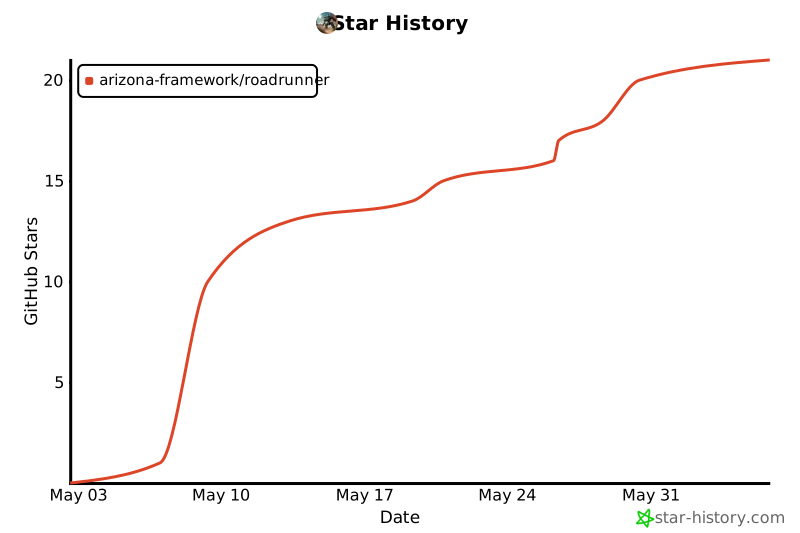
Star History
License
Copyright (c) 2026 William Fank Thomé
Roadrunner is open-source under the Apache 2.0 License on GitHub.
See LICENSE.md for more information.