 Ragex
Ragex
Hybrid Retrieval-Augmented Generation for Multi-Language Codebases
Ragex is an MCP (Model Context Protocol) server that analyzes codebases using compiler output and language-native tools to build comprehensive knowledge graphs. It enables natural language querying of code structure, relationships, and semantics.
Features
Foundation
▸ MCP Server Protocol: Full JSON-RPC 2.0 implementation over both stdio and socket▸ Elixir Code Analyzer: AST-based parser extracting modules, functions, calls, and dependencies
▸ Knowledge Graph: ETS-based storage for code entities and relationships
▸ MCP Tools:
▹ `analyze_file`: Parse and index source files
▹ `query_graph`: Search for modules, functions, and relationships
▹ `list_nodes`: Browse indexed code entities
Multi-Language Support
▸ Erlang Analyzer: Uses `:erl_scan` and `:erl_parse` for native Erlang AST parsing▸ Python Analyzer: Shells out to Python's `ast` module for comprehensive analysis
▸ Ruby Analyzer: Uses Metastatic Ruby adapter (parser gem) with native fallback
▸ JavaScript/TypeScript Analyzer: Regex-based parsing for common JS/TS patterns
▸ Auto-detection: Automatically detects language from file extension
▸ Directory Analysis: Batch analyze entire projects with parallel processing
▸ File Watching: Auto-reindex on file changes
▸ Supported Extensions: `.ex`, `.exs`, `.erl`, `.hrl`, `.py`, `.rb`, `.js`, `.jsx`, `.ts`, `.tsx`, `.mjs`
Semantic Search & Hybrid Retrieval
▸ Embeddings Foundation▹ Local ML Model: Bumblebee integration with sentence-transformers/all-MiniLM-L6-v2
▹ Vector Embeddings: 384-dimensional embeddings for code entities
▹ Automatic Generation: Embeddings created during code analysis
▹ Text Descriptions: Natural language descriptions for modules and functions
▹ ETS Storage: Embeddings stored alongside graph entities
▹ No External APIs: Fully local model inference (~400MB memory)
▸ Vector Store
▹ Cosine Similarity: Fast vector similarity search (less than 50ms for 100 entities)
▹ Parallel Search: Concurrent similarity calculations
▹ Filtering: By node type, similarity threshold, and result limit
▹ k-NN Search: Nearest neighbor queries
▹ Statistics API: Vector store metrics and monitoring
▸ Semantic Search Tools
▹ Semantic Search: Natural language code queries (“function to parse JSON”)
▹ Getting Embeddings Stats: ML model and vector store statistics
▹ Result Enrichment: Context with callers, callees, file locations
▹ Flexible Filtering: By type, threshold, limit, with context inclusion
▸ Hybrid Retrieval
▹ Hybrid Search: Combines symbolic and semantic approaches
▹ Three Strategies: Fusion (RRF), semantic-first, graph-first
▹ Reciprocal Rank Fusion: Intelligent ranking combination (k is 60)
▹ Graph Constraints: Optional symbolic filtering
▹ Performance: <100ms for typical queries
▸ Enhanced Graph Queries
▹ PageRank: Importance scoring based on call relationships
▹ Path Finding: Discover call chains between functions (with limits)
▹ Degree Centrality: In-degree, out-degree, and total degree metrics
▹ Graph Statistics: Comprehensive codebase analysis
▹ MCP Tools: `find_paths` and `graph_stats` tools
Production Features
▸ Custom Embedding Models▹ Model Registry: 4 pre-configured embedding models
▹ Flexible Configuration: Config file, environment variable, or default
▹ Model Compatibility: Automatic detection of compatible models (same dimensions)
▹ Migration Tool: `mix ragex.embeddings.migrate` for model changes
▹ Validation: Startup checks for model compatibility
▸ Embedding Persistence
▹ Automatic Cache: Save on shutdown, load on startup
▹ Model Validation: Ensures cache matches current model
▹ Project-Specific: Isolated caches per project directory
▹ Cache Management: Mix tasks for stats and cleanup (`mix ragex.cache.*`)
▹ Performance: Cold start <5s vs 50s without cache
▹ Storage: ~15MB per 1,000 entities (ETS binary format)
▸ Incremental Embedding Updates
▹ File Tracking: SHA256 content hashing for change detection
▹ Smart Diff: Only re-analyzes changed files
▹ Selective Regeneration: Updates embeddings for modified entities only
▹ Performance: <5% regeneration on single-file changes
▹ Mix Task: `mix ragex.cache.refresh` for incremental/full updates
▸ Path Finding Limits
▹ `max_paths` Parametrization: Limits returned paths (default: 100) to prevent hangs
▹ Early Stopping: DFS traversal stops when max_paths reached
▹ Dense Graph Detection: Automatic warnings for highly-connected nodes (≥10 edges)
▹ Configurable Options: max_depth, max_paths, warn_dense flags
▹ Performance: Prevents exponential explosion on dense graphs
Code Editing Capabilities
▸ Core Editor Infrastructure▹ Editor Types: Change types (replace, insert, delete) with validation
▹ Backup Management: Automatic backups with timestamps and project-specific directories
▹ Core Editor: Atomic operations with concurrent modification detection
▹ Rollback Support: Restore previous versions from backup history
▹ Configuration: Backup retention, compression, and directory settings
▸ Validation Pipeline
▹ Validator Behavior: Behavior definition with callbacks and orchestration
▹ Elixir Validator: Syntax validation using `Code.string_to_quoted/2`
▹ Erlang Validator: Validation using `:erl_scan` and `:erl_parse`
▹ Python Validator: Shell-out to Python's `ast.parse()` for syntax checking
▹ Ruby Validator: `ruby -c` for Ruby syntax checking
▹ JavaScript Validator: Node.js `vm.Script` for JS/TS validation
▹ Automatic Detection: Language detection from file extension
▹ Core Integration: Validators integrated with `Core.edit_file`
▸ MCP Edit Tools
▹ edit_file: MCP tool for safe file editing with validation
▹ validate_edit: Preview validation before applying changes
▹ rollback_edit: Undo recent edits via MCP
▹ edit_history: Query backup history
▸ Advanced Editing
▹ Format Integration: Auto-format after edits with language-specific formatters
▹ Formatter Detection: Automatic formatter discovery (mix, rebar3, black, rubocop, prettier)
▹ Core Integration: `:format` option in `Core.edit_file`
▹ Multi-file Transactions: Atomic cross-file changes with automatic rollback
▹ Transaction Validation: Pre-validate all files before applying changes
▹ MCP Integration: `edit_files` tool for coordinated multi-file edits
▸ Semantic Refactoring
▹ AST Manipulation: Elixir-specific AST parsing and transformation
▹ Rename Function: Rename functions with automatic call site updates
▹ Rename Module: Rename modules with reference updates
▹ Graph Integration: Use knowledge graph to find all affected files
▹ Arity Support: Handle functions with multiple arities correctly
▹ Scope Control: Module-level or project-wide refactoring
▹ MCP Integration: `refactor_code` tool for semantic refactoring
▸ Advanced Refactoring
▹ Extract Function: Extract code range into new function (basic support)
▹ Inline Function: Replace all calls with function body, remove definition (fully working)
▹ Convert Visibility: Toggle between `def` and `defp` (fully working)
▹ Rename Parameter: Rename parameter within function scope (fully working)
▹ Modify Attributes: Add/remove/update module attributes (fully working)
▹ Change Signature: Add/remove/reorder/rename parameters with call site updates (fully working)
▹ Move Function: Move function between modules (deferred - requires advanced semantic analysis)
▹ Extract Module: Extract multiple functions into new module (deferred - requires advanced semantic analysis)
▹ MCP Integration: `advanced_refactor` tool with 8 operation types
▹ Status: 6 of 8 operations fully functional, 2 deferred pending semantic analysis enhancements
Advanced Graph Algorithms
▸ Centrality Metrics▹ Betweenness Centrality: Identify bridge/bottleneck functions using Brandes’ algorithm
▹ Closeness Centrality: Identify central functions based on average distance
▹ Normalized Scores: Configurable 0-1 normalization
▹ Performance Limits: `max_nodes` parameter for large graphs
▹ MCP Tools: `betweenness_centrality` and `closeness_centrality`
▸ Community Detection
▹ Louvain Method: Modularity optimization for discovering architectural modules
▹ Label Propagation: Fast alternative algorithm (O(m) per iteration)
▹ Hierarchical Structure: Multi-level community detection support
▹ Weighted Edges: Support for edge weights (call frequency)
▹ MCP Tool: `detect_communities` with algorithm selection
▸ Weighted Graph Support
▹ Edge Weights: Store call frequency in edge metadata (default: 1.0)
▹ Weighted Algorithms: Modularity computation with weights
▹ Store Integration: `get_edge_weight` helper function
▸ Graph Visualization
▹ Graphviz DOT Export: Community clustering, colored nodes, weighted edges
▹ D3.js JSON Export: Force-directed graph format with metadata
▹ Node Coloring: By PageRank, betweenness, or degree centrality
▹ Edge Thickness: Proportional to edge weight
▹ MCP Tool: `export_graph` with format selection
MCP Resources & Prompts
▸ Resources (Read-only State Access)▹ Graph Statistics: Node/edge counts, PageRank scores, centrality metrics
▹ Cache Status: Embedding cache health, file tracking, stale entities
▹ Model Configuration: Active model details, capabilities, readiness
▹ Project Index: Tracked files, language distribution, entity counts
▹ Algorithm Catalog: Available algorithms with parameters and complexity
▹ Analysis Summary: Pre-computed architectural insights and communities
▹ URI Format: `ragex:///`
▹ Documentation: See [RESOURCES.md](RESOURCES.md)
▸ Prompts (High-level Workflows)
▹ Analyze Architecture: Comprehensive architectural analysis (shallow/deep)
▹ Find Impact: Function importance and refactoring risk assessment
▹ Explain Code Flow: Narrative execution flow between functions
▹ Find Similar Code: Hybrid search with natural language descriptions
▹ Suggest Refactoring: Modularity, coupling, and complexity analysis
▹ Safe Rename: Impact preview for semantic refactoring operations
▹ Tool Composition: Each prompt suggests sequence of tools to use
▹ Documentation: See [PROMPTS.md](PROMPTS.md)
RAG System (🔥)
▸ AI Provider Abstraction▹ Provider Behaviour: Clean interface for multiple AI providers
▹ DeepSeek R1: Full integration with deepseek-chat and deepseek-reasoner models
▹ Streaming Support: All providers support streaming responses (SSE/NDJSON)
▹ Real-time Responses: Progressive content delivery with token usage tracking
▹ OpenAI: GPT-4, GPT-4-turbo, GPT-3.5-turbo support
▹ Anthropic: Claude 3 Opus, Sonnet, and Haiku models
▹ Ollama: Local LLM support (llama2, mistral, codellama, phi)
▹ Configuration System: Multi-provider with fallback support
▹ Provider Registry: GenServer for runtime provider management
▸ AI Response Caching
▹ ETS-based Cache: SHA256 key generation with TTL expiration
▹ LRU Eviction: Automatic eviction when max size reached
▹ Operation-specific TTL: Configurable per operation type
▹ Cache Statistics: Hit rate, misses, puts, evictions tracking
▹ Mix Tasks: `mix ragex.ai.cache.stats` and `mix ragex.ai.cache.clear`
▹ Performance: >50% cache hit rate for repeated queries
▸ Usage Tracking & Rate Limiting
▹ Per-provider Tracking: Requests, tokens, and cost estimation
▹ Real-time Costs: Accurate pricing for OpenAI, Anthropic, DeepSeek
▹ Time-windowed Limits: Per-minute, per-hour, per-day controls
▹ Automatic Enforcement: Rate limit checks before API calls
▹ Mix Tasks: `mix ragex.ai.usage.stats` for monitoring
▹ MCP Tools: `get_ai_usage`, `get_ai_cache_stats`
▸ Metastatic Integration
▹ MetaAST Analyzer: Enhanced cross-language analysis via Metastatic library
▹ Supported Languages: Elixir, Erlang, Python, Ruby, Haskell
▹ Fallback Strategy: Graceful degradation to native analyzers
▹ Feature Flags: Configurable `use_metastatic` option
▸ RAG Pipeline
▹ Context Builder: Format retrieval results for AI consumption (8000 char max)
▹ Prompt Templates: Query, explain, and suggest operations
▹ Full Pipeline: Retrieval → Context → Prompting → Generation → Post-processing
▹ Hybrid Retrieval: Leverages semantic + graph-based search
▹ Cache Integration: Automatic caching of AI responses
▹ Usage Tracking: All requests tracked with cost estimation
▸ Agent-Based RAG (chat & audit)
▹ The AI drives retrieval: agent calls Ragex MCP tools directly instead of receiving pre-fetched context
▹ `mix ragex.chat`: every question answered via ReAct loop with `hybrid_search`, `semantic_search`, `read_file`, `query_graph`, etc.
▹ `mix ragex.audit`: AI report enriched by read-only RAG tool calls for concrete evidence (`ToolSchema.rag_query_tools/1`)
▹ Evidence-based findings: AI can quote actual function bodies, confirm dependency paths, and check coupling metrics
▹ Safe scoping: heavy re-analysis tools excluded so the analysis pipeline is never re-triggered during report writing
▸ MCP RAG Tools
▹ `rag_query`: Answer general codebase questions with AI
▹ `rag_explain`: Explain code with aspect focus (purpose, complexity, dependencies, all)
▹ `rag_suggest`: Suggest improvements (performance, readability, testing, security, all)
▹ `rag_query_stream`: Streaming version of rag_query (internally uses streaming)
▹ `rag_explain_stream`: Streaming version of rag_explain (internally uses streaming)
▹ `rag_suggest_stream`: Streaming version of rag_suggest (internally uses streaming)
▹ `get_ai_usage`: Query usage statistics and costs per provider
▹ `get_ai_cache_stats`: View cache performance metrics
▹ `clear_ai_cache`: Clear cache via MCP
▹ Provider Override: Select provider per-query (openai, anthropic, deepseek_r1, ollama)
▸ MetaAST-Enhanced Retrieval
▹ Context-Aware Ranking: Query intent detection (explain, refactor, example, debug)
▹ Purity Analysis: Boost pure functions, penalize side effects
▹ Complexity Scoring: Favor simple code for explanations, complex code for refactoring
▹ Cross-Language Search: Find equivalent constructs across languages via MetaAST
▹ Query Expansion: Automatic synonym injection and cross-language terms
▹ Pattern Search: Find all implementations of MetaAST patterns (map, filter, lambda, etc.)
▹ Hybrid Integration: MetaAST ranking applied to all search strategies
▹ MCP Tools: `metaast_search`, `cross_language_alternatives`, `expand_query`, `find_metaast_pattern`
AI Features (🔥)
▸ Foundation Layer▹ Features.Config: Per-feature flags with master switch
▹ Features.Context: Rich context builders (6 context types)
▹ Features.Cache: Automatic caching with TTL policies (3-7 days)
▹ Graceful degradation when AI disabled
▸ High-Priority Features
▹ ValidationAI: AI-enhanced validation error explanations
▹ AIPreview: Refactoring preview with risk assessment and recommendations
▸ Analysis Features
▹ AIRefiner: Dead code false positive reduction (50%+ target)
▹ AIAnalyzer: Semantic Type IV clone detection (>70% accuracy target)
▹ AIInsights: Architectural insights for coupling and circular dependencies
▹ Context-aware recommendations with technical debt scoring
▸ Configuration
▹ Opt-in via `:ai_features` config (dead_code_refinement, duplication_semantic_analysis, etc.)
▹ Master switch with per-feature overrides
▹ Integrates with existing analysis modules (DeadCode, Duplication, DependencyGraph)
▹ MCP tools: validate_with_ai, enhanced preview_refactor
Code Analysis & Quality
▸ Dead Code Detection▹ Graph-Based Analysis: Find unused functions via call graph traversal
▹ Confidence Scoring: 0.0-1.0 score to distinguish callbacks from dead code
▹ Pattern Detection: AST-based unreachable code detection via Metastatic
▹ Intraprocedural Analysis: Constant conditionals, unreachable branches
▹ Interprocedural Analysis: Unused exports, private functions
▹ Callback Recognition: GenServer, Phoenix, and other framework callbacks
▹ MCP Tools: `find_dead_code`, `analyze_dead_code_patterns`
▸ Dependency Analysis
▹ Coupling Metrics: Afferent (Ca) and Efferent (Ce) coupling
▹ Instability: I = Ce / (Ca + Ce) ranges from 0 (stable) to 1 (unstable)
▹ Circular Dependencies: Detect cycles at module and function levels
▹ Transitive Dependencies: Optional deep dependency traversal
▹ God Module Detection: Find modules with high coupling
▹ MCP Tools: `analyze_dependencies`, `find_circular_dependencies`, `coupling_report`
▸ Code Duplication Detection
▹ AST-Based Clones: Type I-IV clone detection via Metastatic
▹ Type I: Exact clones (whitespace/comment differences only)
▹ Type II: Renamed clones (same structure, different identifiers)
▹ Type III: Near-miss clones (similar with modifications, configurable threshold)
▹ Type IV: Semantic clones (different syntax, same behavior)
▹ Embedding-Based Similarity: Semantic code similarity using ML embeddings
▹ Directory Scanning: Recursive multi-file analysis with exclusion patterns
▹ Reports: Summary, detailed, and JSON formats
▹ MCP Tools: `find_duplicates`, `find_similar_code`
▸ Impact Analysis
▹ Change Impact: Predict affected code via graph traversal
▹ Risk Scoring: Combine importance (PageRank) + coupling + complexity
▹ Test Discovery: Find affected tests automatically
▹ Effort Estimation: Estimate refactoring time/complexity for 6 operations
▹ Risk Levels: Low (<0.3), medium (0.3-0.6), high (0.6-0.8), critical (≥0.8)
▹ Complexity Levels: Low (<5 changes), medium (5-20), high (20-50), very high (50+)
▹ Support Operations: rename_function, rename_module, extract_function, inline_function, move_function, change_signature
▹ MCP Tools: `analyze_impact`, `estimate_refactoring_effort`, `risk_assessment`
▸ Code Smells Detection (Metastatic Integration)
▹ Long Function: Functions with too many statements (default: >50)
▹ Deep Nesting: Excessive nesting depth (default: >4 levels)
▹ Magic Numbers: Unexplained numeric literals in expressions
▹ Complex Conditionals: Deeply nested boolean operations
▹ Long Parameter List: Too many parameters (default: >5)
▹ Configurable Thresholds: Custom limits per project
▹ Severity Levels: Critical, high, medium, low
▹ Actionable Suggestions: Refactoring recommendations for each smell
▹ Directory Scanning: Recursive analysis with parallel processing
▹ Filtering: By severity or smell type
▹ MCP Tool: `detect_smells`
▸ Business Logic Analysis (20 Metastatic Analyzers)
▹ Control Flow Issues:
• Callback Hell: Excessive nested callbacks (default: >3 levels)
• Missing Error Handling: Functions without try/rescue or error tuples
• Silent Error Case: Pattern matches that ignore error tuples
• Swallowing Exception: Rescue clauses without re-raising or logging
▹ Data & Configuration:
• Hardcoded Value: URLs, secrets, or config values in code
• Direct Struct Update: Using `%{struct | ...}` instead of changesets/contexts
• Missing Preload: Ecto queries without required preloads
▹ Performance & Scalability:
• N+1 Query: Multiple database queries in iterations
• Inefficient Filter: Filtering after fetching instead of in query
• Unmanaged Task: `Task.start` without supervision
• Blocking in Plug: Slow synchronous operations in plug pipeline
• Sync Over Async: Using sync calls when async is available
▹ Observability:
• Missing Telemetry for External HTTP: External API calls without telemetry
• Missing Telemetry in Auth Plug: Auth operations without metrics
• Missing Telemetry in LiveView Mount: LiveView lifecycle without tracking
• Missing Telemetry in Oban Worker: Background jobs without observability
• Telemetry in Recursive Function: Performance overhead from recursive telemetry
▹ Framework-Specific:
• Missing Handle Async: LiveView async results without handlers
• Inline JavaScript: JavaScript in Phoenix templates/LiveView
• Missing Throttle: User-facing actions without rate limiting
▹ Tier Classification: 4 tiers from pure MetaAST to content analysis
▹ Actionable Recommendations: Specific fixes for each issue type
▹ Severity Levels: Critical, high, medium, low, info
▹ Directory Scanning: Recursive analysis with file type detection
▹ Filtering: By analyzer, minimum severity, or file patterns
▹ Reports: Summary with counts by analyzer and severity
▹ MCP Tool: `analyze_business_logic`
▹ Mix Task: `mix ragex.analyze --business-logic`
▸ Quality Metrics (Metastatic Integration)
▹ Complexity Metrics (Full Suite):
• Cyclomatic Complexity: McCabe metric (decision points + 1)
• Cognitive Complexity: Structural complexity with nesting penalties
• Nesting Depth: Maximum nesting level tracking
▹ Halstead Metrics (Comprehensive):
• Vocabulary: distinct_operators + distinct_operands
• Length: total_operators + total_operands
• Volume: length × log₂(vocabulary)
• Difficulty: (distinct_operators / 2) × (total_operands / distinct_operands)
• Effort: volume × difficulty
▹ Lines of Code (Detailed):
• Physical Lines: Total lines including blank/comments
• Logical Lines: Executable statements only
• Comments: Comment lines count
• Blank Lines: Whitespace-only lines
▹ Function Metrics:
• Statement Count: Number of executable statements
• Return Points: Multiple return analysis
• Variable Count: Local variable tracking
• Parameter Count: Function signature complexity
▹ Purity Analysis: Function purity and side-effect detection
▹ Per-Function Analysis: Individual function breakdown with all metrics
▹ Project-wide Reports: Aggregated statistics by language
▹ MCP Tools: `analyze_quality`, `quality_report`, `find_complex_code`
▸ Documentation
▹ Comprehensive Guide: See [ANALYSIS](stuff/docs/ANALYSIS.md) for complete API documentation
▹ Analysis Approaches: AST-based vs embedding-based strategies
▹ Usage Examples: API and MCP tool examples with code snippets
▹ Best Practices: Threshold recommendations, workflow tips
▹ Troubleshooting: Common issues and solutions
▹ CI/CD Integration: Pre-commit hooks, pipeline examples
CLI Improvements
▸ CLI Foundation▹ Colors: ANSI color helpers with NO_COLOR support
▹ Output: Rich formatting (sections, lists, tables, key-value pairs, diffs)
▹ Progress: Spinners and progress indicators
▹ Prompt: Interactive prompts (confirm, select, input, number with validation)
▸ Enhanced Mix Tasks (7 upgraded)
▹ `mix ragex.cache.{stats,refresh,clear}` - Colored output, spinners, confirmations
▹ `mix ragex.embeddings.migrate` - Sections, formatted output, interactive confirmations
▹ `mix ragex.ai.{usage.stats,cache.stats,cache.clear}` - Rich formatting, color-coded metrics
▸ Interactive Wizards
▹ `mix ragex.chat` - AI-powered codebase Q&A via Ragex MCP tools:
• Agent ReAct loop — AI calls `hybrid_search`, `semantic_search`, `read_file`, `query_graph`, etc.
• Initial analysis + streaming audit report on first run
• Multi-turn conversation with session memory
• `--provider` / `--model` overrides; `--skip-analysis` to reuse existing graph
• `--debug` to print tool-call traces to stderr
▹ `mix ragex.audit` - AI-powered code audit report:
• Static analysis + AI report with optional RAG evidence retrieval
• JSON (default) or Markdown output; `--output FILE` to save
• `--format markdown` renders the report directly in the terminal
• `--verbose` shows progress; `--dead-code` enables dead-code section
▹ `mix ragex.refactor` - Interactive refactoring wizard:
• 5 operations: rename_function, rename_module, change_signature, extract_function, inline_function
• Parameter gathering with validation
• Knowledge graph integration
• Preview and confirmation before applying
• Both interactive and direct CLI modes
▹ `mix ragex.configure` - Configuration wizard:
• Smart project type detection
• Embedding model comparison and selection
• AI provider configuration with environment detection
• Analysis options and cache settings
• Generates complete `.ragex.exs` configuration file
▸ Live Dashboard
▹ `mix ragex.dashboard` - Real-time monitoring:
• 4 stat panels: Graph, Embeddings, Cache, AI Usage
• Live updating display (customizable refresh interval)
• Color-coded metrics with thresholds
• Activity log
▸ Shell Completions
▹ Bash, Zsh, Fish completion scripts
▹ `mix ragex.completions` - Auto-detect and install completions
▹ Task name completion with descriptions
▹ Context-aware argument completion
▸ Documentation
▹ Man pages in groff format (ragex.1)
▹ `mix ragex.install_man` - System-wide man page installation
▹ Complete command reference (10 Mix tasks)
▹ Configuration guide and usage examples
Planned Features
- [✓] Streaming RAG responses
- [✓] MCP streaming notifications
- [✓] MetaAST-enhanced retrieval
- [✓] Code quality analysis
- [✓] Impact analysis and risk assessment
- [✓] CLI improvements (interactive wizards, dashboard, completions, man pages)
- [✗] CI tasks
- [✗] Provider health checks and auto-failover
- [✗] Production optimizations
- [✗] Additional language support
- [✗] Cross-language refactoring via Metastatic
- [✗] Enhanced editor integrations
Architecture
graph TD
    MCP["MCP Server (stdio)<br/>28 Tools + 6 Resources + 6 Prompts"]

    MCP --> Tools["Tools Handler"]
    MCP --> Resources["Resources Handler"]
    MCP --> Prompts["Prompts Handler"]
    MCP --> Analyzers["Analyzers<br/>(Elixir, Erlang, Metastatic)"]
    MCP --> Graph["Graph Store<br/>(ETS Knowledge Graph)"]
    MCP --> Vector["Vector Store<br/>(Cosine Similarity)"]
    MCP --> Bumblebee["Bumblebee Embedding<br/>(all-MiniLM-L6-v2)"]

    Tools <--> Analyzers
    Analyzers <--> Graph
    Resources --> Graph
    Resources --> Vector
    Resources --> Bumblebee
    Prompts --> Tools

    Tools --> Hybrid["Hybrid Retrieval (RRF)<br/>Semantic + Graph + Fusion"]
    Graph --> Hybrid
    Vector --> Hybrid

    Tools --> RAG["RAG Pipeline<br/>Cache → Context → Prompts → AI"]
    Hybrid --> RAG
    RAG --> Cache["AI Cache<br/>(TTL + LRU)"]
    RAG --> Usage["Usage Tracker<br/>(Costs + Limits)"]
    RAG --> AIProvider["AI Providers<br/>(OpenAI, Anthropic, DeepSeek, Ollama)"]

    style MCP fill:#e1f5ff,color:#01579b,stroke:#01579b,stroke-width:2px
    style Hybrid fill:#f3e5f5,color:#4a148c,stroke:#4a148c,stroke-width:2px
    style Graph fill:#e8f5e9,color:#1b5e20,stroke:#1b5e20,stroke-width:2px
    style Vector fill:#fff3e0,color:#e65100,stroke:#e65100,stroke-width:2px
    style Bumblebee fill:#fce4ec,color:#880e4f,stroke:#880e4f,stroke-width:2px
    style Resources fill:#e0f2f1,color:#004d40,stroke:#004d40,stroke-width:2px
    style Prompts fill:#fff9c4,color:#f57f17,stroke:#f57f17,stroke-width:2px
    style RAG fill:#ffebee,color:#b71c1c,stroke:#b71c1c,stroke-width:2px
    style AIProvider fill:#e8eaf6,color:#1a237e,stroke:#1a237e,stroke-width:2px
    style Cache fill:#e0f7fa,color:#006064,stroke:#006064,stroke-width:2px
    style Usage fill:#fff8e1,color:#f57c00,stroke:#f57c00,stroke-width:2px
Use as MCP Server
The only MCP client currently supported is LunarVim (technically, any NeoVim,
but I never tested it.)
To enable Ragex support in LunarVim, copy files from lvim.cfg/lua/user/ to
where your LunarVim configs are (typically, it’s ~/.config/lvim/lua/user/) and
amend your config.lua as shown below.
-- Ragex integration
local ragex = require("user.ragex")
local ragex_telescope = require("user.ragex_telescope")

-- Setup Ragex with configuration
ragex.setup({
  ragex_path = vim.fn.expand("~/Proyectos/Ammotion/ragex"),
  enabled = true,
  debug = false,
})

-- Ragex keybindings (using "r" prefix for Ragex)
lvim.builtin.which_key.mappings["r"] = {
  name = "Ragex",
  s = { function() ragex_telescope.ragex_search() end, "Semantic Search" },
  w = { function() ragex_telescope.ragex_search_word() end, "Search Word" },
  f = { function() ragex_telescope.ragex_functions() end, "Find Functions" },
  m = { function() ragex_telescope.ragex_modules() end, "Find Modules" },
  a = { function() ragex.analyze_current_file() end, "Analyze File" },
  d = { function() ragex.analyze_directory(vim.fn.getcwd()) end, "Analyze Directory" },
  c = { function() ragex.show_callers() end, "Find Callers" },
  r = {
    function()
      vim.ui.input({ prompt = "New name: " }, function(name)
        if name then
          ragex.rename_function(name)
        end
      end)
    end,
    "Rename Function",
  },
  R = {
    function()
      vim.ui.input({ prompt = "Old module: " }, function(old_name)
        if old_name then
          vim.ui.input({ prompt = "New module: " }, function(new_name)
            if new_name then
              ragex.rename_module(old_name, new_name)
            end
          end)
        end
      end)
    end,
    "Rename Module",
  },
  g = {
    function()
      local result = ragex.graph_stats()
      if result and result.result then
        -- Unwrap MCP response
        local stats = result.result
        if stats.content and stats.content[1] and stats.content[1].text then
          local ok, parsed = pcall(vim.fn.json_decode, stats.content[1].text)
          if ok then
            stats = parsed
          end
        end

        -- Format stats for display
        local lines = {
          "# Graph Statistics",
          "",
          string.format("**Nodes**: %d", stats.node_count or 0),
          string.format("**Edges**: %d", stats.edge_count or 0),
          string.format("**Average Degree**: %.2f", stats.average_degree or 0),
          string.format("**Density**: %.4f", stats.density or 0),
          "",
          "## Node Types",
        }

        if stats.node_counts_by_type then
          for node_type, count in pairs(stats.node_counts_by_type) do
            table.insert(lines, string.format("- %s: %d", node_type, count))
          end
        end

        if stats.top_by_degree and #stats.top_by_degree > 0 then
          table.insert(lines, "")
          table.insert(lines, "## Top by Degree")
          for i, node in ipairs(stats.top_by_degree) do
            if i > 10 then break end
            table.insert(lines, string.format("- %s (in:%d, out:%d, total:%d)",
              node.node_id or "unknown",
              node.in_degree or 0,
              node.out_degree or 0,
              node.total_degree or 0))
          end
        end

        ragex.show_in_float("Ragex Graph Statistics", lines)
      else
        vim.notify("No graph statistics available", vim.log.levels.WARN)
      end
    end,
    "Graph Stats"
  },
  W = { function() ragex.watch_directory(vim.fn.getcwd()) end, "Watch Directory" },
  t = { function() ragex.toggle_auto_analyze() end, "Toggle Auto-Analysis" },
  -- Advanced Graph Algorithms
  b = { function() ragex.show_betweenness_centrality() end, "Betweenness Centrality" },
  o = { function() ragex.show_closeness_centrality() end, "Closeness Centrality" },
  n = { function() ragex.show_communities("louvain") end, "Detect Communities (Louvain)" },
  l = { function() ragex.show_communities("label_propagation") end, "Detect Communities (Label Prop)" },
  e = {
    function()
      vim.ui.select({ "graphviz", "d3" }, {
        prompt = "Export format:",
      }, function(format)
        if format then
          local ext = format == "graphviz" and "dot" or "json"
          vim.ui.input({
            prompt = "Save as: ",
            default = vim.fn.getcwd() .. "/graph." .. ext,
          }, function(filepath)
            if filepath then
              ragex.export_graph_to_file(format, filepath)
            end
          end)
        end
      end)
    end,
    "Export Graph"
  },
}

-- Register Telescope commands for Ragex
vim.api.nvim_create_user_command("RagexSearch", ragex_telescope.ragex_search, {})
vim.api.nvim_create_user_command("RagexFunctions", ragex_telescope.ragex_functions, {})
vim.api.nvim_create_user_command("RagexModules", ragex_telescope.ragex_modules, {})
vim.api.nvim_create_user_command("RagexSearchWord", ragex_telescope.ragex_search_word, {})
vim.api.nvim_create_user_command("RagexToggleAuto", function() ragex.toggle_auto_analyze() end, {})

-- Add Ragex status to lualine
local function ragex_status()
  if ragex.config.enabled then
    return "  Ragex"
  end
  return ""
end
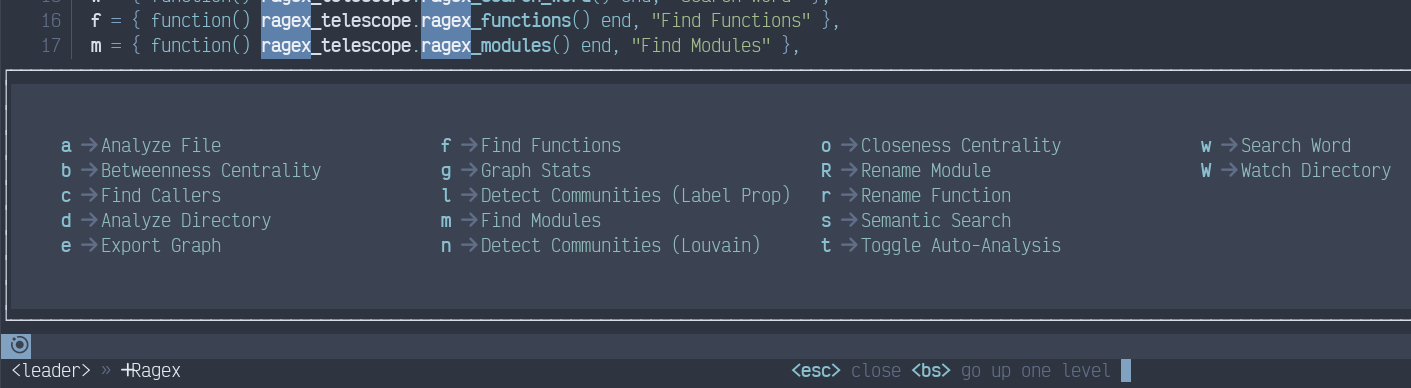
This should result in the following <leader>r update:
Installation
Prerequisites
- Elixir 1.19 or later
- Erlang/OTP 28 or later
- Python 3.x (optional, for Python code analysis)
- Node.JS (optional, for Javascript code analysis)
- ~500MB RAM for embedding model (first run downloads ~90MB)
Build
cd ragex
mix deps.get
mix compileNote: First compilation will take longer due to ML dependencies. The embedding model (~90MB) will download on first run and be cached at ~/.cache/huggingface/.
Demo
A comprehensive demo showcasing all Ragex features is available in examples/product_cart/.
The demo uses an intentionally mediocre e-commerce cart application to demonstrate:
- Security vulnerability scanning (8+ issues detected)
- Code complexity analysis (cyclomatic, cognitive, Halstead metrics)
- Code smell detection (long functions, deep nesting, magic numbers)
- Code duplication detection (Type I-IV clones)
- Dead code analysis (4 unused functions)
- Dependency and coupling analysis
- Impact analysis and refactoring suggestions
- AI-enhanced features (ValidationAI, AIPreview, AIRefiner, AIAnalyzer, AIInsights)
Quick Start:
cd examples/product_cart
./run_demo.sh
The demo generates 11 detailed reports showing:
- 8 security vulnerabilities (2 critical, 3 high)
- 18 code smells across 5 types
- 52 lines of duplicated code (10% of codebase)
- 28 lines of dead code (7% of codebase)
- 8 prioritized refactoring suggestions
- Expected improvement: 65% better maintainability
See Produce Cart’s README for full details and Product Cart’s DEMO for step-by-step walkthrough.
Usage
As an MCP Server
Run the server (it will listen on both stdin and socket):
./start_mcp.shNote: The stdio server is validated and production-ready.
Auto-Analyze Directories on Startup
You can configure Ragex to automatically analyze specific directories when it starts. Add to config/config.exs:
config :ragex, :auto_analyze_dirs, [
  "/opt/Proyectos/MyProject",
  "~/workspace/important-lib"
]
This pre-loads your frequently used codebases into the knowledge graph, making them immediately available for querying. See CONFIGURATION for details.
MCP Protocol Example
Initialize the server:
{"jsonrpc":"2.0","method":"initialize","params":{"clientInfo":{"name":"test-client","version":"1.0"}},"id":1}List available tools:
{"jsonrpc":"2.0","method":"tools/list","id":2}Analyze a file (with auto-detection):
{
  "jsonrpc": "2.0",
  "method": "tools/call",
  "params": {
    "name": "analyze_file",
    "arguments": {
      "path": "lib/ragex.ex"
    }
  },
  "id": 3
}
Or specify the language explicitly:
{
  "jsonrpc": "2.0",
  "method": "tools/call",
  "params": {
    "name": "analyze_file",
    "arguments": {
      "path": "script.py",
      "language": "python"
    }
  },
  "id": 3
}
Query the graph:
{
  "jsonrpc": "2.0",
  "method": "tools/call",
  "params": {
    "name": "query_graph",
    "arguments": {
      "query_type": "find_module",
      "params": {"name": "Ragex"}
    }
  },
  "id": 4
}
Development
Running Tests
mix testInteractive Development
RAGEX_NO_SERVER=1 iex -S mix# Analyze a file
{:ok, content} = File.read("lib/ragex.ex")
{:ok, analysis} = Ragex.Analyzers.Elixir.analyze(content, "lib/ragex.ex")
# Check graph stats, it’s expected to be empty for this single file
Ragex.stats()MCP Tools Reference
Core Analysis Tools
analyze_file
Analyzes a source file and extracts code structure into the knowledge graph.
Parameters:
path(string, required): Path to the filelanguage(string, optional): Programming language -elixir,erlang,python,javascript,typescript, orauto(default: auto-detect from extension)generate_embeddings(boolean, optional): Generate embeddings for semantic search (default: true)
analyze_directory
Batch analyzes all source files in a directory.
Parameters:
path(string, required): Directory pathlanguage(string, optional): Language to filter files (default: auto-detect)recursive(boolean, optional): Recursively analyze subdirectories (default: true)generate_embeddings(boolean, optional): Generate embeddings (default: true)
query_graph
Queries the knowledge graph for code entities and relationships (symbolic search).
Parameters:
query_type(string, required): Type of queryfind_module: Find a module by namefind_function: Find a function by module and nameget_calls: Get function call relationshipsget_dependencies: Get module dependencies
params(object, required): Query-specific parameters
list_nodes
Lists all nodes in the knowledge graph with optional filtering.
Parameters:
node_type(string, optional): Filter by type (module, function, etc.)limit(integer, optional): Maximum results (default: 100)
File Watching Tools
watch_directory
Automatically re-index files when they change.
Parameters:
path(string, required): Directory to watch
unwatch_directory
Stop watching a directory.
Parameters:
path(string, required): Directory to stop watching
list_watched
List all watched directories.
Parameters: None
Semantic Search Tools
semantic_search
Performs natural language code search using vector embeddings.
Parameters:
query(string, required): Natural language query (e.g., "function to parse JSON")limit(integer, optional): Maximum results (default: 10)threshold(number, optional): Minimum similarity score 0.0-1.0 (default: 0.7)node_type(string, optional): Filter by type (module, function)include_context(boolean, optional): Include caller/callee context (default: false)
Example:
{
  "query": "HTTP request handler",
  "limit": 5,
  "threshold": 0.75,
  "node_type": "function"
}
hybrid_search
Combines symbolic graph queries with semantic search for best results.
Parameters:
query(string, required): Search querystrategy(string, optional): Search strategy:fusion(default): RRF fusion of both approachessemantic_first: Semantic search then graph filteringgraph_first: Graph query then semantic ranking
limit(integer, optional): Maximum results (default: 10)threshold(number, optional): Minimum similarity (default: 0.7)graph_filter(object, optional): Optional symbolic constraintsinclude_context(boolean, optional): Include context (default: false)
Example:
{
  "query": "database connection",
  "strategy": "fusion",
  "limit": 10,
  "graph_filter": {"module": "DB"}
}
get_embeddings_stats
Returns ML model and vector store statistics.
Parameters: None
Returns:
- Model information (name, dimensions, status)
- Vector store metrics (total embeddings, by type)
- Graph statistics (nodes, edges)
Code Editing Tools
edit_file
Safely edit a single file with automatic backup, validation, and atomic operations.
Parameters:
path(string, required): Path to the file to editchanges(array, required): List of changes to applytype(string):replace,insert, ordeleteline_start(integer): Starting line number (1-indexed)line_end(integer): Ending line number (for replace/delete)content(string): New content (for replace/insert)
validate(boolean, optional): Validate syntax before applying (default: true)create_backup(boolean, optional): Create backup before editing (default: true)format(boolean, optional): Format code after editing (default: false)language(string, optional): Explicit language for validation (auto-detected from extension)
Example:
{
  "path": "lib/my_module.ex",
  "changes": [
    {
      "type": "replace",
      "line_start": 10,
      "line_end": 15,
      "content": "def new_function do\n  :ok\nend"
    }
  ],
  "validate": true,
  "format": true
}
edit_files
Atomically edit multiple files with coordinated rollback on failure.
Parameters:
files(array, required): List of files to editpath(string): Path to the filechanges(array): List of changes (same format asedit_file)validate(boolean, optional): Override transaction-level validationformat(boolean, optional): Override transaction-level formattinglanguage(string, optional): Explicit language for this file
validate(boolean, optional): Validate all files before applying (default: true)create_backup(boolean, optional): Create backups for all files (default: true)format(boolean, optional): Format all files after editing (default: false)
Example:
{
  "files": [
    {
      "path": "lib/module_a.ex",
      "changes": [{"type": "replace", "line_start": 5, "line_end": 5, "content": "@version \"2.0.0\""}]
    },
    {
      "path": "lib/module_b.ex",
      "changes": [{"type": "replace", "line_start": 10, "line_end": 12, "content": "# Updated"}]
    }
  ],
  "validate": true,
  "format": true
}
validate_edit
Preview validation of changes without applying them.
Parameters:
path(string, required): Path to the filechanges(array, required): List of changes to validatelanguage(string, optional): Explicit language for validation
rollback_edit
Undo a recent edit by restoring from backup.
Parameters:
path(string, required): Path to the file to rollbackbackup_id(string, optional): Specific backup to restore (default: most recent)
edit_history
Query backup history for a file.
Parameters:
path(string, required): Path to the filelimit(integer, optional): Maximum number of backups to return (default: 10)
refactor_code
Semantic refactoring operations using AST analysis and knowledge graph.
Parameters:
operation(string, required): Type of refactoring -rename_functionorrename_moduleparams(object, required): Operation-specific parameters-
For
rename_function:module(string): Module containing the functionold_name(string): Current function namenew_name(string): New function namearity(integer): Function arity
-
For
rename_module:old_name(string): Current module namenew_name(string): New module name
-
For
scope(string, optional):module(same file only) orproject(all files, default: project)validate(boolean, optional): Validate before/after (default: true)format(boolean, optional): Format code after (default: true)
Example - Rename Function:
{
  "operation": "rename_function",
  "params": {
    "module": "MyModule",
    "old_name": "old_function",
    "new_name": "new_function",
    "arity": 2
  },
  "scope": "project",
  "validate": true,
  "format": true
}
Example - Rename Module:
{
  "operation": "rename_module",
  "params": {
    "old_name": "OldModule",
    "new_name": "NewModule"
  },
  "validate": true
}
RAG (AI-Powered) Tools
rag_query
Query the codebase using Retrieval-Augmented Generation with AI assistance.
Parameters:
query(string, required): Natural language query about the codebaselimit(integer, optional): Maximum number of code snippets to retrieve (default: 10)include_code(boolean, optional): Include full code snippets in context (default: true)provider(string, optional): AI provider override (deepseek_r1)
Example:
{
  "query": "How does authentication work in this codebase?",
  "limit": 15,
  "include_code": true
}
Returns:
- AI-generated response based on retrieved code context
- Sources count and model information
rag_explain
Explain code using RAG with AI assistance and aspect-focused analysis.
Parameters:
target(string, required): File path or function identifier (e.g.,MyModule.function/2)aspect(string, optional): What to explain -purpose,complexity,dependencies, orall(default:all)
Example:
{
  "target": "Ragex.Graph.Store.add_node/3",
  "aspect": "complexity"
}
Returns:
- AI-generated explanation based on code analysis
- Related code context and dependencies
rag_suggest
Suggest code improvements using RAG with AI analysis.
Parameters:
target(string, required): File path or function identifierfocus(string, optional): Improvement focus -performance,readability,testing,security, orall(default:all)
Example:
{
  "target": "lib/ragex/editor/core.ex",
  "focus": "performance"
}
Returns:
- AI-generated improvement suggestions
- Code context and rationale
Configuration:
RAG tools require the DEEPSEEK_API_KEY environment variable:
export DEEPSEEK_API_KEY="sk-xxxxxxxxxxxxx"Documentation
- Algorithms - Algorithms used
- Usage - Tips on how to use
Ragex - Configuration - Embedding model configuration and migration
- Persistence - Embedding cache management and performance
- Analysis - Code analysis features and tools
- Troubleshooting - Common issues and error messages
Cache Management
Ragex automatically caches embeddings for faster startup:
# View cache statistics
mix ragex.cache.stats

# Clear current project cache
mix ragex.cache.clear --current

# Clear all caches
mix ragex.cache.clear --all --force
TODO: Streaming Enhancements
The following streaming improvements are planned but not yet implemented:
Tool-call delta parsing in providers: Currently, streaming parsers for all four providers (DeepSeek, OpenAI, Anthropic, Ollama) silently skip
tool_callsdeltas in the SSE stream. Adding index-basedfunction.argumentsaccumulation would allow real-time thinking tokens even during intermediate tool-call steps in the agent loop. This requires per-provider work (OpenAI/DeepSeek:delta.tool_calls[i]; Anthropic:content_block_start+input_json_delta; Ollama: not supported by API).Full MCP streaming protocol: Emit individual JSON-RPC streaming responses (not just notifications) per chunk, allowing MCP clients to render responses incrementally. Includes cancellation support via MCP protocol.
Stream caching and replay: Cache reconstructed responses from consumed streams so that repeated queries can be served from cache without re-calling the AI provider.
Supported Languages
| Language | Extensions | Parser | Status |
|---|---|---|---|
| Elixir | .ex, .exs |
Native AST (Code.string_to_quoted) | ✓ Full |
| Erlang | .erl, .hrl |
Native AST (:erl_scan, :erl_parse) | ✓ Full |
| Python | .py |
Python ast module (subprocess) | ✓ Full |
| JavaScript/TypeScript | .js, .jsx, .ts, .tsx, .mjs | Regex-based | ✗ Basic |