Prometheus.erl


Prometheus.io monitoring system and time series database client in Erlang.
Metrics
Standard
- Counter
- Gauge
- Summary
- Histogram
Custom Collectors
erlang_vm_memory_collector- Collects information about Erlang VM memory usage mainly usingerlang:memory/0erlang_vm_statistics_collector- Collects Erlang VM statistics usingerlang:statistics/1
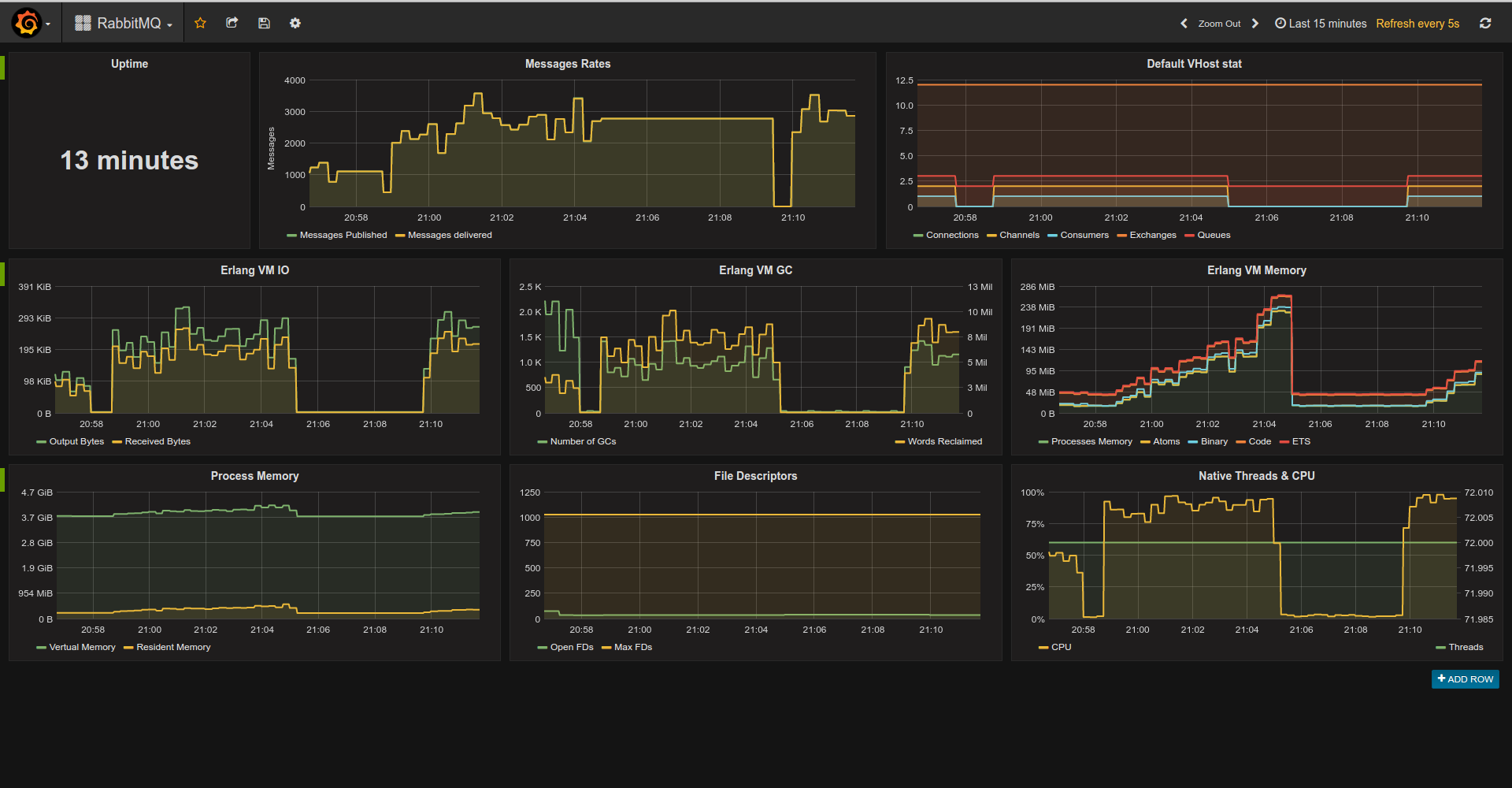
You can write custom collector/exporter for any library/app you'd like. For example here is Queue info collector from RabbitMQ Exporter.
Integrations / Collectors / Instrumenters
- Ecto collector
- Elixir client
- Plugs Instrumenter/Exporter
- Elli middleware
- Fuse plugin
- Phoenix instrumenter
- Process Info Collector
- RabbitMQ Exporter
Example Console Session
Run shell with compiled and loaded app:
$ rebar3 shellStart prometheus app:
prometheus:start().Register metrics:
prometheus_gauge:new([{name, pool_size}, {help, "MongoDB Connections pool size"}]),
prometheus_counter:new([{name, http_requests_total}, {help, "Http request count"}]).
prometheus_summary:new([{name, orders}, {help, "Track orders count/total sum"}]).
prometheus_histogram:new([{name, http_request_duration_milliseconds},
                               {labels, [method]},
                               {bounds, [100, 300, 500, 750, 1000]},
                               {help, "Http Request execution time"}]).
Use metrics:
prometheus_gauge:set(pool_size, 365),
prometheus_counter:inc(http_requests_total).
prometheus_summary:observe(orders, 10).
prometheus_summary:observe(orders, 15).
prometheus_histogram:observe(http_request_duration_milliseconds, [get], 95).
prometheus_histogram:observe(http_request_duration_milliseconds, [get], 100).
prometheus_histogram:observe(http_request_duration_milliseconds, [get], 102).
prometheus_histogram:observe(http_request_duration_milliseconds, [get], 150).
prometheus_histogram:observe(http_request_duration_milliseconds, [get], 250).
prometheus_histogram:observe(http_request_duration_milliseconds, [get], 75).
prometheus_histogram:observe(http_request_duration_milliseconds, [get], 350).
prometheus_histogram:observe(http_request_duration_milliseconds, [get], 550).
prometheus_histogram:observe(http_request_duration_milliseconds, [get], 950).
prometheus_histogram:observe(http_request_duration_milliseconds, [post], 500),
prometheus_histogram:observe(http_request_duration_milliseconds, [post], 150).
prometheus_histogram:observe(http_request_duration_milliseconds, [post], 450).
prometheus_histogram:observe(http_request_duration_milliseconds, [post], 850).
prometheus_histogram:observe(http_request_duration_milliseconds, [post], 750).
prometheus_histogram:observe(http_request_duration_milliseconds, [post], 1650).
Export metrics as text:
io:format(prometheus_text_format:format()).->
# TYPE http_requests_total counter
# HELP http_requests_total Http request count
http_requests_total 2
# TYPE pool_size gauge
# HELP pool_size MongoDB Connections pool size
pool_size 365
# TYPE orders summary
# HELP orders Track orders count/total sum
orders_count 4
orders_sum 50
# TYPE http_request_duration_milliseconds histogram
# HELP http_request_duration_milliseconds Http Request execution time
http_request_duration_milliseconds_bucket{method="post",le="100"} 0
http_request_duration_milliseconds_bucket{method="post",le="300"} 1
http_request_duration_milliseconds_bucket{method="post",le="500"} 3
http_request_duration_milliseconds_bucket{method="post",le="750"} 4
http_request_duration_milliseconds_bucket{method="post",le="1000"} 5
http_request_duration_milliseconds_bucket{method="post",le="+Inf"} 6
http_request_duration_milliseconds_count{method="post"} 6
http_request_duration_milliseconds_sum{method="post"} 4350
http_request_duration_milliseconds_bucket{method="get",le="100"} 3
http_request_duration_milliseconds_bucket{method="get",le="300"} 6
http_request_duration_milliseconds_bucket{method="get",le="500"} 7
http_request_duration_milliseconds_bucket{method="get",le="750"} 8
http_request_duration_milliseconds_bucket{method="get",le="1000"} 9
http_request_duration_milliseconds_bucket{method="get",le="+Inf"} 9
http_request_duration_milliseconds_count{method="get"} 9
http_request_duration_milliseconds_sum{method="get"} 2622
Bucket generators
prometheus_buckets:linear(-15, 5, 6) produces [-15, -10, -5, 0, 5, 10]

prometheus_buckets:exponential(100, 1.2, 3) produces [100, 120, 144]
Implementation Note
Prometheus.erl exports two API sets.
- For Integers:
prometheus_coutner:inc,prometheus_summary:observeandprometheus_histogram:observe. Implementation is based onets:update_counter. While this is expected to be much faster than using processes for synchronization it restricts us to integers-only while Prometheus expects series values to be double. ETS-based metrics are optimistic - for basic metrics such as counters/gauges it first tries to increment and iff series doesn't exist it queries ETS to check if metric actually registered and if so it inserts series. For histograms at least one lookup is required - we need buckets to compute bucket counter position. - For Floats:
prometheus_coutner:dinc,prometheus_summary:dobserveandprometheus_histogram:dobserve. Implementation is based ongen_serverwhich is used for synchronizations (ets doesn't support float atomic increments).
NOTE: you can use float APIs after integer but not vice-versa.
Configuration
Prometheus.erl supports standard Erlang app configuration.
default_collectors- List of custom collectors modules to be registered automatically. If undefined list of all modules implementingprometheus_collectorbehaviour will be used.default_metrics- List of metrics to be registered during app startup. Metric format:{Registry, Metric, Spec}whereRegistryis registry name,Metricis metric type (prometheus_counter, prometheus_gauge ... etc),Specis a list to be passed toMetric:register/2.
Collectors & Exporters Conventions
Configuration
All 3d-party libraries should be configured via prometheus app env.
Exproters are responsible for maintianing scrape endpoint. Exporters usually tightly coupled with web server and are singletons. They should understand these keys:
path- url for scraping;format- scrape format as module name i.e.prometheus_text_formatorprometheus_protobuf_format. Exporter-specific options should be under<exporter_name>_exporterfor erlang or<Exporter_name>Exporterfor Elixir i.e.PlugsExporterorelli_exporter
Collectors collect integration specific metrics i.e. ecto timings, process informations and so on.
Their configuration should be under <collector_name>_collectorfor erlang or <Collector_name>Collector for Elixir i.e. process_collector, EctoCollector and so on.
Naming
For Erlang: prometheus_<name>_collector/prometheus_<name>_exporter.
For Elixir: Prometheus.Collectors.<name>/Prometheus.Exporters.<name>.
TODO
- Floats support
- Tests
- Bucket generators
- Protobuf format
- Full summary implementation
- Extend custom collectors collection?
Build
$ rebar3 compileContributing
Types -> Macros -> Callbacks -> Public API -> Deprecations -> Private Partsinstall git precommit hook:
./bin/pre-commit.sh installPre-commit check can be skipped passing --no-verify option to git commit.
License
MIT