PhoenixReplay
Session recording and replay for Phoenix LiveView.
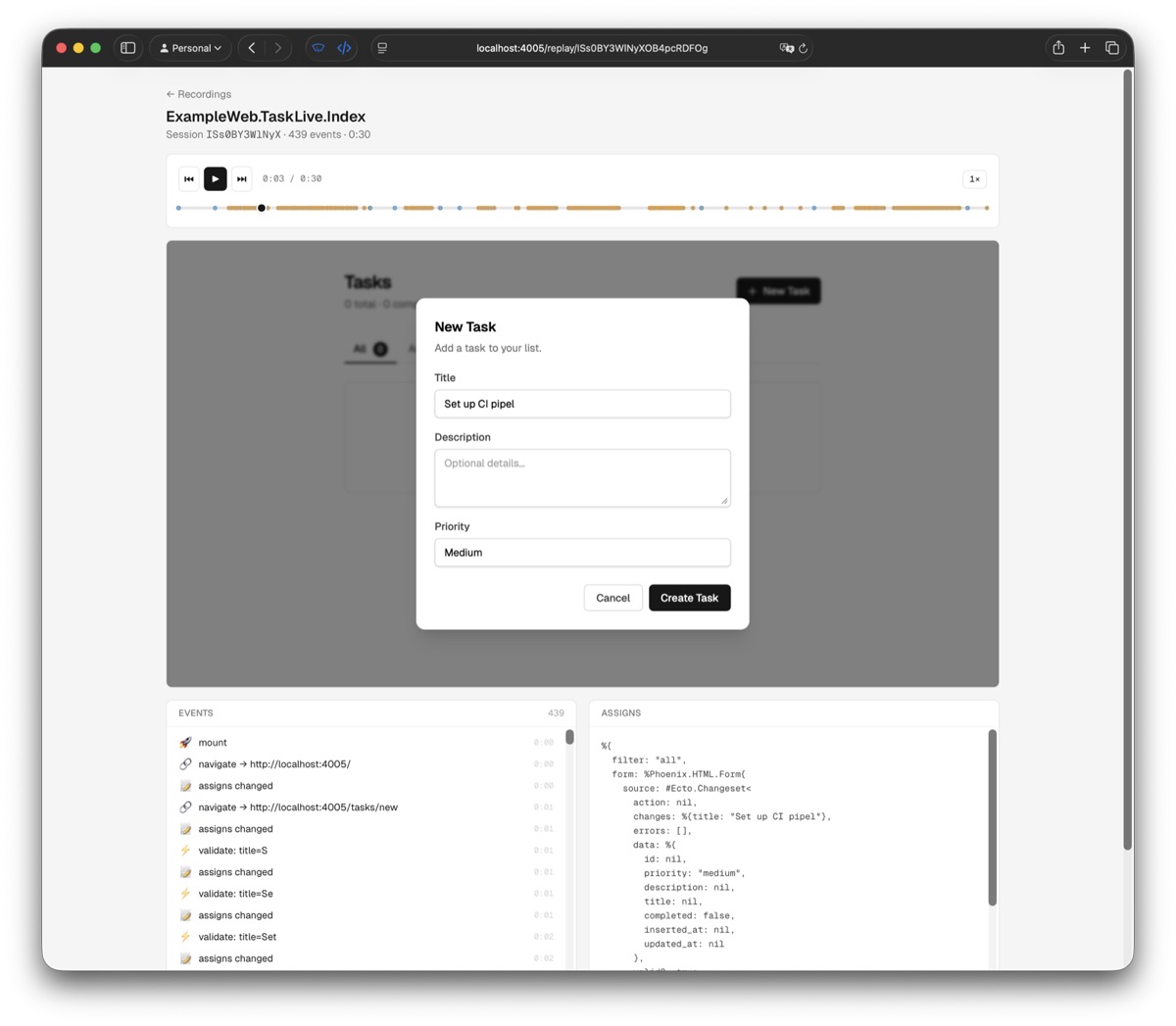
LiveView templates are pure functions: same assigns produce the same HTML. PhoenixReplay captures assigns at each state transition and replays them by re-rendering the original view — no client-side recording, no DOM snapshots, no JavaScript changes. A 30-second session with active form input is ~400 events and ~8 KB on disk (ETF + gzip).
Quick start
Add the dependency:
def deps do
  [{:phoenix_replay, "~> 0.1.0"}]
end
Attach the recorder to a live session:
live_session :default, on_mount: [PhoenixReplay.Recorder] do
  live "/dashboard", DashboardLive
  live "/posts", PostLive.Index
end
Mount the replay dashboard:
import PhoenixReplay.Router

scope "/" do
  pipe_through [:browser, :require_admin]
  phoenix_replay "/replay"
end
Visit /replay to browse recordings and replay sessions with a scrubber, play/pause, and speed controls. Every connected LiveView in the live session is recorded automatically — sanitized mount params, events, navigation, and assign deltas. Sessions with no user interaction are discarded.
Recordings can contain business data even after sanitization. Mount the dashboard only behind an authenticated admin pipeline. You can also add a final authorization callback:
config :phoenix_replay,
  authorize: fn recording -> recording.view in [MyAppWeb.SafeLive] end
How it works
-
The
on_mounthook attaches lifecycle hooks to each connected LiveView. - Session start sends a single async cast to the Store GenServer to set up a process monitor.
-
All subsequent events are written directly to ETS (
ordered_setwithwrite_concurrency) — no GenServer messages on the hot path. - When the LiveView process exits, the Store finalizes the recording and hands persistence to a supervised worker.
Recorded events
| Event | Data |
|---|---|
| Mount | View module, URL, params, session, initial assigns |
| Handle event | Event name, params |
| Handle params | URL, params |
| Handle info | Type marker only |
| After render | Changed assigns (delta, or full snapshot when batched) |
Each event includes a millisecond offset from session start.
Current limitations
Replay is currently based on root LiveView assigns. It does not fully reconstruct stateful LiveComponents, streams, uploads, client-only JavaScript state, or pushed JS events. Those sessions may still be useful for debugging server-side state, but replay output can differ from what the browser showed.
Configuration
config :phoenix_replay,
  max_events: 10_000,
  sanitizer: MyApp.ReplaySanitizer,
  max_recordings: 1_000,
  max_recording_age_ms: 7 * 24 * 60 * 60 * 1000,
  cleanup_interval_ms: 60 * 60 * 1000,
  persistence_retry_attempts: 3,
  persistence_retry_delay_ms: 1_000
Storage backends
Active recordings live in ETS. When a LiveView process exits, the recording is persisted via the configured backend. Async persistence retries transient failures using :persistence_retry_attempts and :persistence_retry_delay_ms; cleanup can be limited by :max_recordings, :max_recording_age_ms, and :cleanup_interval_ms.
File (default):
config :phoenix_replay,
  storage: PhoenixReplay.Storage.File,
  storage_opts: [path: "priv/replay_recordings", format: :etf]
Ecto:
config :phoenix_replay,
  storage: PhoenixReplay.Storage.Ecto,
  storage_opts: [repo: MyApp.Repo, format: :etf]
Requires a migration:
defmodule MyApp.Repo.Migrations.CreatePhoenixReplayRecordings do
  use Ecto.Migration

  def change do
    create table(:phoenix_replay_recordings, primary_key: false) do
      add :id, :string, primary_key: true
      add :view, :string, null: false
      add :connected_at, :bigint, null: false
      add :event_count, :integer, null: false, default: 0
      add :data, :binary, null: false
      timestamps(type: :utc_datetime)
    end
  end
end
Both backends support :etf (default — fast, preserves Elixir types) and :json (portable but lossy).
Custom sanitizer
The default sanitizer strips internal LiveView keys and sensitive fields, and compacts Form, Changeset, and Ecto structs. To customize:
defmodule MyApp.ReplaySanitizer do
  @drop [:__changed__, :flash, :uploads, :streams,
         :_replay_id, :_replay_t0, :csrf_token, :password,
         :current_password, :password_confirmation, :token, :secret,
         :my_custom_secret]

  def sanitize_assigns(assigns), do: Map.drop(assigns, @drop)
  def sanitize_params(params), do: Map.drop(params, Enum.map(@drop, &Atom.to_string/1))

  def sanitize_delta(changed, assigns) do
    changed
    |> Map.keys()
    |> Enum.reject(&(&1 in @drop))
    |> Map.new(fn key -> {key, Map.get(assigns, key)} end)
  end
end
Manual attachment
To record individual views instead of an entire live session:
def mount(params, session, socket) do
  {:ok, PhoenixReplay.Recorder.attach(socket, params, session)}
end
Programmatic access
PhoenixReplay.Store.list_recording_summaries()
PhoenixReplay.Store.list_recordings()
PhoenixReplay.Store.get_recording(id)
PhoenixReplay.Store.get_active(id)
PhoenixReplay.Store.delete_recording(id)
PhoenixReplay.Store.clear_all()
PhoenixReplay.Store.cleanup()
Roadmap
- Real-time session observation via PubSub
- LiveComponent state tracking
- Configurable sampling (record N% of sessions)
- Session search and filtering
License
MIT