Orchid





Orchid is an Elixir-based workflow orchestration engine inspired by a personal project(written in Chinese).
It is primarily designed for scenarios requiring complex processing of data(time series limited originally) with low real-time demands, providing a relevant protocol or interface for subsequent development.
Features
- Declarative Recipes: Define your workflow steps and dependencies clearly.
- Flexible Execution: Switch execution strategies(or implement and use yours) without changing business logic.
- Composable & Nested: Treat entire recipes as atomic steps (
NestedStep). Supports deep configuration inheritance and parameter mapping. - Dependency Resolution: Automatic topological sorting of steps based on input/output keys.
- Onion-like Hooks: Inject custom logic (logging, telemetry, etc.) at both the Step and Recipe levels.
Installation
Add to your mix.exs:
def deps do
  [
    {:orchid, "~> 0.5"}
  ]
end
Quick Start
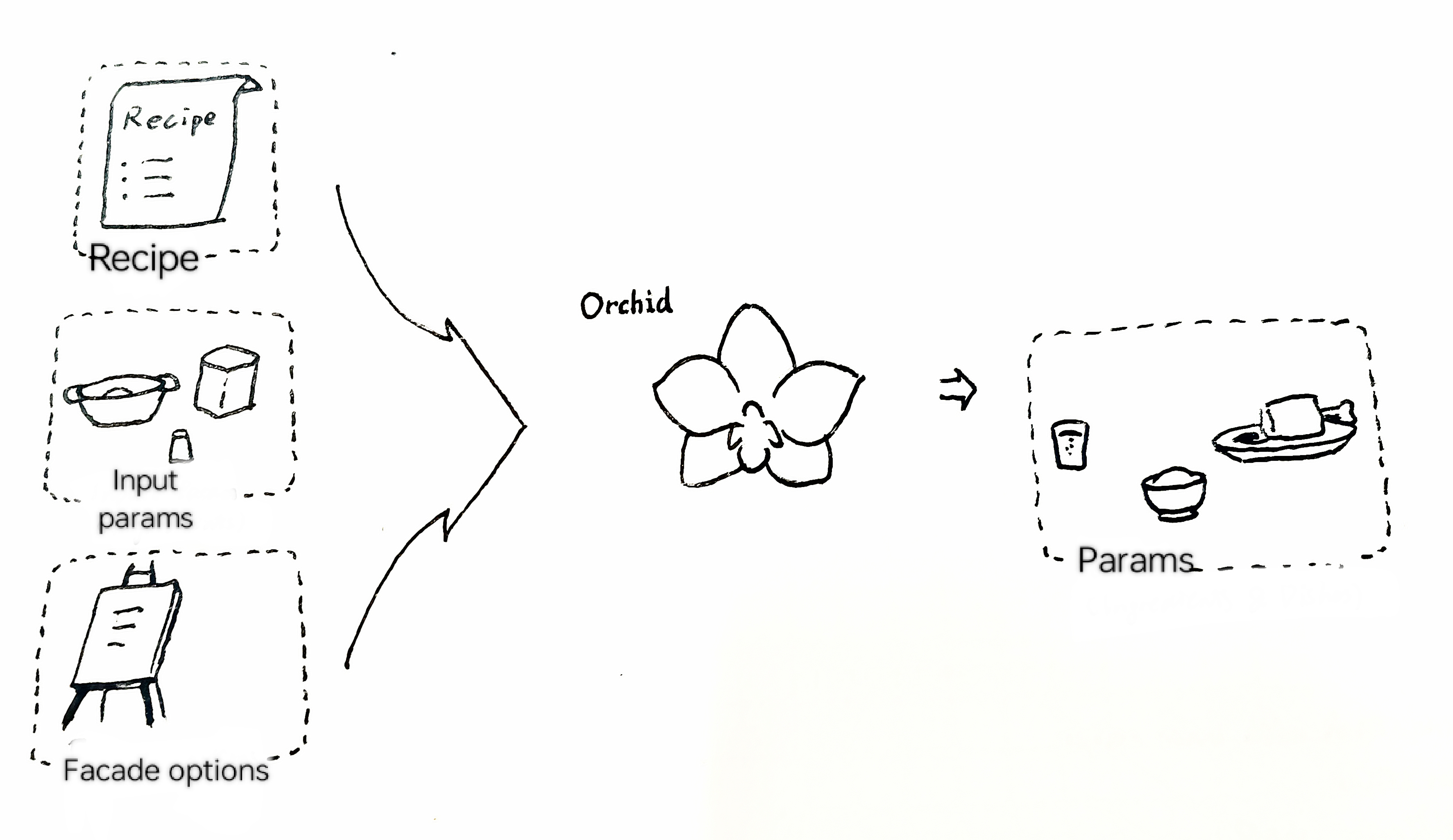
Well, let's make a cup of coffee to see how Orchid works.
We will define a process where beans are ground into powder, and then brewed with water. Notice how we can control the brewing style using opts.
It can explained clearly with just one picture.
Definate Steps
Create modules that use Orchid.Step, or simply function with 2 arities.
defmodule Barista.Grind do
  use Orchid.Step
  alias Orchid.Param

  # Simple 1-to-1 transformation

  def run(beans, opts) do
    amount = Param.get_payload(beans)
    IO.puts("⚙️  Grinding #{amount}g beans...")
    # You need use `{:ok, res}` or `{:error, term}` explicitly.

    {:ok, Param.new(:powder, :solid, amount * Keyword.get(opts, :ratio, 1))}
  end
end

defmodule Barista.Brew do
  use Orchid.Step
  alias Orchid.Param

  # Multi-input step with options

  def run([powder, water], opts) do
    # Get configuration from opts, default is :espresso

    style = Keyword.get(opts, :style, :espresso)

    p_amount = Param.get_payload(powder)
    w_amount = Param.get_payload(water)

    IO.puts("💧 Brewing #{style} coffee with #{p_amount}g powder and #{w_amount}ml water...")
    {:ok, Param.new(:coffee, :liquid, "Cup of #{style}")}
  end
end
Build Recipe
Define the workflow. Key features demonstrated here:
- Out of Order: We define Brew before Grind, but Orchid will figure it out.
- Options: We pass style: :latte to the brewing step.
alias Orchid.{Recipe, Param}

# Initial Ingredients

inputs = [
  Param.new(:beans, :raw, 20),    # 20g beans

  Param.new(:water, :raw, 200)    # 200ml water

]

steps = [
  # Step 2: Brew (Depends on :powder and :water)

  # We want a Latte, so we pass options here.

  {Barista.Brew, [:powder, :water], :coffee, [style: :latte]},

  # Step 1: Grind (Depends on :beans, Provides :powder)

  {Barista.Grind, :beans, :powder}
]

recipe = Recipe.new(steps, name: :morning_routine)
Run
Execute the recipe. Orchid automatically resolves dependencies: Grind runs first, then Brew.
{:ok, results} = Orchid.run(recipe, inputs)
# Output:

# ⚙️  Grinding 20g beans...

# 💧 Brewing latte coffee with 20g powder and 200ml water...


IO.inspect(Param.get_payload(results[:coffee]))
# => "Cup of latte"
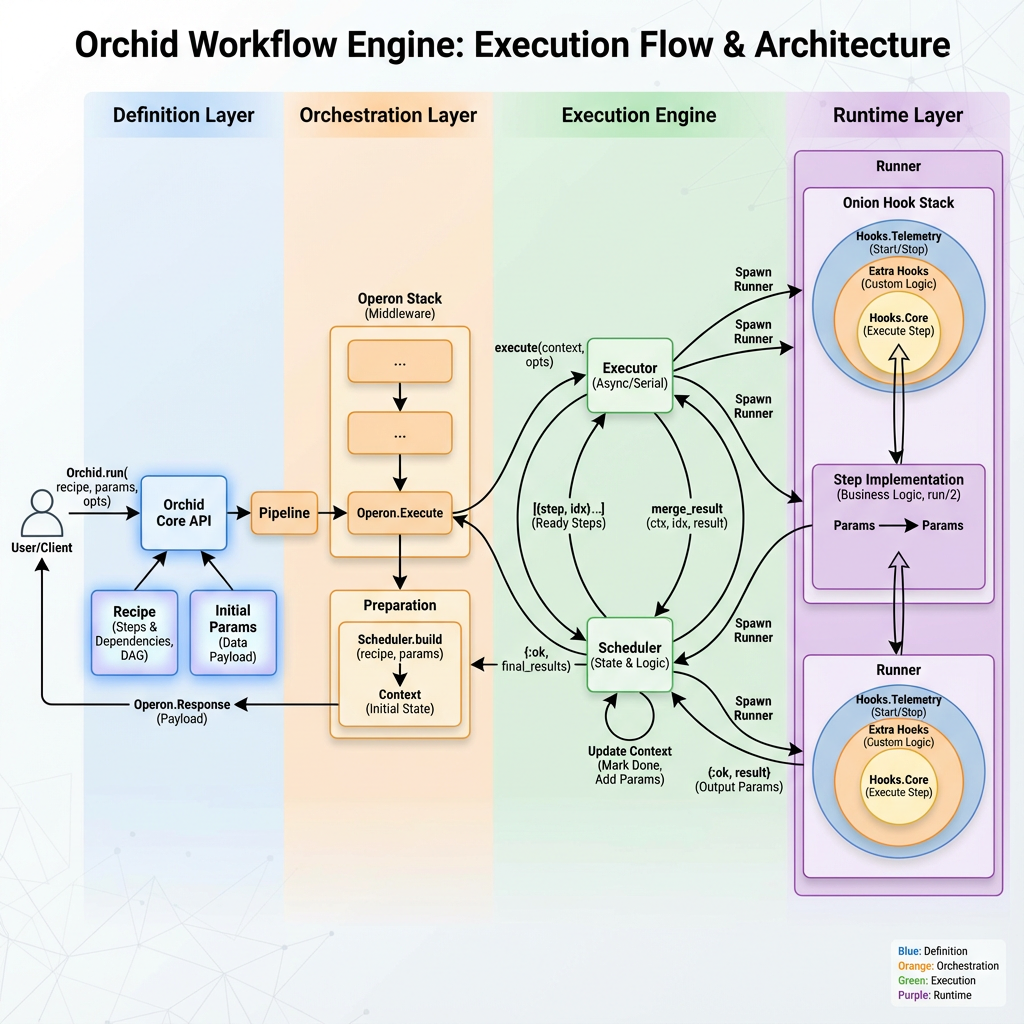
Architecture
Advanced Usage
Executors
Currently, orchid includes two executors:
Orchid.Executor.Serial: Runs steps one by one. Good for debugging.Orchid.Executor.Async: Runs independent steps in parallel based on the dependency graph.
Due to the atomic nature of Step operations, no further behavior-adapter design has been implemented.
As business complexity increases dramatically (e.g., external resource monitoring, more fault-tolerant business environments), custom Executors are encouraged.
However, in some cases, considering business complexity, a hook mechanism has been introduced.
Layered Hooks
Orchid employs an onion-like execution model (similar to Rack or Plug middleware), where hooks wrap around the core logic.
Note: This refers to the runtime call stack, distinct from the 'Onion Architecture' design pattern which concerns static code dependencies and domain boundaries.
Step Level (Hook)
Within Orchid.Runner, which is responsible for executing steps, data flows like an onion from the outer layers through the inner layers and back to the outer layers.
The general flow for each hook is as follows:
defmodule MyHook do
  @behaviour Orchid.Runner.Hook

  @impl true
  def call(ctx, next) do
    # Prelude

    ...

    # Execute inner part

    case next.(ctx) do
      # When success and get result

      {:ok, result} ->
        ...

      # Reserved for plugin

      {:special, _any} ->
        ...

      # When failed

      {:error, term} ->
        ...
    end
  end
end
Therefore, the order and definition of Hooks need careful consideration.
To run additional Hooks, they must be configured in the step's opts[:extra_hooks_stack].
Currently, Runner has two hooks:
Orchid.Runner.Hooks.Telemetryfor telemetryOrchid.Runner.Hooks.Corefor executing the step
Vertical-propagated Context
Allows propagating global data deeply into nested steps.
Originally designed to track the context of nested executions.
Orchid.run(recipe, initial_params, baggage: %{foo: :bar})
Pipeline Middleware (Operons)
Similar to hooks, data is also processed in an onion-like flow.
It has a somewhat peculiar name called "Operon" (may be changed later).
defmodule QyPersist do
  @behavior Orchid.Operon

  @impl true
  def call(%Request{} = req_before, next_fn) do
    # Modify request or recipe before execution

    new_req = %{req | recipe: modify_recipe(req.recipe)}

    next_fn.(req)
  end
end
The execution is handled by Orchid.Pipeline which calls a series of middleware conforming to the Orchid.Operon protocol.
However, the difference is that we define two structs: Orchid.Operon.Request and Orchid.Operon.Response.
The transformation module is Orchid.Operon.Execute, which wraps the Executor.
No additional middleware has been introduced yet, but it will be added later.
Libs
OrchidSymbiont- Let Orchid can execute steps where required HEAVY service(Ortex service(via NxServing), ErlPort, NIF, HTTP request, etc.).