Opus



A framework for pluggable business logic components.
Installation
The package can be installed by adding opus to your list of dependencies in mix.exs:
def deps do
  [{:opus, "~> 0.3"}]
end
Conventions
-
Each Opus pipeline module has a single entry point and returns tagged tuples
{:ok, value} | {:error, error} - A pipeline is a composition of stateless stages
-
A stage returning
{:error, _}halts the pipeline -
A stage may be skipped based on a condition function (
:ifoption) -
Exceptions are converted to
{:error, error}tuples by default -
An exception may be left to raise using the
:raiseoption - Each stage of the pipeline is instrumented. Metrics are captured automatically (but can be disabled).
- Errors are meaningful and predictable
Usage
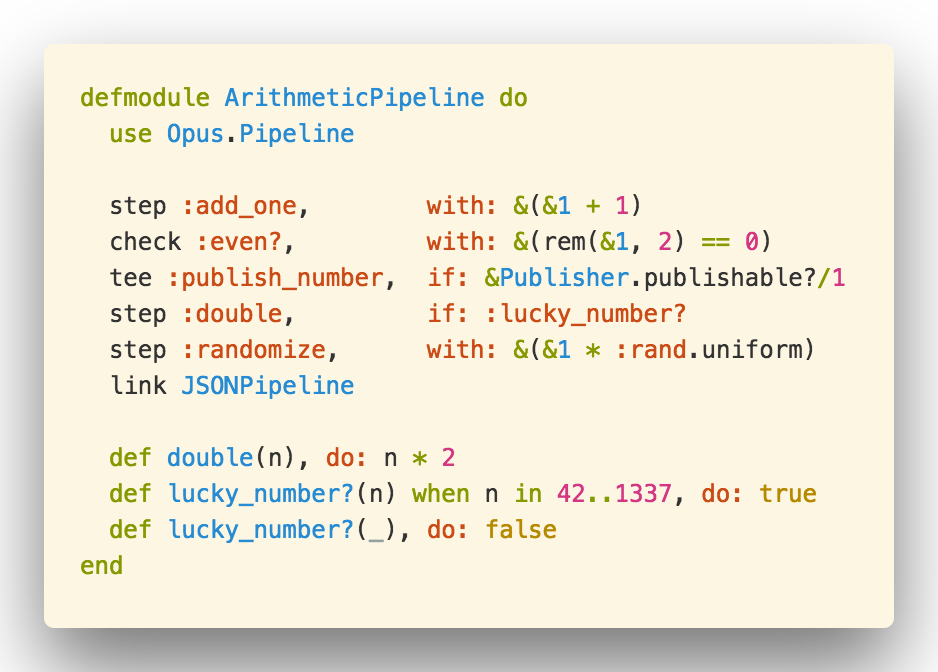
defmodule ArithmeticPipeline do
  use Opus.Pipeline

  step  :add_one,         with: &(&1 + 1)
  check :even?,           with: &(rem(&1, 2) == 0), error_message: :expected_an_even
  tee   :publish_number,  if: &Publisher.publishable?/1, raise: [ExternalError]
  step  :double,          if: :lucky_number?
  step  :randomize,       with: &(&1 * :rand.uniform)
  link  JSONPipeline

  def double(n), do: n * 2
  def lucky_number?(n) when n in 42..1337, do: true
  def lucky_number?(_), do: false
end

ArithmeticPipeline.call(41)
# {:ok, %{number: 84.13436750126804}}
Pipeline
The core aspect of this library is defining pipeline modules. As in the
example above you need to add use Opus.Pipeline to turn a module into
a pipeline. A pipeline module is a composition of stages executed in
sequence.
Stages
Available options
The behaviour of each stage can be configured with any of the available options:
:with: The function to call to fulfill this stage. It can be an Atom referring to a public function of the module, an anonymous function or a function reference.:if: Makes a stage conditional, it can be either an Atom referring to a public function of the module, an anonymous function or a function reference. For the stage to be executed, the condition must returntrue. When the stage is skipped, the input is forwarded to the next step if there’s one.:raise: A list of exceptions to not rescue. Defaults tofalsewhich converts all exceptions to{:error, %Opus.PipelineError{}}values halting the pipeline.:error_message: A String or Atom to replace the original error when a stage fails.:retry_times: How many times to retry a failing stage, before halting the pipeline.:retry_backoff: A backoff function to provide delay values for retries. It can be an Atom referring to a public function in the module, an anonymous function or a function reference. It must return anEnumerable.tyielding at least as many numbers as theretry_times.:instrument?: A boolean which defaults totrue. Set tofalseto skip instrumentation for a stage.
Retries
defmodule ExternalApiPipeline do
  use Opus.Pipeline

  step :http_request, retry_times: 8, retry_backoff: fn -> lin_backoff(10, 2) |> cap(100) end

  def http_request(_input) do
    # code for the actual request
  end
end
The above module, will retry be retried up to 8 times, each time applying a delay from the next value of the retry_backoff function, which returns a Stream.
All the functions from the :retry package will be available to be used in retry_backoff.
Stage Filtering
You can select the stages of a pipeline to run using call/2 with the :except and :only options.
Example:
# Runs only the stage with the :validate_params name
CreateUserPipeline.call(params, only: [:validate_params]

# Runs all the stages except the selected ones
CreateUserPipeline.call(params, except: :send_notification)
Instrumentation
Instrumentation hooks which can be defined:
:before_stage: Called before each stage:stage_skipped: Called when a conditional stage was skipped:stage_completed: Called after each stage
You can disable all instrumentation callbacks for a stage using instrument?: false.
defmodule ArithmeticPipeline do
  use Opus.Pipeline

  step :double, instrument: false
end
You can define module specific instrumentation callbacks using:
defmodule ArithmeticPipeline do
  use Opus.Pipeline

  step :double, with: &(&1 * 2)
  step :triple, with: &(&1 * 3)

  instrument :before_stage, fn %{input: input} ->
    IO.inspect input
  end

  # Will be called only for the matching stage
  instrument :stage_completed, %{stage: %{name: :triple}}, fn %{time: time} ->
    # send to the monitoring tool of your choice
  end
end
You can define a default instrumentation module for all your pipelines
by adding in your config/*.exs:
config :opus, :instrumentation, YourModule

# but you may choose to provide a list of modules
config :opus, :instrumentation, [YourModuleA, YourModuleB]
An instrumentation module has to export instrument/3 functions like:
defmodule CustomInstrumentation do
  def instrument(:stage_completed, %{stage: %{pipeline: ArithmeticPipeline}}, %{time: time}) do
    # publish the metrics to specific backend
  end

  def instrument(:stage_completed, _metadata, %{time: time}) do
    # publish the metrics to common backend
  end
end
License
Copyright (c) 2018 Dimitris Zorbas, MIT License. See LICENSE.txt for further details.