/ˈniːmiː/ - Snapshot testing utilities for Elixir


🎥 Video Demo
https://gist.github.com/assets/503938/3155b333-6a59-448e-8735-dc0093bd677e
Mneme augments ExUnit.Assertions with a set of assertions that know how to update themselves.
This is sometimes called snapshot or approval testing.
With Mneme, you write something like...
auto_assert my_function()
...and next time you run your tests, Mneme:
- runs the code and generates a pattern from the returned value, then
- prints a diff and prompts you to confirm the change.
Now your test looks like this:
auto_assert %MyAwesomeValue{so: :cool} <- my_function()
This lets you quickly write lots of tests, and like ordinary tests, you'll see a diff when they fail. But, unlike ordinary tests, you can choose to accept the changes and Mneme will rewrite the test for you.
Features:
- Auto-updating assertions: maintain correct tests as behavior changes during development.
- Alternatives to familiar assertions
auto_assert,auto_assert_raise,auto_assert_receive,auto_assert_received. - Seamless integration with ExUnit: no need to change your workflow, just run
mix test. - Interactive prompts in your terminal when a new assertion is added or an existing one changes.
- Syntax-aware diffs highlight the meaningful changes in a value.
Take a brief tour:
If you'd like to see Mneme in action, you can download and run examples/tour_mneme.exs, a standalone tour that only requires that you have Elixir installed.
$ curl -o tour_mneme.exs https://raw.githubusercontent.com/zachallaun/mneme/main/examples/tour_mneme.exs

$ elixir tour_mneme.exs
Quickstart
-
Add
:mnemedo your deps inmix.exs:defp deps do[{:mneme, ">= 0.0.0", only: [:dev, :test]}]end -
Add
:mnemeto your:import_depsin.formatter.exs:[import_deps: [:mneme],inputs: ["{mix,.formatter}.exs", "{config,lib,test}/**/*.{ex,exs}"]] -
Start Mneme right after you start ExUnit in
test/test_helper.exs:ExUnit.start()Mneme.start() -
Add
use Mnemewherever youuse ExUnit.Case:defmodule MyTest douse ExUnit.Case, async: trueuse Mnemetest "arithmetic" doauto_assert 2 + 2endend -
Run
mix testand typey<ENTER>when prompted; your test should look like:defmodule MyTest douse ExUnit.Case, async: trueuse Mnemetest "arithmetic" doauto_assert 4 <- 2 + 2endend
Requirements
Elixir
Mneme requires Elixir version 1.14 or later.
Formatter
If you do not use a formatter, the first auto-assertion will reformat the entire file, introducing unrelated formatting changes. Mneme rewrites your test scripts when updating an assertion using the formatter configuration for your project.
It's highly recommended to configure your editor to format Elixir files on-save.
Note: Mneme uses Rewrite to update files, which supports the Elixir formatter and FreedomFormatter.
Command line interface
Auto-assertions are run with your normal tests when you run mix test and a terminal prompt is used whenever one needs to be updated.
Here's what that might look like:
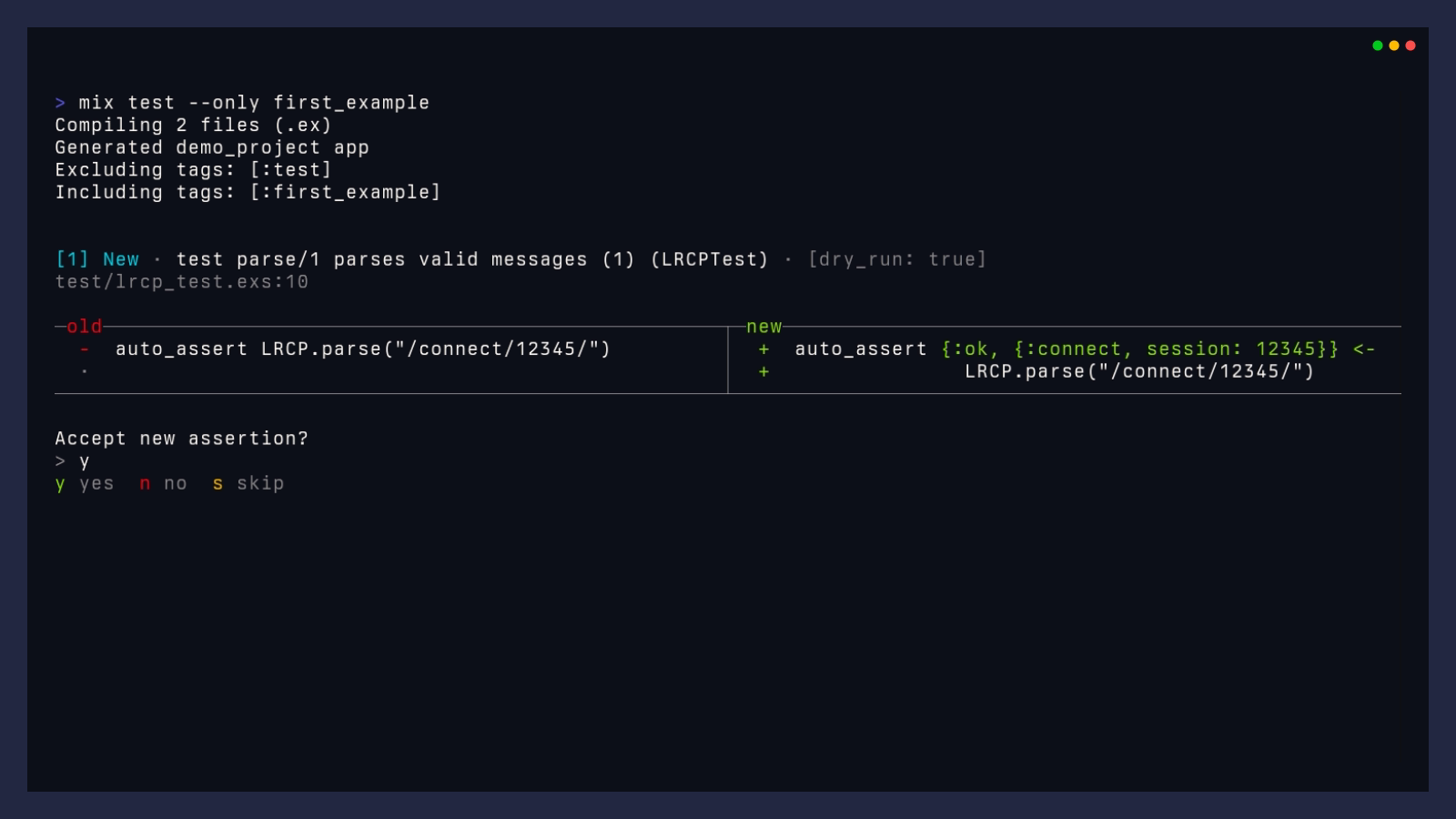
Whenever that happens, you have a few options:
| Key | Action | Description |
|---|---|---|
y |
Accept | Accept the proposed change. The assertion will be re-run and should pass. |
n |
Reject | Reject the proposed change and fail the test. |
s |
Skip | Skip this assertion. The test will not fail, but the mix test process will exit with 1. |
k |
Next | If multiple patterns have been generated, cycle to the next one. |
j |
Previous | If multiple patterns have been generated, cycle to the previous one. |
Note that the CLI is not available when tests are run in a CI environment. See the Continuous Integration section for more info.
Generated patterns
Mneme tries to generate match patterns that are close to what you would write. Basic data types like numbers, lists, tuples, and strings will generate as you would expect. For maps and structs, Mneme will often give you a couple of options. For values without a literal representation, like pids, guards will be used.
auto_assert pid when is_pid(pid) <- self()
Additionally, local bindings can be found and pinned as a part of patterns. This keeps the number of "magic values" down and makes tests more robust.
test "create_post/1 creates a new post with valid attrs", %{user: user} do
  valid_attrs = %{title: "my_post", author: user}

  auto_assert create_post(valid_attrs)
end

# generates:

test "create_post/1 creates a new post with valid attrs", %{user: user} do
  valid_attrs = %{title: "my_post", author: user}

  auto_assert {:ok, %Post{title: "my_post", author: ^user}} <- create_post(valid_attrs)
end
Special patterns
This is a non-exhaustive list of things Mneme takes into consideration when generating match patterns:
-
Pinned variables are generated by default if a value is equal to a variable in scope.
-
Date and time values are written using their sigil representation.
-
Struct patterns only include fields that are different from the struct defaults.
-
Structs defined by Ecto schemas exclude primary keys, association foreign keys, and auto generated fields like
:inserted_atand:updated_at. This is because these fields are often randomly generated and would fail on subsequent tests.
Continuous Integration
In a CI environment, Mneme will not attempt to prompt and update any assertions, but will instead fail any tests that would update.
This behavior is enabled by the CI environment variable, which is set by convention by many continuous integration providers.
export CI=true
Editor support
Guides for optional editor integration can be found here:
Acknowledgements
Special thanks to:
-
What if writing tests was a joyful experience?, from the Jane Street Tech Blog, for inspiring this library.
-
Sourceror, a library that makes complex code modifications simple.
-
Rewrite, which provides the diff functionality present in Mneme.
-
Owl, which makes it much easier to build a pretty CLI.
-
Insta, a snapshot testing tool for Rust, whose great documentation provided an excellent reference for snapshot testing.
-
assert_value, an existing Elixir project that provides similar functionality. Thank you for paving the way!