Loader
disclaimer
i started working on this project as a result of a suggestion from a friend that it would be a useful exploration to build a load tester and using it against naively constructed services to practice building/ fixing systems to make them more resilient against load.
this project is not now, and may never, be suitable for use by others, but i hope it will be!
Summary
Loader is a load-generating library that allows you to define arbitrary distributions of arbitrary work via mathematical functions and small structs.
These distributions, called LoadProfiles, can be paired up with a WorkSpec and executed to generate load, and gather statistics from a client's perspective.
Usage
In order to use Loader you must start it and provide a :name, typically in a supervision tree:
children = [
  {Loader, name: MyLoader}
]
However you may want to use Loader in an iex session, or as part of a mix script via Mix.install/2, in which case you can also start Loader dynamically:
Loader.start_link(name: MyLoader)
Example
Let's assume there is some service at http://website.io/public/api, and we want to generate some simple, uniform load against that service.
alias Loader.{LoadProfile, WorkResponse, WorkSpec}

uniform_one_minute_profile =
  LoadProfile.new(%{
    target_running_time: 60,
    function: &LoadProfile.Curves.uniform(&1, 10) # y = 10
  })

service_call_spec = %WorkSpec{
  task: fn ->
    Finch.build(:get, "http://website.io/public/api", [])
    |> Finch.request(MyApp.Finch)
  end,
  is_success?: fn %WorkResponse{data: res} ->
    case res do
      {:ok, _any} -> true
      _any -> false
    end
  end
}

Loader.start_link(name: MyLoader)

Loader.execute({uniform_one_minute_profile, service_call_spec}, MyLoader)
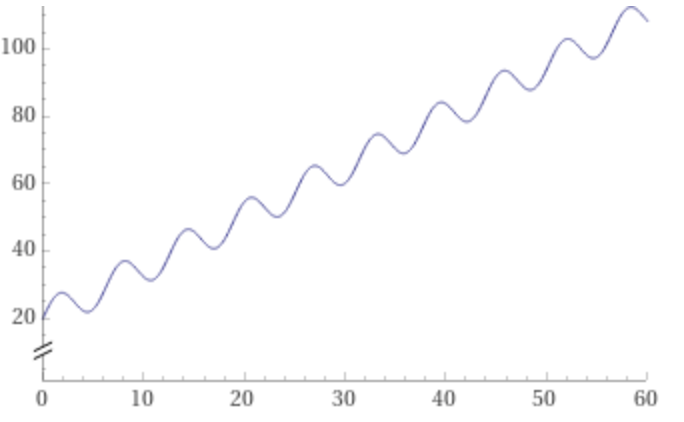
The above example will generate a uniform 10 requests/ second against our imaginary service. We could also write additional load profiles, and run them concurrently to generate constructive interference!
linear_one_minute_profile =
  LoadProfile.new(%{
    target_running_time: 60,
    function: &LoadProfile.Curves.linear(&1, 1.5, 5) # y = 1.5x + 5
  })

sine_wave_one_minute_profile =
  LoadProfile.new(%{
    target_running_time: 60,
    function: fn x -> 5 * (:math.sin(x) + 1) end # y = 5 * (sin(x) + 1)
  })

[
  {uniform_one_minute_profile, service_call_spec},
  {linear_one_minute_profile, service_call_spec},
  {sine_wave_one_minute_profile, service_call_spec},
]
|> Loader.execute(MyLoader)
Visualized, this second example would produce load on the service as shown, where x is in seconds and y is requests/ second:
Telemetry
Loader emits the following telemetry events:
[:loader, :load_profile_execution, :start]- emitted whenLoader.execute/2is called.[:loader, :load_profile_execution, :stop]- emitted when aLoadProfilehas been fully emitted, regardless of the number of successes or failures of individual tasks[:loader, :task, :start]- emitted when the:taskcallback from aLoader.WorkSpecis invoked[:loader, :task, :stop]- emitted when the:taskcallback from aLoader.WorkSpecis invoked[:loader, :task, :exception]- emitted if there is an uncaught exception while invoking the:taskcallback from aLoader.WorkSpec
See the documentation for the Loader.Telemetry module for more information.
ETS
Note that Loader uses one ETS table per instance.
Installation
The package can be installed by adding loader to your list of dependencies in mix.exs:
def deps do
  [
    {:loader, "~> 0.3.0"}
  ]
end
The docs can be found at https://hexdocs.pm/loader.