KinoExRatatui


Run ExRatatui apps inside Livebook notebooks.
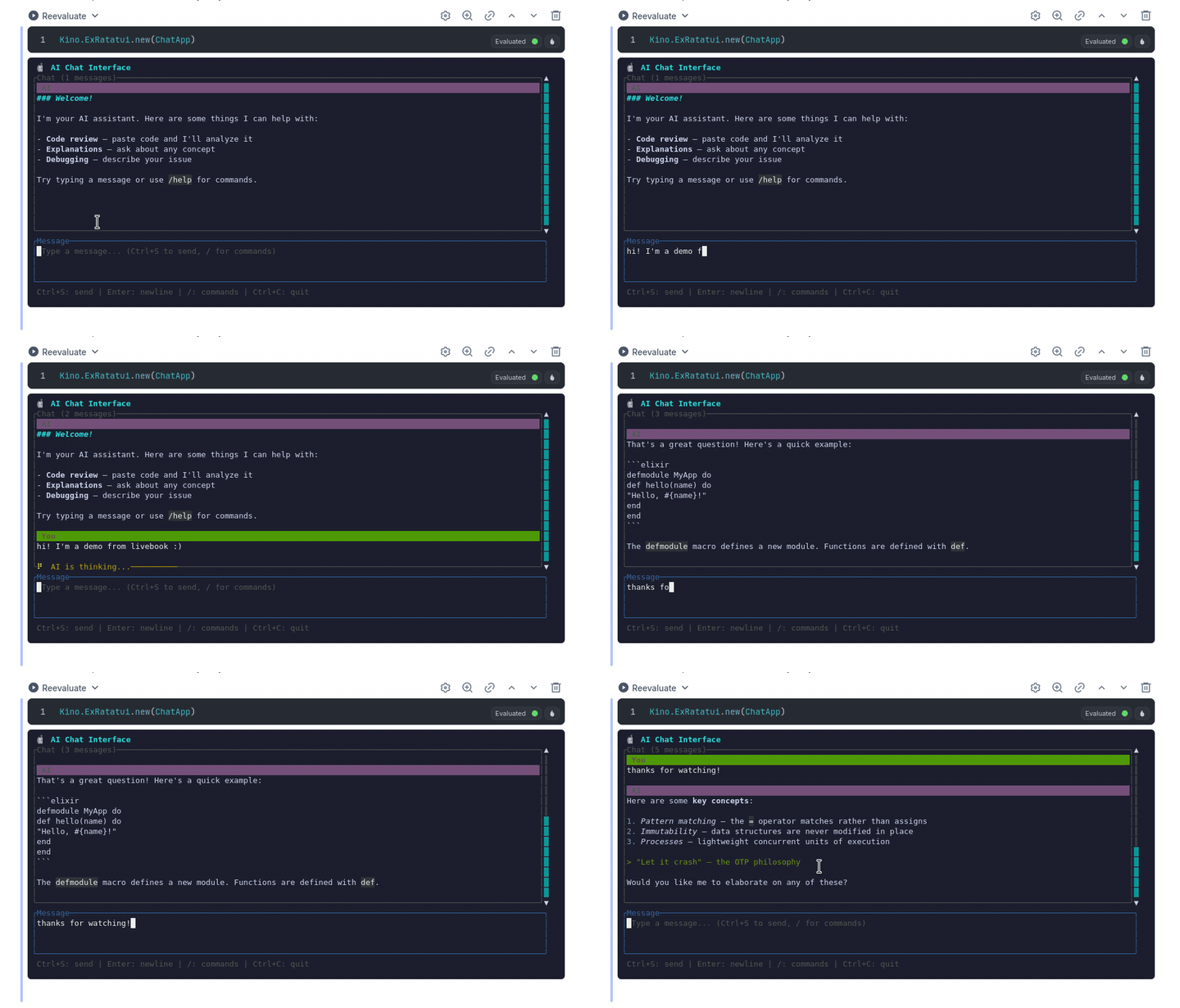
KinoExRatatui is a byte-stream transport that pipes the runtime's rendered ANSI through xterm.js and forwards keypresses and resize events back. Implemented as a Kino.JS.Live widget on top of ExRatatui.Transport.ByteStream.
Features
- Same App, same surface — any module implementing
ExRatatui.Appruns unchanged. - Responsive sizing — xterm.js's
FitAddonderives cell dimensions and reports resize events; the App sees them as%ExRatatui.Event.Resize{}inhandle_event/2. - Static frames —
Kino.ExRatatui.frame/2renders a one-shot[{widget, rect}, ...]list and ships the bytes to xterm.js. Useful for documentation, side-by-side comparisons viaKino.Layout.grid/1, screenshots, etc. - Inline images — the bundled
@xterm/addon-imageregisters Sixel and iTerm2 inline-image parsers, soExRatatui.Widgets.Imagerenders PNG / JPEG / GIF / WebP / BMP end-to-end in Livebook. Build images withExRatatui.Image.new/2and place them in the widget tree like any other widget; passprotocol: :sixelorprotocol: :iterm2at construction time. - Themeable — pass
:theme,:font_family,:font_size,:height,:cursor_blink,:scrollback, and:stopped_messagetonew/2(or the static-friendly subset toframe/2) to override the defaults per cell. The:thememap is the full xterm.jsITheme— 16 ANSI colors, selection, cursor accents, the lot. Use the:dark/:light/:livebookatom shorthands to pick a bundled palette;:livebookfollows the user'sprefers-color-schemeand live-switches. - Global defaults —
Kino.ExRatatui.configure/1writes display defaults to the:kino_ex_ratatuiApplication environment. Per-instance opts still win key-by-key. See the Configuration guide. - Accessible stopped state — when the runtime exits the widget renders a
role="status"aria-live="polite"DOM overlay over the xterm container. Screen readers announce it; sighted users see a clean italic message instead of the frozen final frame. Customise the text with:stopped_message. - Zero browser-side state on cell re-eval — re-running the cell tears the runtime down and starts a fresh one, matching every other
Kino.JS.Livewidget. - Telemetry —
[:kino_ex_ratatui, :transport, :connect | :disconnect],[:kino_ex_ratatui, :render, :frame],[:kino_ex_ratatui, :input, :forward], and[:kino_ex_ratatui, :resize]events sit one layer aboveex_ratatui's own runtime/render telemetry. See the Telemetry guide for the full event catalogue and aTelemetry.Metricsexample.
Examples
Five notebook examples live under examples/ — open them in Livebook and run the cells. See the catalog for a one-liner per notebook and a recommended starting point.
Ecosystem
- ex_ratatui — The core terminal UI library this builds on.
- phoenix_ex_ratatui — Run TUIs in the browser within Phoenix LiveView.
Installation
Add kino_ex_ratatui to the Livebook setup cell (or the project's mix.exs):
Mix.install([
  {:kino_ex_ratatui, "~> 0.2"}
])
Prerequisites
- Elixir 1.17+
- Livebook 0.19+
Quick Start
defmodule Counter do
  use ExRatatui.App

  alias ExRatatui.Event.Key
  alias ExRatatui.Layout.Rect
  alias ExRatatui.Widgets.{Block, Paragraph}

  def mount(_), do: {:ok, %{n: 0}}

  def render(state, frame) do
    [
      {%Paragraph{
         text: "Count: #{state.n}\n\n+ increment   - decrement   q quit",
         block: %Block{title: "counter"}
       },
       %Rect{x: 0, y: 0, width: frame.width, height: frame.height}}
    ]
  end

  def handle_event(%Key{code: "+"}, s), do: {:noreply, %{s | n: s.n + 1}}
  def handle_event(%Key{code: "-"}, s), do: {:noreply, %{s | n: s.n - 1}}
  def handle_event(%Key{code: "q"}, s), do: {:stop, s}
  def handle_event(_, s),                do: {:noreply, s}
end

Kino.ExRatatui.new(Counter)
Static frames
alias ExRatatui.Layout.Rect
alias ExRatatui.Widgets.{Block, Paragraph}

Kino.ExRatatui.frame(
  [
    {%Paragraph{
       text: "Hello from a static frame!",
       block: %Block{title: "demo"}
     },
     %Rect{x: 0, y: 0, width: 40, height: 5}}
  ],
  cols: 40,
  rows: 5
)
frame/2 renders the widget list once via ExRatatui.Session, ships the resulting ANSI to xterm.js, and stops. No event loop, no runtime server.
How it works
KinoExRatatui implements ExRatatui.Transport as a byte-stream transport — the same shape as the built-in SSH transport. The wiring:
xterm.js (iframe)            Kino.ExRatatui (Kino.JS.Live)         ExRatatui.Server
─────────────────            ─────────────────────────────         ────────────────
onData(bytes)         ──>    handle_event("input", _)        ──>   {:ex_ratatui_event, _}
ResizeObserver        ──>    handle_event("resize", _)       ──>   {:ex_ratatui_resize, _, _}
xterm.write(bytes)    <──    broadcast_event("ansi", _)      <──   writer_fn.(bytes)
The runtime server starts lazily on the first "resize" event so the ExRatatui.Session opens at the exact dimensions xterm.js's FitAddon settled on. From there, input bytes round-trip through ExRatatui.Transport.ByteStream.forward_input/3 (which absorbs synthesized Event.Resize events and dispatches everything else as {:ex_ratatui_event, _}). When the App returns {:stop, _}, the live widget catches the runtime's :DOWN and broadcasts a stop state message.
Guides
| Guide | Description |
|---|---|
| Configuration | Global display defaults via configure/1, the theme atom shorthands, and the merge order |
| Telemetry | :telemetry events for transport, render, input, and resize — logging and Telemetry.Metrics |
Contributing
See CONTRIBUTING.md for development setup and guidelines.
KinoExRatatui is built on ExRatatui, a general-purpose terminal UI library for Elixir. Contributions to its underlying rendering, widgets, or layout engine are very welcome too.
License
MIT — see LICENSE.