JC
##Erlang, Distributable, In-Memory Cache
Featruing: Pub/Sub, JSON-query, consistency support, and a simple, TCP interop. protocol.


###Features
-
Cache entries are Map, Key, Value, [TTL], [Sequence]
- Maps represent a name-space for Keys - similar to the notion of 'bucket' in other caching systems
- Maps, Keys and Values can be any Erlang term
- TTL is time-to-live in seconds
- Consistency assist through sequence numbers: An alternative API allows for a sequence-number parameter on the put/x, evict/x, match/x and remove/x operations. Operations whose sequence number is lower than the current, per-map max are disallowed thereby ensuring, for example, that stale puts do not overwrite newer ones due to the newer one beating the stale ones to the cache.
-
JSON query support
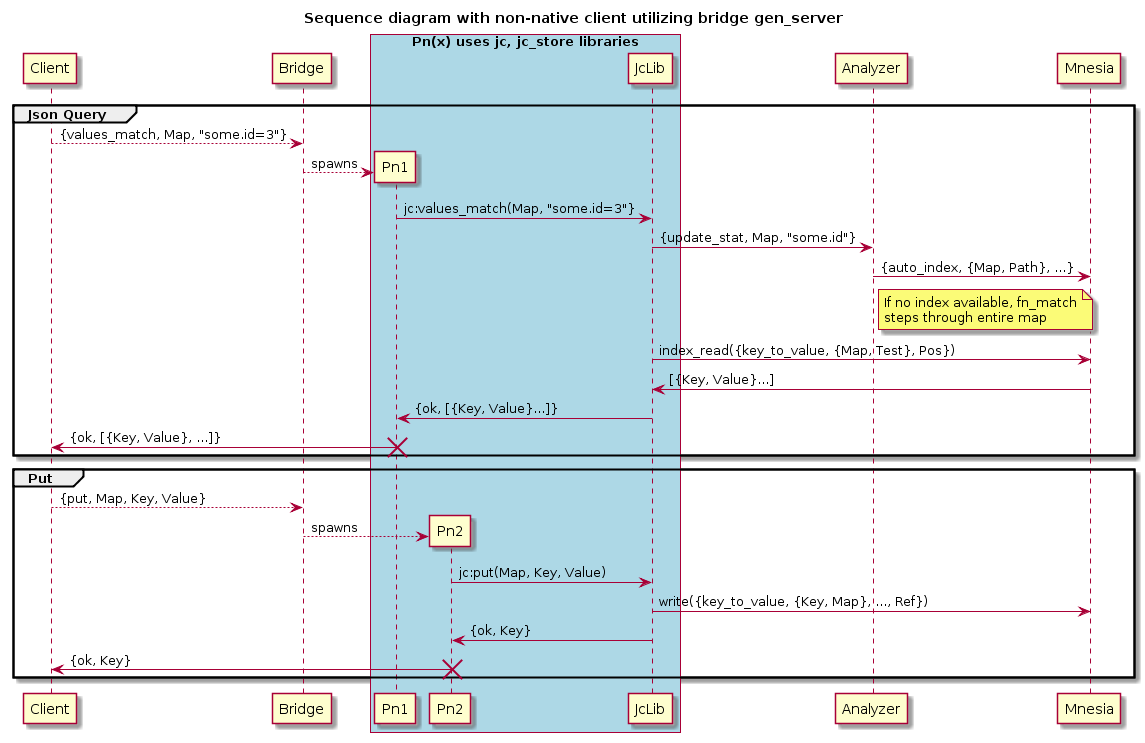
- Query by JSON: When Values are JSON, evict_match/2, evict_all_match/1 and values_match/2 will search or evict keys whose JSON value, at a location specificed by a java-style, dot-path string, equals the given value. That is, jc:values_match(bed, "id.type=3") would return all values, in the given map (bed), where that value was a JSON object, id, with a "type":3 at its top-level.
- Ad-hoc, index support: In order to support faster operations, (2-3 orders of magnitude), each map can have up to four, dot-path, strings configured (or added at run-time) for which jc will provide index support.
- Auto index recognition - Frequently used JSON querries will be automatically detected and indexing initiated.
-
User controlled eviction
- Map-level TTL: A job runs at configured intervals and removes items whose create-date is older than a map-specific, configured number of seconds.
- Item-level TTL: PUTS can include a TTL which defines when the item should be evicted. Used for shorter TTLs, as an exception to a Map-level TTL, or when more precision is required than that offered by the Map-level TTL.
-
Pub/Sub
- Clients can subscribe to Map events for a specific key or for any key, and for write, delete or either operations
- Clients can create and subscribe to arbitrary 'topics' and broadcast arbitrary messages under those topic names
- Clients can subscribe to node-up and node-down events
-
Interopability
- Binary string over TCP returning JSON
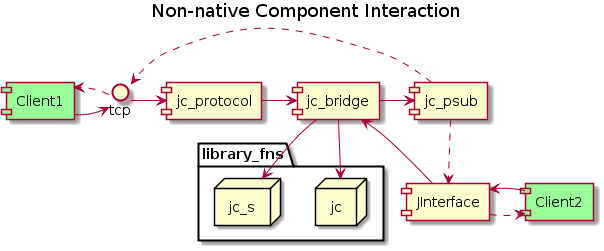
- Bridge process that accepts messages from a client indicating cache operations, executes the cache operations and returns the results to the client. This has been used with JInterface to interoperate with CLOJURE and Java clients
- Fine-grained logging via Lager
###Cache Functions (jc)
-
Create
- put(Map, Key, Value, [TTLSecs]) -> {ok, Key} | {error, badarg}
-
put_all(Map, [{K,V},{K,V},...], [TTLSecs]) -> {ok, CountOfSuccessfulPuts} |
{error, badarg}
-
Delete
- evict(Map, Key) -> ok
- evict_all_match(Criteria = "Json.Path.Match=Value") -> ok
- evict_map_since(Map, Age_In_Secs) -> ok
- evict_match(Map, Criteria = "Json.Path.Match=Value") -> ok
- remove_items(Map, Keys) -> {ok, [{K, V}, ...]} for each {K, V} deleted.
-
Retrieve
- get(Map, Key) -> {ok, Value} | miss
- get_all(Map, [K1, K2, ...]) -> {ok, {Found=[{K1,V1},...], Misses=[K2,...]}}
- key_set(Map) -> {ok, [K1, K2, ...]} for each Key in the Map
- values(Map) -> {ok, [V1, V2, ...]} for each Value in the Map
-
values_match(Map, Criteria="JSon.Path.Match=Value") ->
{ok, [{K1,V1}, {K2,V2}, ...]}
-
Flush
- clear(Map) -> ok
- flush() -> ok
- flush(silent) -> ok, Does not send alerts to subscribers
-
Predicates
- contains_key(Map, Key) -> true | false.
-
Meta
- cache_nodes() -> {{active, [Node1,... ]}, {configured, [Node1,... ]}}
- cache_size() -> {size, [{TableName, RecordCnt, Words}],...}
- map_size(Map) -> {records, Count}
- maps() -> {maps, [Map1, Map2,...]}
-
up() -> {uptime, [{up_at, String},{now, String},
{up_time, {D, {H, M, S}}}]
Consistency Support Functions (jc_s)
Identical to the Create and Evict family of functions of the jc module (see above), except:
- An additional sequence parameter, which is expected to be a monotonically incresing integer (with respect to a given Map), used to disalow "out of sequence" operations
-
Functions return {error, out_of_seq} if out of sequence operation is attempted
- evict(Map, Key, Seq)
- evict_all_match(Criteria = "Json.Path.Match=Value", Seq)
- evict_match(Map, Criteria = "Json.Path.Match=Value", Seq)
- put(Map, Key, Value, [TTLSecs], Seq)
- put_all(Map, [{K,V},{K,V},...], [TTLSecs], Seq)
- remove_items(Map, Keys, Seq)
-
Meta functions
- sequence() -> [{Map, HighestNnumber},... ]
- sequence(Map) -> HightestNumber
###Eviction Manager Functions (jc_eviction_manager)
- set_max_ttl(Map, Secs) -> ok | {error, badarg}
- get_max_ttls() -> [{Map, Secs}, ...]
###Pub/Sub Functions (jc_psub)
map_subscribe(Pid, Map, Key|any, write|delete|any) -> ok | {error, badarg}
map_unsubscribe(Pid, Map, Key|any, write|delete|any) -> ok | {error, badarg}
client receives
{map_event, {Map, Key, delete}}or{map_event, {Map, key, write, Value}
topic_subscribe(Pid, Topic, Value) -> ok | {error, badarg}
topic_unsubscribe(Pid, Topic, Value) -> ok | {error, badarg}
- client receives: {topic_event, {Topic, Value}}
topic_event(Topic, Value) -> ok
- Broadcasts Value to all subscribers of Topic
topic_subscribe(Pid, jc_node_events, any) -> ok
- subscribtes the user to node up and node down events:
{jc_node_events, {nodedown, DownedNode, [ActiveNodes],[ConfiguredNodes]}}{jc_node_events, {nodeup, UppedNode, [ActiveNodes],[ConfiguredNodes]}}
###Indexing Functions (jc_store)
-
start_indexing(Map, Path={bed,"menu.id"}) -> ok |
{error, no_indexes_available} | {error, Term} - stop_indexing(Map, Path={bed,"menu.id"}) -> ok
-
indexes(Map) -> {indexes, [{{Map, Path}, Position},...]} for all indexes
of given Map - indexes() -> {indexes, [{{Map, Path}, Position},...]} for all indexes
###Interoperability: Bridge (jc_bridge)
All functions from the jc, jc_s, jc_eviction_manager, jc_psub and jc_store are supported and are of the form:
{From, {Fn, P1, P2,...}}for each paramater, as in
jc_bridge ! {Pid, {put, Map, Key, Value}}Additionally,
{From, {node_topic_sub}} -> ok | {error, badarg}, client will recieve:
{jc_node_events, {nodedown, DownedNode, [ActiveNodes],[ConfiguredNodes]}}or
{jc_node_events, {nodeup, UppedNode, [ActiveNodes],[ConfiguredNodes]}}{From, {node_topic_unsub}} -> ok.
Interoperability: Socket Protocol
Binary-encoded, string protocol used to provide socket-based interoperability with JC.
All messages to JC are string representations of a tuple. All messages form the caching system to the client are JSON
The protocol defines three message types: CONNECT, CLOSE and COMMAND all of which are binary strings consisting of an 8-byte size followed by the actual command messages.
Responses are also binary strings with an 8-byte size prefix.
The CONNECT command initiates a session,
M = <<"{connect,{version,\"1.0\"}}">>

Size is 25, so the CONNECT message is:

<<25:8, M/binary>> =
<<25,40,58,99,111,110,110,101,99,116,32,123,58,118,101,
  114,115,105,111,110,32,49,46,48,125,41>>
The server will respond to a CONNECT command with either an error or the encoded version of {"version":" "1.0"}
<<15:8, <<"{\"version\":\"1.0\"}">> =
<<15,123,34,118,101,114,115,105,111,110,34,58,49,46,48,125>>
The CLOSE command closes the socket, ending the session
M = <<"{close}">>

 Size is 7 so the CLOSE message is:
 <<7,123,99,108,111,115,101,125>>
COMMAND messages are string versions of the tuple-messages, which jc_bridge uses, without the self() parameter. For example
{self(), {put, Map, Key, Value}} becomes
{put, Map, Key, Value}
The return will be an encoded version of a JSON string. A client session might look as follows:
client:send("{put, evs, \"1\", \"{\\\"value:\\\":true}\"}")
<<"{\"ok\":\"1\"}">>

client:send("{get, evs, \"1\"}"),
<<"{\"ok\":"{\\\"value\\\":true}\"}">>

client:send("{put, evs, 1, \"{\\\"value:\\\":true}\"}")
<<"{\"ok\":1}">>

client:send("{get, evs, 1}"),
<<"{\"ok\":"{\\\"value\\\":true}\"}">>
###Configuration
- Application configuration is in sys.config which is heavily commented
- Cookie, node-name and auto-restart of VM controlled by vm.args
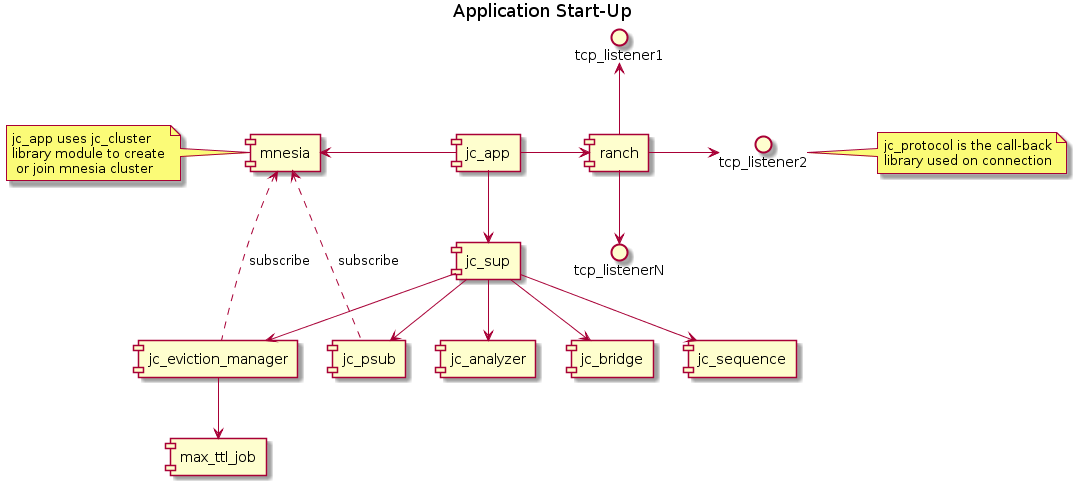
###Application Modules
-
jc_cluster
- Simple, mnesia-based, cluster creation and management
-
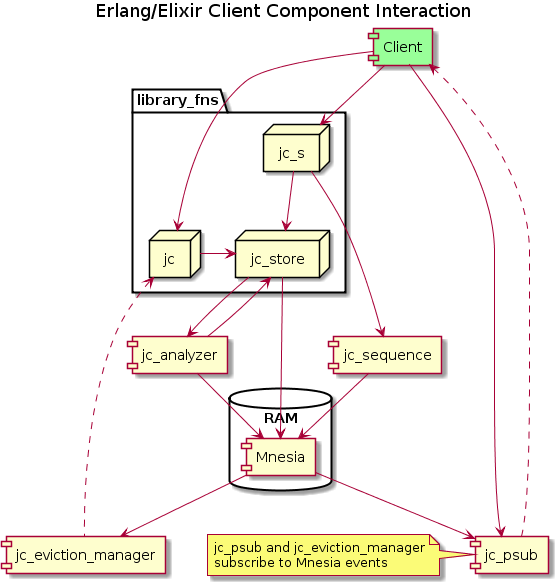
jc, jc_s, jc_store, jc_eviction_manager
- Caching operations, Key-specific and Map-level TTLs
-
jc_sequence
- Singleton service enforcing strictly monotonic sequence numbers on jc_s operations
-
jc_analyzer
- Analysis and indexing inititation of JSON query strings
-
jc_protocol
- Socket processing of messages and Erlang -> JSON
-
jc_psub:
- Pub / Sub of cache write and delete events
- On-demand, ad-hoc topic events
- Predefined, jc_node_events topic provides subscribers node-up and node-down notifications
-
jc_bridge
- Server that acts as a proxy between an external process and jc functionality
-
jc_netsplit
- Looks for evidence of node dis/apperation and implements a recovery strategy
###Net Split/Join Strategy Mnesia does not merge on its own when a node joins (returns) to a mesh of nodes. There are two situations where this is relevant:
- j_cache nodes start in a disconnected state so more than one initiates a new cluster and then, subsequently, those nodes join into one cluster;
- A node drops out of the cluster due to some network glitch and then rejoins.
To handle these situations, whenever a cluster is created by a Node (node@123.45.67, for example), it creates a ClusterId - its Node name (node@123.45.67), for that cluster.
Given this ClusterId, we have the following strategy:
- Cluster Creation: creates an initial ClusterId;
- Nodedown: If the Node that created the cluster dissapears, a surviving Node changes the ClusterId such that ClusterId is now this new Node's name. In the case of a disconnected newtwork, one of the islands will have the original ClusterId Node dissapear, and it will create a new one as described.
- Nodeup Whenever a Node appears, an arbitary Node ensures that any Nodes that report a different ClusterId (different than the arbitrary Node's ClusterId) are killed to be restarted by the hearbeat application. If any Nodes required restarting, the entire cache is flushed.
###Build Instructions
Ensure that Erlang 17 or higher is installed
Get the Source Code from Stash
[root@db01] git clone https://github.com/jr0senblum/jc.gitEdit the sys.config and vm.args files in ./config
- vm.args: Indicate the correct node names and cookie
- sys.config: Adjust prarameters as neccesary.
[root@db01] ./rebar3 releaseor
[root@db01] ./rebar3 as prod release
###Documentation
[root@dbo1] ./rebar3 edoc