IREE.Tokenizers
IREE.Tokenizers is an inference-only Elixir tokenizer package backed by the
IREE tokenizer runtime. It lets
Elixir applications load common LLM tokenizer assets and run fast local
encode/decode without a Python service. I first discovered IREE's tokenizer work
through the ZML.ai blog, and deeply
admire the company and the engineering behind it.
In one sentence: this package turns Hugging Face tokenizer.json, OpenAI
.tiktoken, and SentencePiece .model files into BEAM-friendly tokenizer
handles with one-shot, batch, streaming, offset, mask, and vocab helper APIs.
What this package does
- Loads tokenizer assets from local files, in-memory buffers, or the Hugging Face Hub.
- Supports Hugging Face
tokenizer.json, OpenAI.tiktoken, and SentencePiece.modelformats. - Supports BPE, WordPiece, and Unigram model families.
- Encodes and decodes single inputs, lists of inputs, and streams of chunks.
- Returns token IDs, token strings, type IDs, attention masks, special-token masks, and optional byte offsets.
- Applies tokenizer-level
tokenizer.jsonpadding/truncation defaults where the referencetokenizerspackage applies them. - Uses a native Rust/C runtime through Rustler, with precompiled NIFs for common release targets and local source builds in development/test.
Why use it
Use this package when an Elixir system needs tokenizer performance and LLM-style runtime ergonomics without leaving the BEAM:
- serving or batching LLM prompts in Phoenix, Livebook, Broadway, Oban, Nx, or custom inference services
- counting or packing tokens before model calls
- streaming tokenization for large prompts or ingestion pipelines
- using OpenAI/tiktoken-compatible encodings from Elixir
- loading SentencePiece
.modelfiles directly when a model repository does not expose the exacttokenizer.jsonpath you want
Current results
The checked-in benchmark and parity files are generated by scripts in bench/.
The README only summarizes results that have corresponding artifacts in
bench/results/.
Correctness/parity
bench/validate_parity.exs compares IREE.Tokenizers with
elixir-nx/tokenizers, the Rust-backed
Hugging Face tokenizers reference package. The current selected matrix is
green for 7 public tokenizer families, 19 representative inputs per family, and
both add_special_tokens: true and false modes. It also checks batch encode
and stream encode parity.
See the full report: bench/results/parity_report.md.
Currently green selected matrix:
| Model / load path | Coverage in the report |
|---|---|
Qwen/Qwen2.5-7B-Instruct |
19/19 cases, both special-token modes; batch OK; stream OK |
google-bert/bert-base-uncased |
19/19 cases, both special-token modes; batch OK; stream OK |
openai-community/gpt2 |
19/19 cases, both special-token modes; batch OK; stream OK |
microsoft/Phi-3-mini-4k-instruct |
19/19 cases, both special-token modes; batch OK; stream OK |
google-t5/t5-small from tokenizer.json |
19/19 cases, both special-token modes; batch OK; stream OK |
google-t5/t5-small from SentencePiece .model |
19/19 cases, both special-token modes; batch OK; stream OK |
sentence-transformers/all-MiniLM-L6-v2 |
19/19 cases, both special-token modes; batch OK; stream OK |
The benchmark-matrix rows currently published in
bench/results/model_matrix.md were also
re-checked on this branch for representative one-shot, batch, and stream parity:
LiquidAI/LFM2.5-1.2B-InstructQwen/Qwen3.5-9Bzai-org/GLM-5.1mistralai/Ministral-3-3B-Reasoning-2512google/gemma-4-31B-it
Historical upstream/runtime gaps and local fixes are documented in
docs/UPSTREAM_BUGS.md. Do not treat that file as the
live status by itself; the latest parity report is the authoritative current
result.
Performance
Benchmark numbers depend on machine, OTP/Elixir versions, CPU, and cache state. The checked-in numbers show the current shape:
| Benchmark artifact | Summary |
|---|---|
bench/results/model_matrix.md |
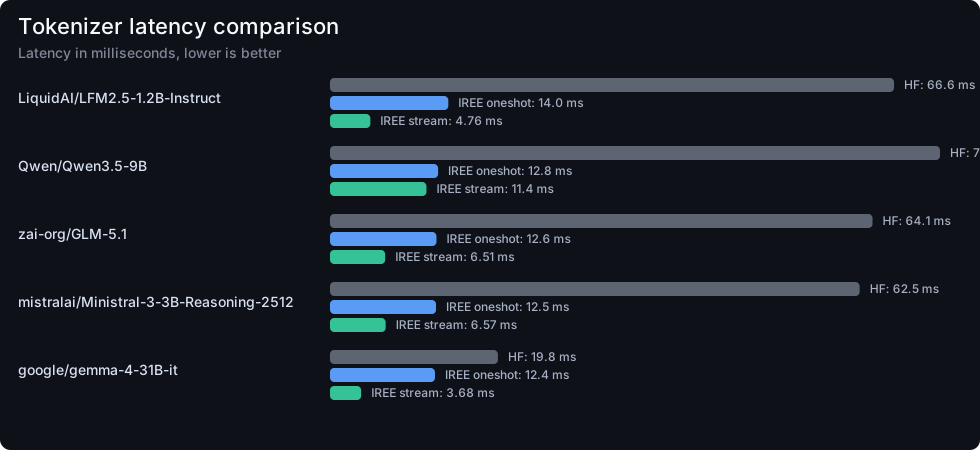
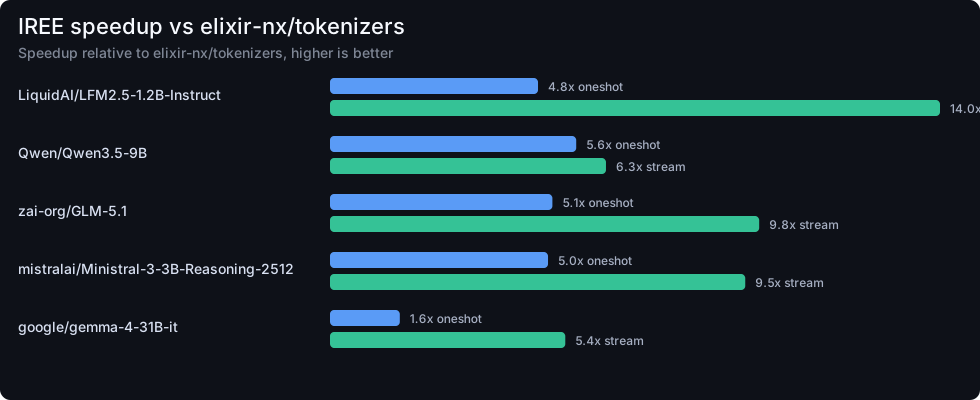
Curated real-model prompt workload: IREE one-shot is 1.6x-5.6x faster than tokenizers; IREE stream is 5.4x-14.0x faster on the published rows. |
bench/results/tokenizers_compare.md |
Local BPE fixture: medium/long encode is about 1.3x faster; medium/long decode is about 10x faster. |
bench/results/sentencepiece_compare.md |
Direct .model loading: T5-small encode is 1.97x faster; LLaMA tokenizer encode is 1.18x faster; LLaMA decode is 1.81x faster. |
The model-matrix run reports latency only for rows where the benchmark corpus produces equivalent outputs across both libraries, and reports stream numbers only when streamed output matches IREE one-shot output on that corpus.
Latency chart:
Speedup chart:
Installation
Add the package to your Mix dependencies:
def deps do
  [
    {:iree_tokenizers, "~> 0.7.0"}
  ]
end
Then run:
mix deps.get
The package uses rustler_precompiled for release builds. The current prebuilt
NIF target list is:
aarch64-apple-darwinx86_64-apple-darwinx86_64-unknown-linux-gnu
In :dev and :test, the project forces a local Rust source build. You can
also force a local build with:
IREE_TOKENIZERS_BUILD=1 mix compile
Quick start
Load from the Hugging Face Hub
alias IREE.Tokenizers.Tokenizer

{:ok, tokenizer} = Tokenizer.from_pretrained("Qwen/Qwen2.5-7B-Instruct")

{:ok, encoding} =
  Tokenizer.encode(tokenizer, "Hello from Elixir", add_special_tokens: false)

encoding.ids
#=> token ids

{:ok, text} = Tokenizer.decode(tokenizer, encoding.ids, skip_special_tokens: false)
#=> "Hello from Elixir"
For gated or private Hugging Face repositories, pass a token:
{:ok, tokenizer} =
  Tokenizer.from_pretrained("some/private-model",
    token: System.fetch_env!("HF_TOKEN")
  )
from_pretrained/2 caches downloaded tokenizer assets by ETag in a per-user
cache directory by default. You can pass cache_dir:, revision:, subfolder:,
filename:, use_cache: false, or a custom http_client:.
Load a local tokenizer.json
{:ok, tokenizer} = Tokenizer.from_file("tokenizer.json")

{:ok, encoding} =
  Tokenizer.encode(tokenizer, "Hello world",
    add_special_tokens: true,
    track_offsets: true
  )

encoding.ids
encoding.tokens
encoding.offsets
encoding.attention_mask
encoding.special_tokens_mask
Load OpenAI .tiktoken encodings
{:ok, tokenizer} =
  Tokenizer.from_pretrained("gpt-4o", format: :tiktoken)

{:ok, cl100k} =
  Tokenizer.from_pretrained("openai/cl100k_base", format: :tiktoken)

Tokenizer.supported_tiktoken_encodings()
#=> ["cl100k_base", "o200k_base", "o200k_harmony", "r50k_base", "gpt2", "p50k_base", "p50k_edit"]
For local .tiktoken files, pass format: :tiktoken when inference from the
filename is not enough:
{:ok, tokenizer} =
  Tokenizer.from_file("gpt2.tiktoken", format: :tiktoken)

{:ok, tokenizer} =
  Tokenizer.from_buffer(buffer,
    format: :tiktoken,
    tiktoken_encoding: "cl100k_base"
  )
Load SentencePiece .model files
Local files ending in .model are inferred automatically:
{:ok, tokenizer} = Tokenizer.from_file("spiece.model")
From Hugging Face, request the SentencePiece path explicitly:
{:ok, tokenizer} =
  Tokenizer.from_pretrained("google-t5/t5-small",
    format: :sentencepiece_model
  )
Batch encode/decode
{:ok, encodings} =
  Tokenizer.encode_batch(tokenizer, ["short prompt", "another prompt"],
    add_special_tokens: false
  )

ids_batch = Enum.map(encodings, & &1.ids)
{:ok, texts} = Tokenizer.decode_batch(tokenizer, ids_batch, skip_special_tokens: false)
encode_batch/3 is intentionally parity-first: it routes through the same
single-input encode/3 path for each item so tokenizer defaults, local fixes,
and transformations are identical to one-shot encoding.
Streaming encode/decode
alias IREE.Tokenizers.{DecodeStream, EncodeStream}

{:ok, stream} = EncodeStream.new(tokenizer, add_special_tokens: false)
{:ok, ids1} = EncodeStream.feed(stream, "Hello ")
{:ok, ids2} = EncodeStream.feed(stream, "world")
{:ok, ids3} = EncodeStream.finalize(stream)
ids = ids1 ++ ids2 ++ ids3

{:ok, decode_stream} = DecodeStream.new(tokenizer, skip_special_tokens: false)
{:ok, text1} = DecodeStream.feed(decode_stream, Enum.take(ids, 2))
{:ok, text2} = DecodeStream.feed(decode_stream, Enum.drop(ids, 2))
{:ok, text3} = DecodeStream.finalize(decode_stream)
text = text1 <> text2 <> text3
For tokenizer families where the native streaming runtime can diverge at chunk boundaries, the wrapper uses buffered-finalize strategies so the final stream output still matches one-shot encode.
Encode transformations
alias IREE.Tokenizers.Encoding.Transformation

{:ok, encoding} =
  Tokenizer.encode(tokenizer, "hello",
    add_special_tokens: false,
    encoding_transformations: [
      Transformation.truncate(128),
      Transformation.pad(128, pad_id: 0, pad_token: "[PAD]")
    ]
  )
When a Hugging Face tokenizer.json carries fixed padding or truncation config,
that default config is applied automatically. Explicit transformations are then
applied after those defaults.
API map
| Module | Purpose |
|---|---|
IREE.Tokenizers.Tokenizer |
Main load/encode/decode/vocab API. |
IREE.Tokenizers.Encoding |
Struct and helpers for token IDs, masks, offsets, tokens, padding, and truncation. |
IREE.Tokenizers.Encoding.Transformation |
Builders for post-encode transformations. |
IREE.Tokenizers.EncodeStream |
Incremental encode state. |
IREE.Tokenizers.DecodeStream |
Incremental decode state. |
IREE.Tokenizers.Model and model modules |
Build simple BPE, WordPiece, or Unigram specs from Elixir data. |
Supported scope
Supported now:
- inference-time encode/decode
- Hugging Face
tokenizer.json - OpenAI
.tiktoken - SentencePiece
.model - BPE, WordPiece, and Unigram tokenizers
- single input encode/decode
- list input batch encode/decode
- streaming encode/decode
- token offsets, type IDs, attention masks, special-token masks, token strings
- special token ID lookup helpers
- tokenizer vocabulary lookup helpers
Deferred or intentionally out of scope for v1:
- pair-sequence encode input such as
{left, right} - tokenizer training APIs
- full tokenizer mutation APIs
- full surface-area parity with every
elixir-nx/tokenizersoption - word ID tracking and overflowing-window output
Unsupported pair input returns:
{:error, {:invalid_argument, "pair sequence inputs are not supported in v1"}}
How it is implemented
The implementation has four layers:
-
Elixir public API
lib/iree/tokenizers/tokenizer.exowns loading, options, Hugging Face downloads/caching, batch behavior, tokenizer JSON defaults, and public result shaping.lib/iree/tokenizers/encoding.exmirrors the practicalEncodinghelper surface: IDs, masks, offsets, tokens, pad/truncate/transform.lib/iree/tokenizers/encode_stream.exanddecode_stream.exprovide BEAM stream state wrappers.
-
Rust NIF bridge
lib/iree/tokenizers/native.exusesRustlerPrecompiledin releases and source builds in development/test.native/iree_tokenizers_native/src/tokenizer.rsmaps Rust resources and NIF structs to the Elixir API.- Dirty CPU NIFs are used for encode/decode paths that can do significant native work.
-
Vendored IREE tokenizer runtime
- The native crate builds a curated C source bundle under
native/iree_tokenizers_native/vendor/iree_tokenizer_src. - The pinned upstream commit is recorded in
native/iree_tokenizers_native/vendor/IREE_COMMIT. scripts/update_iree_bundle.shrefreshes the vendored source bundle from a matching upstream IREE checkout.
- The native crate builds a curated C source bundle under
-
Parity-preserving compatibility layer
- SentencePiece
.modelbuffers are converted to tokenizer JSON in Rust before construction. - Some tokenizer families use special decode or buffered stream strategies to match the Hugging Face reference output.
- Encode buffers grow with bounded retry logic so native output-capacity issues return clear errors instead of silently truncating or exhausting the BEAM.
encode_batch/3delegates through one-shotencode/3for each input to preserve correctness across known native batch-runtime edge cases.- Hugging Face
tokenizer.jsonpadding/truncation defaults are parsed and applied in the Elixir layer.
- SentencePiece
Repository usage
Install dependencies and run the normal local checks from the repository root:
mix deps.get
mix test
cargo test --manifest-path native/iree_tokenizers_native/Cargo.toml
Format Elixir and Rust code:
mix format
cargo fmt --manifest-path native/iree_tokenizers_native/Cargo.toml
Run optional pretrained integration suites:
RUN_PRETRAINED_BATCH_INTEGRATION=1 mix test test/iree_tokenizers/batch_integration_test.exs
RUN_PRETRAINED_STREAM_INTEGRATION=1 mix test test/iree_tokenizers/stream_integration_test.exs
RUN_SENTENCEPIECE_INTEGRATION=1 mix test test/iree_tokenizers/sentencepiece_integration_test.exs
Run the full selected parity matrix:
cd bench
mix deps.get
mix run validate_parity.exs
Limit the parity matrix while iterating:
cd bench
MODEL_FILTER="Qwen/Qwen2.5-7B-Instruct" mix run validate_parity.exs
The parity report is written to bench/results/parity_report.md.
Benchmark harness
Set up once:
cd bench
mix deps.get
Run the generic fixture comparison:
mix run compare.exs
Generate the SentencePiece .model comparison charts:
mix run sentencepiece_compare.exs
Generate the curated model latency/speedup matrix:
mix run model_matrix_graphs.exs
Limit a model-matrix run while iterating:
MODEL_FILTER="Qwen/Qwen3.5-9B" mix run model_matrix_graphs.exs
All benchmark outputs are written to bench/results/. If a benchmark target
requires authentication, set HF_TOKEN before running the script.
Vendored IREE bundle
The native crate builds against the vendored source bundle under
native/iree_tokenizers_native/vendor/iree_tokenizer_src.
The pinned IREE commit is recorded in:
native/iree_tokenizers_native/vendor/IREE_COMMIT
To refresh the bundle from a matching upstream checkout:
scripts/update_iree_bundle.sh /path/to/iree
After any vendor refresh, run Rust tests, Elixir tests, and the pretrained parity suites. Vendor updates can overwrite local C patches that are required for parity.
Releases
Merge a change to @version in mix.exs into main to publish a release.
The Release workflow compares versions before and after the push, creates
v<VERSION> at that commit, builds the native assets and checksums, and publishes
to Hex.pm using the repository's HEX_API_KEY secret. Other changes to mix.exs
do not trigger publication. Use a new SemVer version for each release.
To retry an unpublished version with an existing tag:
gh workflow run release.yml --ref main -f release_tag=v0.8.17
Manual runs build the tagged commit, validate its version, and skip versions already published on Hex. Concurrent runs for the same version are serialized.
License
This package is distributed under the Apache-2.0 license. The vendored IREE
runtime carries its own license file under
native/iree_tokenizers_native/vendor/iree_tokenizer_src/IREE-LICENSE.