IREE.Tokenizers
Fast Hugging Face tokenizer.json, OpenAI .tiktoken, and SentencePiece .model bindings for Elixir backed by the IREE tokenizer runtime. I discovered IREE Tokenizers from the ZML.ai blog, a company I deeply admire!
Features
-
Load tokenizer definitions from a local
tokenizer.json,.tiktoken, or SentencePiece.modelbuffer or file -
Download and cache
tokenizer.json,.tiktoken, or SentencePiece.modelfiles from the Hugging Face Hub - One-shot encode/decode and batched encode/decode
- Token offsets and type IDs
- Vocab lookup helpers
- Streaming encode/decode
Scope
V1 is intentionally inference-only.
-
Supported:
-
Hugging Face
tokenizer.json -
OpenAI
.tiktoken -
SentencePiece
.model - BPE
- WordPiece
- Unigram
-
Hugging Face
-
Deferred:
- pair-sequence encode input
- training and tokenizer mutation APIs
-
full
elixir-nx/tokenizersconfiguration surface parity
Repository Usage
Install dependencies and run the full local validation flow from the repo root:
mix deps.get
mix test
cargo test --manifest-path native/iree_tokenizers_native/Cargo.toml
In :dev and :test, the project forces a local source build of the Rust NIF, so you do not need precompiled release assets for normal development.
Example
{:ok, tokenizer} = IREE.Tokenizers.Tokenizer.from_file("tokenizer.json")

{:ok, encoding} =
  IREE.Tokenizers.Tokenizer.encode(tokenizer, "Hello world", add_special_tokens: false)

encoding.ids

{:ok, text} =
  IREE.Tokenizers.Tokenizer.decode(tokenizer, encoding.ids, skip_special_tokens: false)
For local .tiktoken files, use the same constructors with format: :tiktoken. If the filename carries a standard encoding name, it is inferred automatically:
{:ok, tokenizer} =
  IREE.Tokenizers.Tokenizer.from_file("gpt2.tiktoken", format: :tiktoken)

IREE.Tokenizers.Tokenizer.supported_tiktoken_encodings()
You can also load directly from the Hugging Face Hub:
{:ok, tokenizer} = IREE.Tokenizers.Tokenizer.from_pretrained("gpt2")
{:ok, cl100k} =
  IREE.Tokenizers.Tokenizer.from_pretrained("openai/cl100k_base", format: :tiktoken)

{:ok, gpt4o} =
  IREE.Tokenizers.Tokenizer.from_pretrained("gpt-4o", format: :tiktoken)
For custom .tiktoken repos or arbitrary in-memory buffers, pass tiktoken_encoding: explicitly when it cannot be inferred from the repo/model name or filename.
For SentencePiece .model files, use format: :sentencepiece_model for raw buffers and pretrained loads. Local files ending in .model are inferred automatically:
{:ok, tokenizer} =
  IREE.Tokenizers.Tokenizer.from_file("spiece.model")

{:ok, tokenizer} =
  IREE.Tokenizers.Tokenizer.from_pretrained("google-t5/t5-small",
    format: :sentencepiece_model
  )
If you need authentication for gated/private repos:
{:ok, tokenizer} =
  IREE.Tokenizers.Tokenizer.from_pretrained("some/private-model",
    token: System.fetch_env!("HF_TOKEN")
  )
Benchmarks
Current Local Results
The benchmark harness compares this package against the published tokenizers package.
All checked-in numbers come from the scripts under bench/. The README reports
only benchmark outputs that are directly reproducible from those scripts.
The benchmark scripts validate cross-library output parity before they report speedups:
- encode/decode fixture comparisons benchmark decode only when both libraries produced the same token sequence for the shared input
-
SentencePiece
.modelcomparisons validate multiple representative inputs per model and skip models whose.modelpath does not matchtokenizer.json - the model matrix excludes embedding models and reports stream numbers only when streamed output matches IREE one-shot output on the benchmark corpus
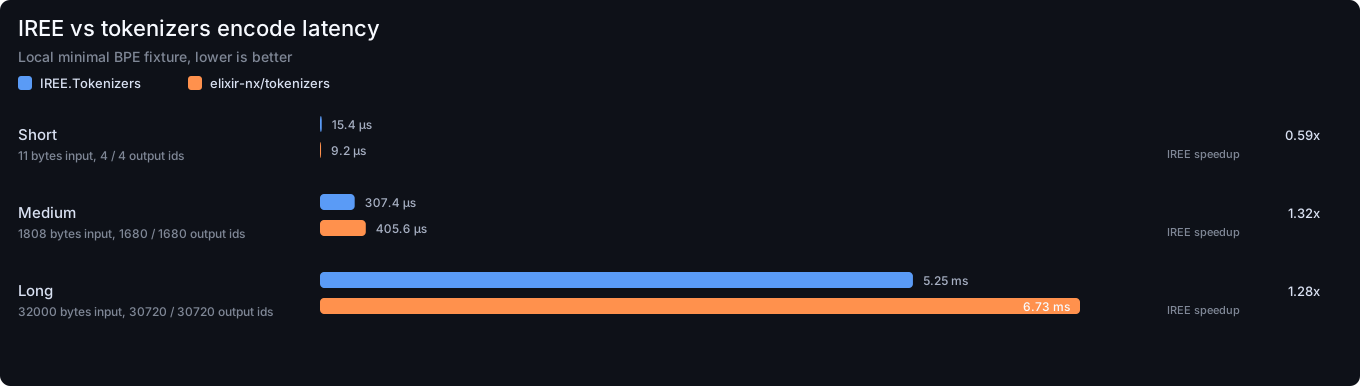
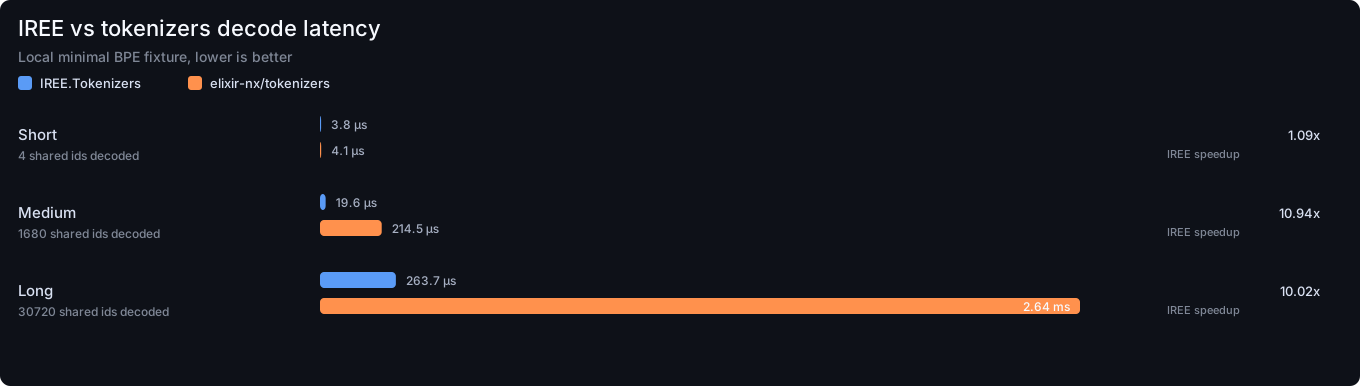
Local fixture comparison against elixir-nx/tokenizers
The local fixture comparison script writes:
bench/results/tokenizers_compare.mdbench/results/tokenizers_compare_encode.svgbench/results/tokenizers_compare_decode.svg
The SentencePiece-specific comparison script writes:
bench/results/sentencepiece_compare.mdbench/results/sentencepiece_compare_encode.svgbench/results/sentencepiece_compare_decode.svg
Fixture encode latency chart:
Fixture decode latency chart:
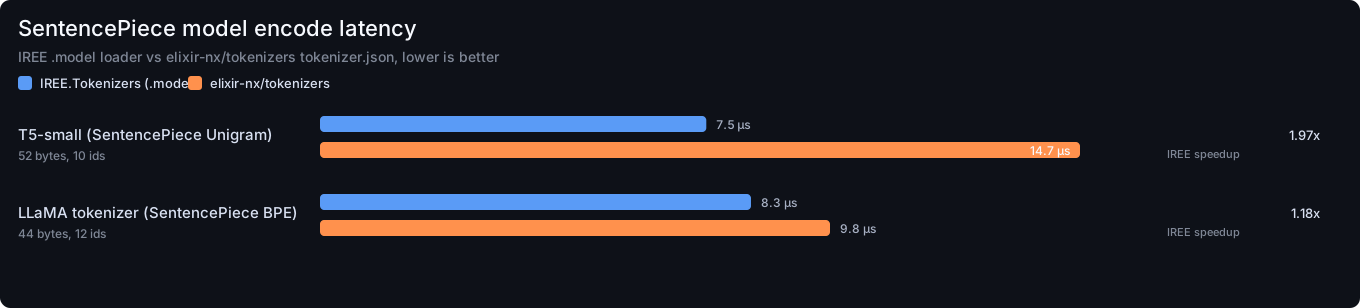
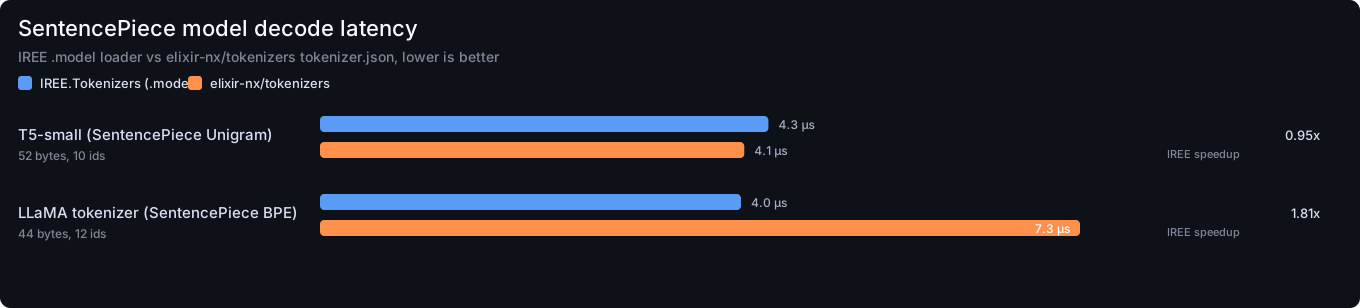
SentencePiece .model comparison
The SentencePiece-specific comparison script checks direct .model loading against the official
tokenizers package loaded from the corresponding
tokenizer.json, using several representative inputs per model before it records
latency numbers.
SentencePiece encode latency chart:
SentencePiece decode latency chart:
Model latency comparison
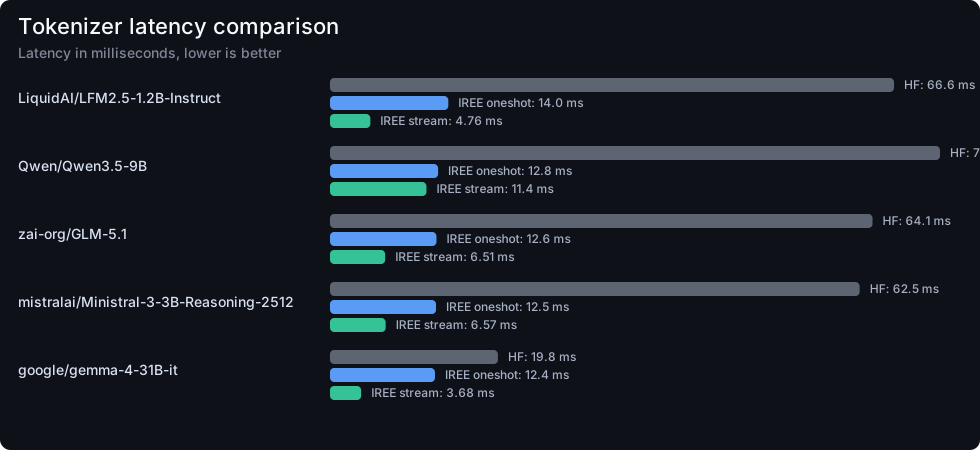
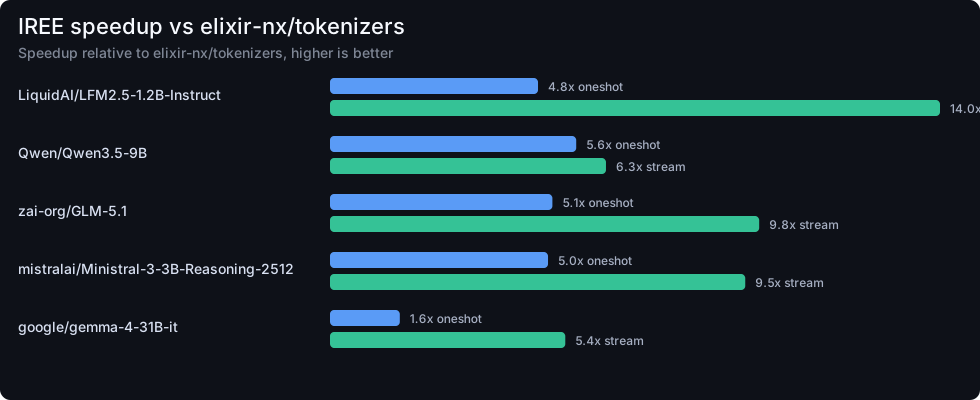
The benchmark harness keeps one representative repo per tokenizer family when multiple model variants share the same tokenizer. The current family-level matrix targets:
LiquidAI/LFM2.5-1.2B-InstructQwen/Qwen3.5-9Bzai-org/GLM-5.1with fallback tozai-org/GLM-5mistralai/Ministral-3-3B-Reasoning-2512arcee-ai/Trinity-Large-Previewgoogle/gemma-4-31B-it
Embedding models are excluded from the published latency matrix. Rows are also skipped when the benchmark corpus does not produce equivalent outputs across the two libraries, and stream measurements are only published when streaming output matches IREE one-shot output on that corpus.
Latency chart:
Speedup chart:
Benchmark Harness
The benchmark harness lives under
bench/.
Set it up once:
cd bench
mix deps.get
Run the generic encode/decode comparison:
mix run compare.exs
This generates the fixture comparison markdown and SVG charts in bench/results/.
Generate the SentencePiece .model comparison charts:
mix run sentencepiece_compare.exsGenerate the multi-model latency/speedup graphs:
mix run model_matrix_graphs.exsLimit the multi-model run to a single model while iterating:
MODEL_FILTER="Qwen/Qwen3.5-9B" mix run model_matrix_graphs.exsYou can also target the latest GLM run specifically:
MODEL_FILTER="zai-org/GLM-5.1" mix run model_matrix_graphs.exs
All benchmark outputs are written to bench/results/.
If any benchmark target requires authentication, set HF_TOKEN before running the script:
HF_TOKEN=... mix run model_matrix_graphs.exsVendored IREE Bundle
The native crate builds against a curated vendored source bundle under native/iree_tokenizers_native/vendor/iree_tokenizer_src.
The vendored bundle is pinned to the IREE commit recorded in native/iree_tokenizers_native/vendor/IREE_COMMIT.
To refresh that bundle from the pinned upstream IREE checkout:
scripts/update_iree_bundle.sh /path/to/iree