http_cache_store_memory
http_cache_store_memory is an in-memory LRU cache that can be used as a backend for http_cache.
It implements the http_cache_store behaviour.
It supports:
- in-memory caching, with fixed limit or limit in % of used system memory
-
clustering, using BEAM distribution. The following events are broadcast:
- newly cached HTTP responses (in an efficient manner)
- invalidation requests
- warmup: already present nodes send their most recently used cached HTTP responses to joining nodes
- telemetry events (see Telemetry)
- Backpressure mechanisms to avoid overloading the whole system with caching operations
-
the optional
http_cache_store:invalidate_by_alternate_key/1callback
It uses Erlang's capabilities and doesn't require external stores (Redis, memcached, DB...). Under the hood, it uses ETS tables, system monitor and Erlang's distribution.
For on-disk caching, see: http_cache_store_disk.
http_cache* pro versions
Advanced HTTP caching features are available as licensed packages:
http_cache_pro: brings HTTP request collapsing, brotli compression support and morehttp_cache_store_disk_pro: offers SSD protection and persistence support to your disk backend
Refer to these links for technical insights and license information.
Support
OTP25+
Usage
This is an OTP application, and automatically starts.
Configuration parameters
cluster_enabled: exchange of information between nodes of the Erlang cluster is enabled. Defaults tofalsememory_limit: how much memory is allocated for caching. If this is an integer, then it's the number of bytes allocated to store the cached responses. If it is a float, it's the system memory threshold that triggers nuking older entries. Defaults to0.9, that is, as soon as 90% of the system memory is used, objects are deleted until system memory use no longer exceeds this thresholdmax_concurrency: how many workers are to be working at the same time for adding new cache entries (including from remote nodes). Defaults to32pull_table_stats_interval: how often stats are retrieved and associated telemetry event emitted, in milliseconds. Defaults to1000warmup_nb_objects: how many objects are sent to joining nodes when they request warm-up. Default to5000warmup_timeout: how long the warmup process is active, that is it tries to get objects from joining nodes, in milliseconds. Default to20000limit_check_interval: how often to check for limits, and trigger LRU nuking when exceeded, in milliseconds. Defaults to200expired_resp_sweep_interval: how often expired responses are purged, in milliseconds. Defaults to3000outdated_lru_sweep_interval: how often outdated LRU entries are purged, in milliseconds. Defaults to2000
All are environment parameters.
All are read at runtime (and can be changed dynamically) except cluster_enabled.
Installation
Erlang (rebar3):
{deps, [{http_cache_store_memory, "~> 0.3.0"}]}.Elixir:
{:http_cache_store_memory, "~> 0.3.0"}Telemetry
[http_cache_store_memory, object_deleted]is emitted whenever an object is deleted- Measurements: none
-
Metadata:
reason: one oflru_nuked,expired,url_invalidation,alternate_key_invalidation
[http_cache_store_memory, memory]is emitted regularly by the stats service-
Measurements:
total_mem: total memory used byhttp_cache_store_memorysubsystemsobjects_mem: memory used byhttp_cache_store_memoryto store HTTP responseslru_mem: memory used byhttp_cache_store_memoryto store LRU dataobjects_count: number of HTTP responses cached
- Metadata: none
-
Measurements:
[http_cache_store_memory, lru_nuker]: events triggered by the LRU nuker process (usestelemetry:span/3)[http_cache_store_memory, expired_lru_entry_sweeper]: events triggered by the LRU sweeper process (usestelemetry:span/3)[http_cache_store_memory, expired_resp_sweeper]: events triggered by the outdated response sweeper process (usestelemetry:span/3)
Architecture
This application uses 3 ETS tables:
- the object table, that stores the cached HTTP responses
- the LRU table, that stores the last time a response was used (returned to a client)
- the configuration table
The configuration table is used to store when the limit is reached, so as to discard immediately requests to cache HTTP responses.
The object and LRU tables store the following tuples:
Object table: {ObjectKey, VaryHeaders, UrlDigest, Response, RespMetadata, Expires, SeqNumber}
LRU table: {{LastUsedTime, ObjectKey, SeqNumber}}. Note there's only one 3-tuple entry.
Both are ordered_set tables, so that:
- they can be traversed even though they're modified at the same time. This is useful for cleanup processes (see below)
-
oldest entries of the LRU table can be found very efficiently (since the timestamp is the primary
key, the entry returned by
ets:first/1is the oldest)
Also note that the ObjectKey of the object table is a {RequestKey, VaryHeadersHash} tuple.
Indeed, the same URL and HTTP verb can have different HTTP responses, depending on the vary header
and we need to return all of them to http_cache to select the correct one. Fortunately, matching
on the first term of a compound key in an ordered_set table is very efficient.
Whenever http_cache:notify_response_used/2 is called, a new entry is added in the LRU table
with the current time, object key and a SeqNumber. This sequence number is a random integer and
is also updated in the object table along with the cached HTTP response. When nuking older entries,
we then can use this sequence number to determine if the cached response was used since
(the SeqNumber between the 2 tables don't match) or not (they do match).
At startup, some processes are launched:
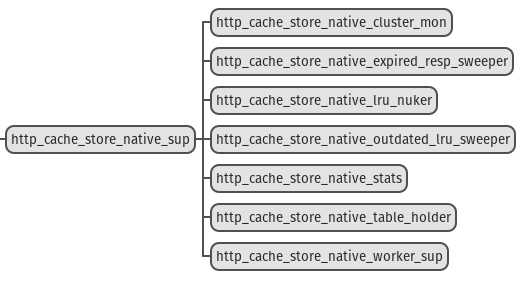
http_cache_store_memory_table_holder holds the ETS tables.
http_cache_store_memory_worker_sup is a supervisor responsible for spawning workers that
insert or update new HTTP responses into the ETS object table, invalidate entries, and process
cluster work. It is used for backpressure, as there's a maximum number of tasks that can be run at
the same time (except for invalidation requests).
http_cache_store_memory_stats collects stats about memory, emits telemetry events related to
it and provides with helper function to calculate how much allocated memory is used, depending on
the configuration.
http_cache_store_memory_cluster_mon handles communication with the other members of the cluster,
by:
- broadcasting and handling invalidation requests
- listening for new cached objects available from other members, and requesting them if they're missing locally
- sending warmup request on startup.
Then we have 3 sweeper processes:
http_cache_store_memory_expired_resp_sweeperremoves HTTP responses than can no longer be used, that is those whose grace period have expiredhttp_cache_store_memory_lru_nukerstarts nuking least recently used HTTP responses as soon as 99% of the allocated memory for caching is used. It does it more and more aggressively by first nuking 200 objects, then 400, then 800... until this threshold is no longer exceeded. It also blocks any new insert of HTTP responses as soon as the threshold exceeds 100%http_cache_store_memory_outdated_lru_sweeperis responsible for sweeping LRU entries that no longer have a corresponding HTTP response in the object table. That might happen for 2 reasons:-
a newer LRU entry was inserted since, that is the response was returned to a client and
http_cache:notify_response_used/2was called - the HTTP response was replaced with a freshest one
-
a newer LRU entry was inserted since, that is the response was returned to a client and