ExkPasswd
ExkPasswd generates strong passwords by combining cryptographically random words with optional digits, symbols, and transformations. The result is easier to remember than a random character string without hiding how its security is measured.






Try It Interactively
The Livebook notebooks are executable guides, not extra API reference pages. Start with the quick-start notebook in a browser:

- Quick Start - Generate passwords and explore the built-in presets.
- Advanced Usage - Work with case modes, padding, substitutions, and custom dictionaries.
- Security Analysis - Compare generator-aware min-entropy with the blind search-space estimate.
- Chinese and Pinyin - Load a Chinese dictionary and produce toneless ASCII Pinyin.
- Japanese and Romaji - Generate from Kana and produce keyboard-friendly Romaji.
- Benchmarks - Measure single and batch generation on your own runtime and hardware.
History & Inspiration
The word-based password idea was popularized by Randall Munroe's XKCD comic #936. It shows why a sequence of independently chosen words can be both easier to remember and harder to guess than a short password built from predictable character tricks.
XKCD #936, “Password Strength,” by Randall Munroe.
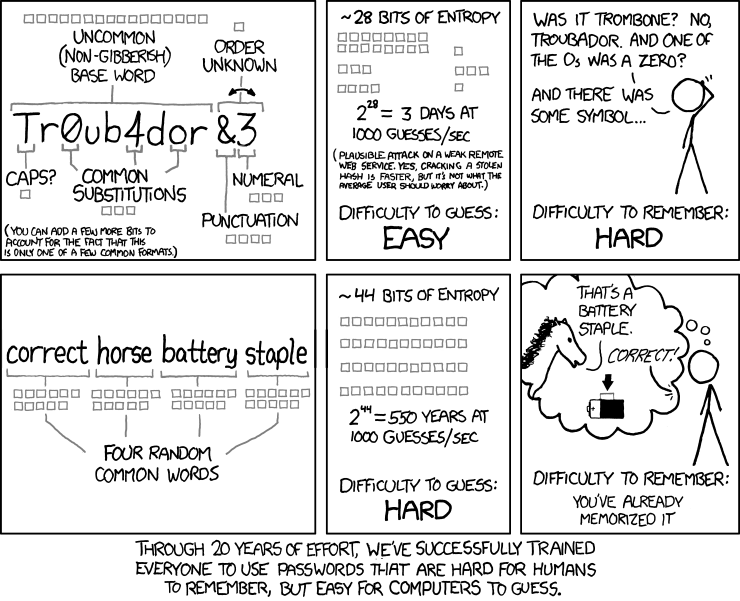
The comic inspired Bart Busschots to create Crypt::HSXKPasswd, a configurable Perl implementation of the idea. The concept was later ported to JavaScript and then to Elixir by Michael Westbay.
ExkPasswd continues that lineage with the EFF Large Wordlist, unbiased cryptographic sampling, strict configuration validation, custom dictionaries, extensible transforms, batch generation, and explicit entropy analysis.
Why Word-Based Passwords?
A short random string such as x4$9Kp2m can be difficult to remember and type.
A human-created variation is often worse because substitutions and punctuation
tend to follow familiar patterns.
A generated password such as
aviator-DANDER-REACTOR-GRATING-STARFISH has different advantages:
- Real words are easier to read, type, and remember.
- Several independent choices create a large output space.
- Length comes naturally instead of being added through repetition.
- The dictionary and generation rules can be public without making a generated password predictable.
Words are not magic. A quotation, lyric, idiom, or phrase chosen by a person is not equivalent to independently sampled words. ExkPasswd's security comes from the random process and the number of reachable outputs, not from obscurity or visual complexity.
Features
Core Features
- Cryptographically secure randomness - All password choices ultimately use
:crypto.strong_rand_bytes/1; integer ranges use rejection sampling to avoid modulo bias. - EFF Large Wordlist - Ships with 7,772 lowercase words derived from the canonical 7,776-entry list.
- Zero runtime dependencies - Uses only Elixir/Erlang and
:cryptoat runtime. - Seven built-in presets - Covers memorable defaults and common compatibility constraints.
- Strict configuration - Rejects unknown, duplicate, malformed, and unsatisfiable options before generation.
- Custom dictionaries - Supports normalized UTF-8 wordlists loaded at application startup.
Advanced Features
- Indexed word selection - Uses precomputed tuples for common EFF word ranges.
- Buffered batch generation - Reduces random-source calls for suitable workloads while preserving unbiased selection.
- Parallel generation - Splits large batches across configurable workers.
- Generator-aware entropy - Measures reachable outputs and known collisions instead of awarding generic complexity points.
- Substitutions and transforms - Includes case handling, character substitution, Pinyin, and Romaji, plus a protocol for custom transforms.
- Runtime presets - Applications can supervise a registry and compose their own named configurations.
Installation
Add exk_passwd to the dependencies in mix.exs:
def deps do
  [
    {:exk_passwd, "~> 0.3.0"}
  ]
end
Then fetch the dependency:
mix deps.get
Quick Start
Basic Usage
Every output below is random; the comments show real examples rather than fixed return values.
# Generate with the default preset
ExkPasswd.generate()
#=> "..83=cocoa=ABDOMEN=tracing=22.."

# Use a preset by atom
ExkPasswd.generate(:xkcd)
#=> "aviator-DANDER-REACTOR-GRATING-STARFISH"

# Preset names can also be strings
ExkPasswd.generate("wifi") |> String.length()
#=> 63

# Start from a preset and override selected options
ExkPasswd.generate(:xkcd, num_words: 6)
#=> "mobile-handful-EATABLE-EXIT-NUTRIENT-PUPPET"
Custom Configuration
Pass a keyword list directly:
ExkPasswd.generate(
  num_words: 4,
  word_length: 5..7,
  case_transform: :capitalize,
  separator: "-",
  digits: {2, 2},
  padding: %{char: "!", before: 1, after: 1}
)
#=> "!86-Arrive-Amnesty-Bauble-Kosher-51!"
Or construct and reuse a validated configuration:
config =
  ExkPasswd.Config.new!(
    num_words: 4,
    word_length: 5..7,
    case_transform: :capitalize,
    separator: "-",
    digits: {2, 2},
    padding: %{char: "!", before: 1, after: 1}
  )

password = ExkPasswd.generate(config)
report = ExkPasswd.Entropy.calculate(password, config)
Use ExkPasswd.Config.new/1 when invalid user input should return an error tuple
instead of raising.
Available Presets
The entropy figures are approximate seen min-entropy for the current EFF dictionary and preset definitions. They assume an attacker knows the library, dictionary, and full configuration.
:default
Three words with alternating case, two digits on each side, random separators, and symbol padding. Approximate seen entropy: 59.4 bits.
ExkPasswd.generate(:default)
#=> "..83=cocoa=ABDOMEN=tracing=22.."
:xkcd
Five words separated by hyphens with independently randomized word casing. Approximate seen entropy: 67.9 bits.
ExkPasswd.generate(:xkcd)
#=> "aviator-DANDER-REACTOR-GRATING-STARFISH"
:web32
Four short words plus digits and symbols, constructed to remain at or below 32 characters. Approximate seen entropy: 65.0 bits.
password = ExkPasswd.generate(:web32)
String.length(password) <= 32
#=> true
:web16
A compatibility fallback for systems that impose a 16-character maximum. Approximate seen entropy: 37.0 bits, so it is not a general recommendation.
password = ExkPasswd.generate(:web16)
String.length(password) <= 16
#=> true
:wifi
Generates exactly 63 printable ASCII characters for a WPA/WPA2-Personal passphrase. Approximate seen entropy: 105.2 bits.
password = ExkPasswd.generate(:wifi)
String.length(password)
#=> 63
WPA/WPA2-Personal accepts an 8–63 character ASCII passphrase. A 64-character
hexadecimal value represents a raw PSK rather than a longer passphrase. See the
wpa-psk(8) manual.
:apple_id
Generates upper- and lowercase letters, numbers, and punctuation available on standard Apple keyboards. Approximate seen entropy: 54.7 bits.
ExkPasswd.generate(:apple_id)
#=> "?32.unmixed.SPEECH.sway.73?"
The preset guarantees the documented composition properties, but Apple may still reject common or otherwise policy-blocked passwords. See Apple's account security guidance.
:security
Generates a random fake answer for a legacy security-question field. Approximate seen entropy: 77.1 bits.
ExkPasswd.generate(:security)
#=> "blip italics pawing unworthy name recliner!"
Knowledge-based authentication itself is not recommended by current NIST guidance. When a service still requires an answer, store the generated value as you would any other password.
Configuration Options
All generation settings live in ExkPasswd.Config:
ExkPasswd.Config.new!(
  num_words: 3,                # 1..10
  word_length: 4..8,           # ascending range, maximum 50
  word_length_bounds: nil,     # custom bounds for non-Latin dictionaries
  case_transform: :alternate,  # see the modes below
  separator: "-",              # one symbol or a set of possible symbols
  digits: {2, 2},              # before and after, each 0..5
  padding: %{
    char: "!@#",
    before: 1,
    after: 1,
    to_length: 0               # 0 disables minimum-length padding
  },
  substitutions: %{"a" => "@", "e" => "3"},
  substitution_mode: :none,    # :none, :always, or :random
  dictionary: :eff,
  meta: %{transforms: []},
  validators: []
)
Separators and padding characters accept punctuation and symbols, not letters or digits. A string containing several graphemes is treated as a set of possible characters.
padding.to_length is a minimum length, never a truncation rule. If the natural
password is already longer, ExkPasswd returns it intact rather than discarding
random words or digits.
Case Transformations
:none- Leave each dictionary word unchanged.:lower- Convert words to lowercase.:upper- Convert words to uppercase.:capitalize- Uppercase the first grapheme of each word.:invert- Lowercase the first grapheme and uppercase the remainder.:alternate- Alternate lower- and uppercase words.:random- Independently choose lower- or uppercase for each word.
Character Substitutions
config =
  ExkPasswd.Config.new!(
    substitutions: %{"a" => "@", "e" => "3", "o" => "0"},
    substitution_mode: :random
  )

ExkPasswd.generate(config)
#=> "__15-clone-BONSAI-m0l3cul3-22__"
Random substitution receives entropy credit only when original and substituted outputs are distinct. Deterministic substitution can reduce the output space when multiple source words collapse to the same result; the entropy model accounts for those collisions.
Security
Cryptographic Randomness
All password choices ultimately use :crypto.strong_rand_bytes/1. Integer
ranges, including buffered batch generation, use rejection sampling so
non-power-of-two ranges remain uniform.
ExkPasswd never uses :rand, Enum.random/1, timestamps, process identifiers,
or a caller-provided seed for password material. This does not protect a system
whose operating system, runtime, or hardware random source is compromised.
Dictionary & Security Model
The bundled dictionary contains 7,772 lowercase ASCII words derived from the EFF
Large Wordlist. Four hyphenated entries are omitted so - can serve as an
unambiguous separator. Selecting from the full bundled list would provide about
12.92 bits per word, but length filters and transforms can change the effective
pool.
The security assumptions are deliberately public: an attacker may know the library, dictionary, preset, and every configuration option. Only the random choices are secret.
For provenance, checksums, and the exact threat model, see
docs/SECURITY.md.
Understanding Entropy Reports
ExkPasswd reports two different quantities:
seenis conservative min-entropy over the configured generator's reachable outputs. It accounts for dictionary filters and known collisions from case conversion, substitutions, Pinyin, and Romaji.blindis a character-class search-space heuristic for the observed string. It is useful as a comparison, but it is not measured entropy and should not be used to assess a human-chosen password.
The weak, fair, good, and excellent ratings are project-defined
presentation bands, not NIST or OWASP standards. Crack-time strings use a simple
one-billion-guesses-per-second comparison model; actual rates depend on online
throttling, MFA, password hashing, hardware, and breach conditions.
What ExkPasswd Does Not Solve
This library generates passwords. It does not store or hash them, check breach blocklists, prevent phishing or keylogging, provide rate limiting or MFA, or detect whether a destination silently normalizes or truncates input.
Use a password manager when possible, enable MFA for important accounts, and test the exact destination field before relying on whitespace, Unicode, or uncommon punctuation.
Current verifier guidance emphasizes length, blocklists, rate limiting, and support for long passphrases:
API Reference
The complete API documentation lives on HexDocs. These are the main entry points.
Password Generation
ExkPasswd.generate/0
Generates one password with the :default preset:
password = ExkPasswd.generate()
is_binary(password)
#=> true
ExkPasswd.generate/1
Accepts a preset atom, preset string, keyword options, or a validated config:
ExkPasswd.generate(:xkcd)
ExkPasswd.generate("xkcd")
ExkPasswd.generate(num_words: 4, separator: "-")

config = ExkPasswd.Config.new!(num_words: 4, separator: "-")
ExkPasswd.generate(config)
ExkPasswd.generate/2
Starts with a built-in or runtime preset and applies validated overrides:
ExkPasswd.generate(:xkcd, num_words: 6, case_transform: :lower)
Configuration
new/1 returns a tagged tuple for expected input errors:
{:ok, config} = ExkPasswd.Config.new(num_words: 4)

{:error, reason} = ExkPasswd.Config.new(num_words: 0)
String.contains?(reason, "num_words")
#=> true
new!/1 returns the config or raises ArgumentError:
config = ExkPasswd.Config.new!(num_words: 4)
Constructors reject unknown and duplicate options. Public generation functions
also validate %ExkPasswd.Config{} values assembled directly by callers.
Presets
Built-in presets work without starting a process:
ExkPasswd.Config.Presets.get(:xkcd)
ExkPasswd.Config.Presets.get("wifi")
ExkPasswd.Config.Presets.list()
Runtime registration requires the preset registry in your supervision tree:
children = [
  {ExkPasswd.Config.Presets, []}
]
You can register a complete config or compose from an existing preset:
ExkPasswd.Config.Presets.register(
  :six_words,
  :xkcd,
  num_words: 6,
  case_transform: :lower
)

ExkPasswd.generate(:six_words)
Batch Generation
config = ExkPasswd.Config.Presets.get(:default)

# Buffered generation
ExkPasswd.Batch.generate_batch(100, config)

# Enforce uniqueness with a bounded retry budget
ExkPasswd.Batch.generate_unique_batch(
  100,
  config,
  max_attempts: 10_000
)

# Split a large batch across worker processes
ExkPasswd.Batch.generate_parallel(10_000, config, workers: 4)
Buffering is not guaranteed to be faster for every workload. Batch size,
runtime version, and hardware all matter, so use the included benchmarks on the
target system. Unique generation raises if it cannot produce the requested
number of distinct values within max_attempts.
Entropy & Strength
config = ExkPasswd.Config.Presets.get(:xkcd)
password = ExkPasswd.generate(config)

entropy = ExkPasswd.Entropy.calculate(password, config)
Float.round(entropy.seen, 1)
#=> 67.9

strength = ExkPasswd.Strength.analyze(password, config)
Map.keys(strength) |> Enum.sort()
#=> [:entropy_bits, :rating, :score]

ExkPasswd.Strength.rating(password, config)
#=> :good
Top-level delegates are also available as ExkPasswd.calculate_entropy/2,
ExkPasswd.analyze_strength/2, and ExkPasswd.strength_rating/2.
Custom Dictionaries
words = ["casa", "perro", "gato", "libro", "nube"]
ExkPasswd.Dictionary.load_custom(:spanish, words)

config =
  ExkPasswd.Config.new!(
    dictionary: :spanish,
    word_length: 4..5,
    num_words: 4,
    case_transform: :lower,
    separator: "-",
    digits: {0, 0},
    padding: %{char: "", before: 0, after: 0, to_length: 0}
  )

ExkPasswd.generate(config)
#=> "gato-casa-nube-libro"
Custom words must be non-empty valid UTF-8 strings. They are normalized to NFC, and duplicates after normalization are rejected. Case-output duplicates are stored once so selection remains uniform over reachable outputs.
Custom dictionaries live in :persistent_term. Load them during application
startup rather than in a request path because writes trigger a global
garbage-collection scan. The application remains responsible for dictionary
quality, size, memorability, and content.
Transform Protocol
Simple substitutions belong directly in the config. More involved
transformations implement ExkPasswd.Transform and go in
config.meta.transforms.
The bundled Romaji transform can make a Kana dictionary typeable on an ASCII keyboard:
ExkPasswd.Dictionary.load_custom(
  :japanese,
  ["さくら", "やま", "うみ", "そら"]
)

config =
  ExkPasswd.Config.new!(
    dictionary: :japanese,
    word_length: 2..6,
    word_length_bounds: 1..10,
    num_words: 3,
    case_transform: :none,
    separator: "-",
    digits: {0, 0},
    padding: %{char: "", before: 0, after: 0, to_length: 0},
    meta: %{transforms: [%ExkPasswd.Transform.Romaji{}]}
  )

ExkPasswd.generate(config)
#=> "sakura-sora-umi"
Pinyin and Romaji are deterministic and can be many-to-one. Unmapped characters pass through unchanged. Validate every custom language dictionary if the destination requires ASCII; the seen-entropy model counts the reachable transformed outputs rather than assuming every source word stays distinct.
Development
Quick Reference
# Setup
mix setup

# Complete required quality gate
mix check

# Useful focused commands while iterating
mix format
mix credo --strict
mix test
mix coveralls.html
mix dialyzer
mix doctor
mix docs
mix deps.audit
Benchmarks
mix bench.password
mix bench.dict
mix bench.batch
mix bench.all
The checked-in benchmark reports are measurements from one recorded environment, not API guarantees. Re-run the suites on the deployment runtime and hardware before drawing performance conclusions.
Interactive Contributor Guide
The contributor notebook is intentionally separate from the user tutorials:
It provides an executable architecture tour. The terminal quality gates remain the source of truth for contributions.
Contributing
Read CONTRIBUTING.md before opening a pull request. Keep security-sensitive changes small, document public APIs, and include tests for success, failure, and relevant edge cases.
Commit messages follow Conventional Commits:
feat: add a new preset
fix(random): reject biased buffered samples
docs: clarify the entropy model
Releasing
Releases are managed with git_ops:
- Run the complete project checks with
mix check. - Run
mix releaseto update the changelog and version, commit, and tag. - Push the release commit and tag with
git push --follow-tags.
The publish workflow verifies the exact project-version tag and tagged commit,
runs the same mix check gate, and exposes the Hex API key only to the final
publish step.
Resources
- Hex package
- HexDocs
- Security model
- Livebook setup
- Changelog
- Issue tracker
- Original Perl module
- EFF random-passphrase wordlists
- XKCD comic #936
Acknowledgments
- Randall Munroe for the comic that made the core idea memorable.
- Bart Busschots for the original Crypt::HSXKPasswd implementation.
- Michael Westbay for bringing the project to Elixir.
- The Electronic Frontier Foundation for its random-passphrase wordlists.
License
ExkPasswd is available under the BSD 2-Clause License. See LICENSE.md.