

Clean Mixer
Tools for code architecture analysis and validation. Heavily inspired by Bob Martin's Clean Architecture and to some extent ArchUnit library.
Usage
Add clean_mixer to your list of dependencies in mix.exs:
def deps do
  [{:clean_mixer, "~> 0.2", only: [:dev, :test], runtime: false}]
end
To generate plantuml diagrams you need to have graphviz (https://graphviz.gitlab.io/) and jre installed.
Configure components of your codebase in .clean_mixer.exs
[
  components: [
    {"some-component", "lib/clean_mixer/path-to-files-of-some-component"},
    {"some-component/sub-component", "lib/clean_mixer/path-to-files-of-some-component/sub-component"},
    {"some-umbrella-app-component", "apps/some-app/lib/some-app/path-to-files-of-some-component"},
    {"some-grouped-component", "lib/clean_mixer/path-to-files-of-some-grouped-component", group:
  "core_domain"},
  ]
]
Each component is just an arbitrary folder with code and name. You can model components as umbrella apps or just subfolders of lib directory.
Note that components can be nested in each other, although architecturally it is not recommended and in some cases might yield confusing results.
Components can have optional arbitrary tags. But the only currently used tag is :group which is used to optionally group components in plantuml diagram.
Visualization and analysis
cd clean_mixer
mix clean_mixer.plantuml -v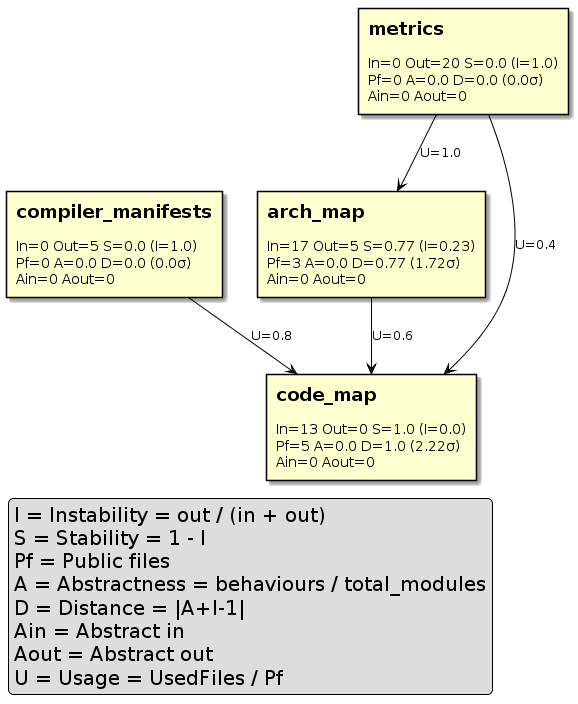
Render component dependencies in plantuml:
mix clean_mixer.plantuml

mix clean_mixer.plantuml --help

# you can hide some components from diagramm
mix clean_mixer.plantuml --except="some-component,other-component"

# render metrics of links beween components
mix clean_mixer.plantuml -v

# you can group components by :group tag
mix clean_mixer.plantuml --group
Metrics provided:
For in depth description of metrics (in, out, I, A, D) and principles please refer to Bob Martin's Clean Architecture book (Chapter 14).
- in = number of incoming dependencies on current component files
- out = number of outgoing dependencies on other components files
- I = instability = out / (in + out)
- A = files_with_behaviours / total_files
- D = Distance = |A + I - 1| (Distance from the Main Sequence)
- Tf = total files = total number of files of current component
- Pf = public files = number of files of current component used by others
- Ain = Abstract in = number of incoming dependencies on current component behaviours
- Aout = Abstract in = number of dependencies on other components behaviours
- U = Usage = percent of current component files that are public (used by others)
Component links are coloured red on a diagramm if the Stable Dependencies Principle (Depend in the direction of stability) is violated.
List all project components and their dependencies:
mix clean_mixer.list

mix clean_mixer.list --help

# you can filter list by source and target components
mix clean_mixer.list --sources="some/component" --targets="other/component"

# you can use wildcard
mix clean_mixer.list --sources="*some-pattern*"

# you can filter by several components
mix clean_mixer.list --sources="some-component,other-component"

# you can filter list by source and target dependencies between files
mix clean_mixer.list --file-sources="*/file1.ex" --file-targets="*/file2.ex"
List all project component usages:
# show components public files
mix clean_mixer.list_usages

# show components public files and who uses them
mix clean_mixer.list_usages -v
List cycles in component dependencies:
mix clean_mixer.component_cyclesList cycles in all files:
mix clean_mixer.file_cyclesValidation
You can use clean_mixer internal api to make some basic assertions about projects architecture:
ExUnit.start(capture_log: true, trace: true)

defmodule ArchTest do
  use ExUnit.Case

  alias CleanMixer.Workspace

  setup_all do
    workspace = CleanMixer.workspace()
    %{ws: workspace}
  end

  test "there are shall be no cyclical dependencies between components", %{ws: ws} do
    assert Workspace.component_cycles(ws) == []
  end

  @adapters [
    "http-api",
    "kafka-downstream"
  ]

  for adapter <- @adapters do
    test "domain shall not depend on adapter #{adapter}", %{ws: ws} do
      refute Workspace.dependency?(ws, "app-domain", unquote(adapter))
    end
  end

  test "`utils` shall have no dependencies", %{ws: ws} do
    assert Workspace.dependencies_of(ws, "utils") == []
  end

end
Run tests:
mix run --no-start test/arch_test.exs