
Typed, supervised dataflow on the BEAM.
You describe a graph of processing stages as TOML; bloccs type-checks the wiring, enforces what each stage is allowed to do, and compiles it to a Broadway/GenStage supervision tree.
⚠️ Experimental — v0.1, pre-release. bloccs is early and moving fast: the public API and the manifest format may change between releases, it isn't on Hex yet, and it isn't durable (put Oban or a broker at the edges for work that must survive restarts). Great for exploring and prototyping — pin a version and check the CHANGELOG before you upgrade.
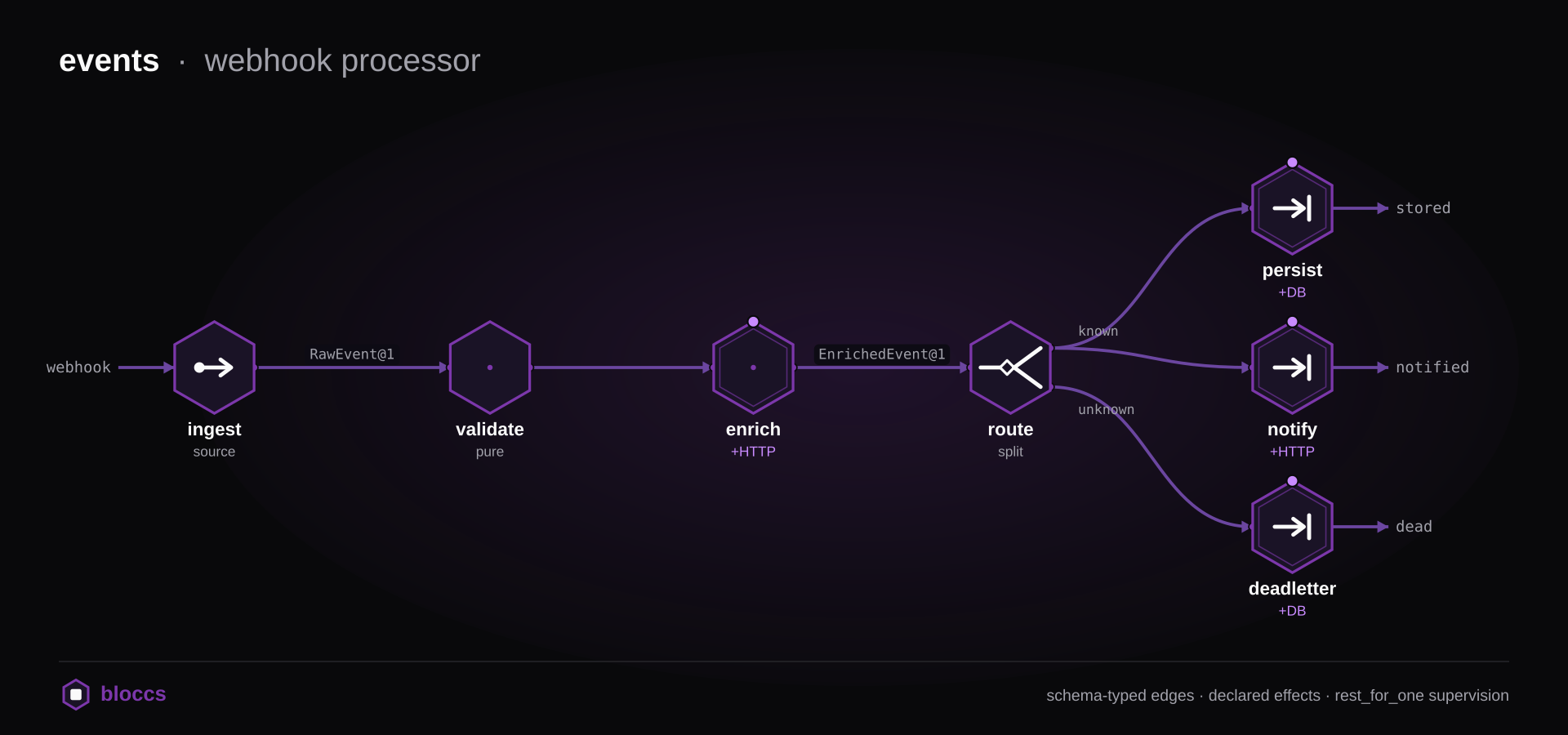
Why bloccs?
Plenty of backend work is a graph of stages: ingest → validate → enrich → branch → persist/notify. On the BEAM you'd build that today by hand-wiring a few Broadway pipelines and a supervisor. That works, but nothing checks it:
- the connections between stages are untyped — stage A emits a map, stage B expects a different shape, and you find out in production;
- the side effects are unconstrained — any stage can call any host or table;
nothing says
enrichis only allowed toGETthe enrichment service; - retry / timeout / idempotency / back-pressure get re-implemented, slightly differently, in every pipeline;
- the topology lives in your head (and a supervisor module), not in a reviewable artifact;
- and once an LLM is writing the pipelines, you're auditing sprawling generated glue line by line — the shape of the system buried in code, with a wrong wiring or an unscoped side effect easy to miss in the diff.
bloccs makes the graph a declared, checked thing. You write the topology and the
per-stage contracts as TOML; bloccs rejects a graph whose edges don't type-match
before it runs, refuses an effect a node didn't declare, and generates the
Broadway supervision tree — as real, debuggable .ex source — with the retry /
timeout / idempotency / back-pressure already wired in. The artifact you review
is the manifest, not the generated glue — which is what keeps a human in control
when an LLM is doing the typing (see Legible to humans and
LLMs).
Why not just write Elixir, or use Broadway directly? You can — and for a single pipeline you should (see How it compares). bloccs earns its keep once you have a graph and want the edges (schemas), the effects (capabilities), and the per-node policy declared and machine-checked rather than maintained by hand. The next section shows the two checks that aren't possible with plain Broadway.
Install
def deps do
  [{:bloccs, "~> 0.1"}]
end
bloccs is not on Hex yet (see Status); until the first release, depend
on it from git: {:bloccs, github: "Bloccs/bloccs"}. The effect adapters are
bring-your-own and opt-in — add {:req, "~> 0.5"} for the real HTTP backend and
point the DB backend at your Ecto repo only if you use them (see
guides/effect-adapters.md).
Quickstart
With the dep in place, the loop is validate → compile → run over a network
manifest. Point the tasks at a .bloccs network — write one (see
guides/concepts.md and the manifest
reference) or copy networks/ + nodes/ from
examples/tour:
mix bloccs.validate networks/hello.bloccs
mix bloccs.compile  networks/hello.bloccs
mix bloccs.run      networks/hello.bloccs --message '{"name": "ada"}'
mix bloccs.compile emits real, debuggable .ex source under
_build/<env>/bloccs_generated/<network>/ — diff it in a PR. For a step-by-step
walkthrough that writes a node by hand, see
guides/getting-started.md.
Start a new project from scratch
To begin from a runnable example instead, install the bloccs.new generator as a
Mix archive and scaffold a project — it wires the dep, a sample node and its
schemas, and a one-node network:
mix archive.install hex bloccs   # makes `mix bloccs.new` available
mix bloccs.new my_flow
cd my_flow
mix deps.get
mix bloccs.run networks/hello.bloccs --message '{"name": "ada"}'
Typed edges and scoped effects
This is the part you can't get from hand-wired Elixir. Both examples below are
real output from the tour example (examples/tour).
1. Mismatched edges are rejected at validation time.examples/tour/networks/pipeline_mismatch.bloccs wires an out-port carrying
WordRequest@1 into an in-port that expects Definition@1. Validate it:
$ cd examples/tour
$ mix bloccs.validate networks/pipeline_mismatch.bloccs
✗ networks/pipeline_mismatch.bloccs
  - [[edges]] (networks/pipeline_mismatch.bloccs): edge accept.word → define.word
    schema mismatch: accept.word=WordRequest@1 but define.word=Definition@1
The network never starts. Plain Broadway has no contract between pipelines —
this mismatch would surface as a FunctionClauseError (or worse, silently wrong
data) at 3am.
2. Undeclared side effects are refused. A node may only touch the world
through effects it declared in [effects]. define declares HTTP to exactly
one host:
[effects]
http = { allow = ["dictionary.local"], methods = ["GET"] }
Call anything else and the capability struct refuses it at runtime:
# a host the node didn't allow:
bloccs effect denied: :http — host of http://evil.example/leak
                              not in declared allowlist ["dictionary.local"]

# an effect axis the node never declared at all:
bloccs effect denied: :http — axis not declared
And use Bloccs.Node warns you at compile time the moment the effect shell
reaches for an undeclared axis:
warning: bloccs: effect :http used in effect_shell but not declared in
         [effects]. Declared: [].
Typed edges and capability-scoped effects are the two guarantees that make a bloccs graph safer than the same graph hand-wired.
The manifests
Two kinds of TOML manifest:
- Node manifests (
.bloccs, one node per file) — the node's input/output ports with versioned schemas, the effects it's allowed to perform (HTTP / DB / Time / Random), the pure-core and effect-shell function refs, and retry / timeout / idempotency / buffer policy. - Network manifests — topology: which nodes wire to which, supervision structure, concurrency per node, and which ports are exposed.
# nodes/enrich.bloccs
[node]
id = "enrich"
version = "0.1.0"
kind = "transform"

[ports.in]
valid = { schema = "RawEvent@1" }

[ports.out]
enriched = { schema = "EnrichedEvent@1" }

[effects]
http = { allow = ["enrichment.local"], methods = ["GET"] }

[contract]
pure_core    = "MyApp.Nodes.Enrich.transform/2"
effect_shell = "MyApp.Nodes.Enrich.execute/2"
retry        = { strategy = "exponential", max = 2, on = ["timeout"], base_ms = 50 }
timeout_ms   = 3000
idempotency  = { key = "id" }
Each node's implementation is split in two: a pure core (no IO, no clock, no randomness — easy to test, deterministic) and an effect shell that touches the world, and only through declared effects.
How it works
What the compiler emits from those manifests, and how each node behaves once it's running.
Flow primitives
A node's behavior is its ports + contract, not a fixed "type". From those, the common dataflow shapes fall out — most are just what the effect shell returns, the rest a small manifest block:
| primitive | how |
|---|---|
| transform | pure_core computes; shell emits one message |
| filter | shell returns :drop — consume, emit nothing |
| split / fan-out | shell returns {:emit, [{port, payload}, …]}, or one out-port wired to many in-ports |
| route / branch | a router shell picks which out-port to emit on |
| merge (fan-in) | several edges into one in-port |
| aggregate / window | [batch] — pure_core reduces the batch (count or time window) |
| join | [join] — correlate two+ typed in-ports by a key |
| throttle / delay | [rate] / [delay] |
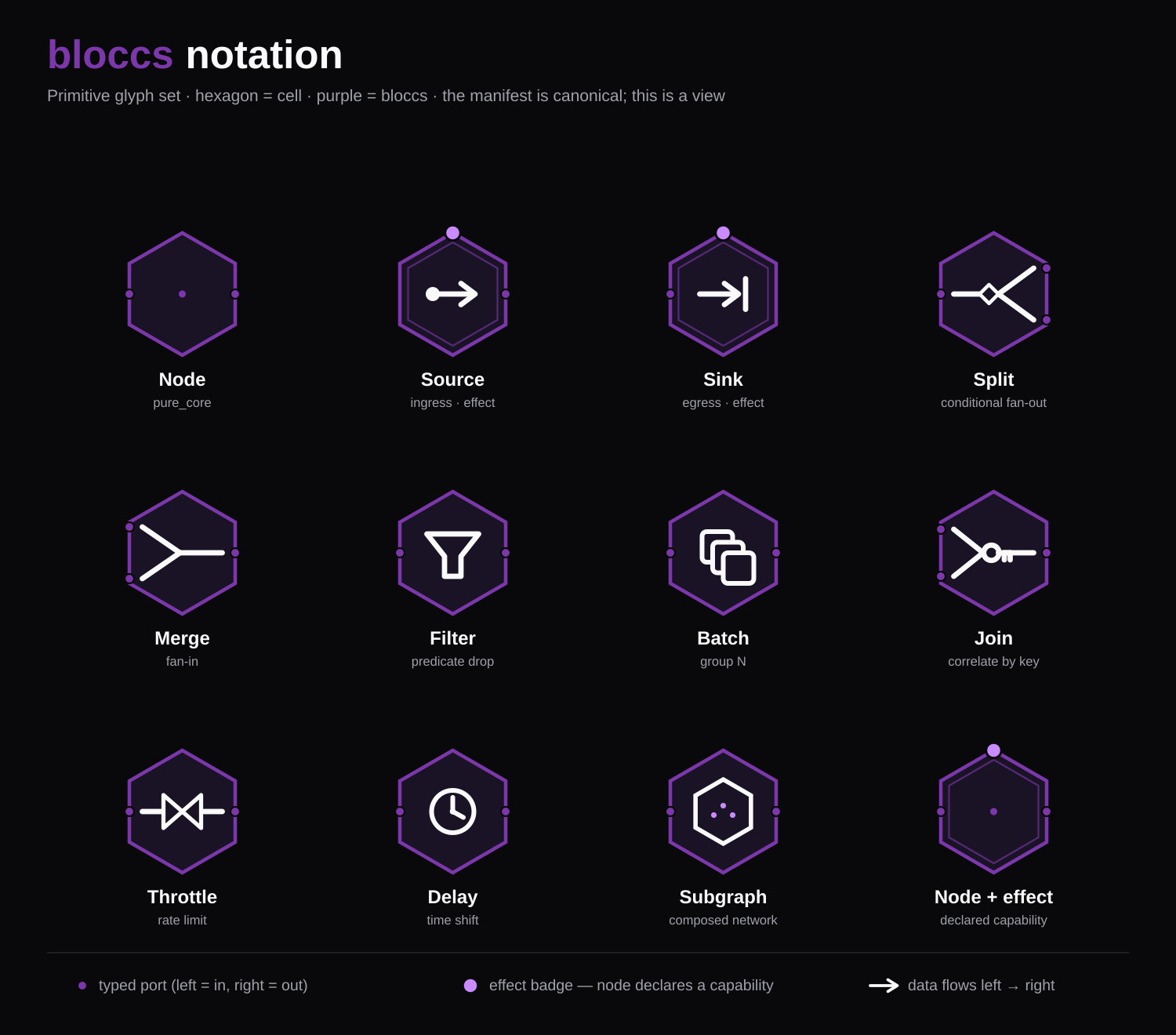
Conditional logic lives in node code (a returned port, a :drop), never in edge
predicates — which keeps the topology declarative and machine-checkable. The
primitives reference catalogues each one (glyph, what it
does, how to declare it); see also guides/concepts.md and
the manifest reference.
The generated runtime
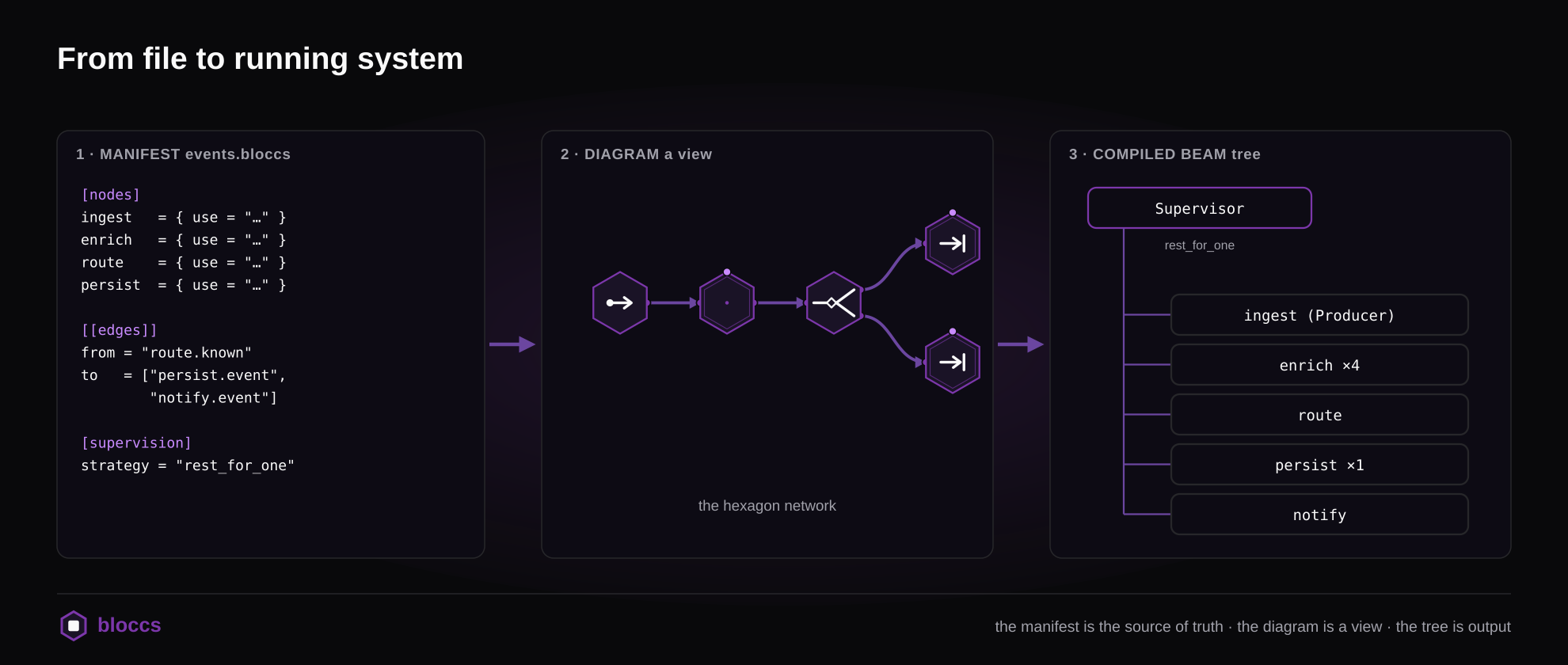
mix bloccs.compile reads the manifests and emits a Broadway-based supervision
tree — one stage per node, a router for edges, a producer for each inbound port.
Every declared contract is wired into that runtime, not just parsed:
- Retry — backed-off re-enqueue (constant / linear / exponential), matched against the failure reason; permanent failures (schema mismatch, capability denial) are never retried.
- Timeout —
timeout_msruns the node in a bounded task; overrun fails the message with:timeout(retriable). - Idempotency — reserves the key in-flight (atomic), so concurrent first-deliveries can't both run; released on terminal failure.
- Back-pressure — a bounded
bufferparks the producer's caller until a consumer drains, instead of dropping. - Observability —
:telemetry.span([:bloccs, :node], …)plus:emit,:retry,:skipped, and:dispatch_errorevents (seeBloccs.Telemetry). A failed downstream delivery is surfaced (telemetry + a failed message), never silently dropped. - Subgraph composition — a
[nodes]entry mayusea network manifest; the parser flattens it into namespaced leaf nodes at parse time.
Effects: mock by default, real adapters opt-in
Nodes call a backend-agnostic facade (Bloccs.Effects.HTTP.post/3,
DB.insert/3, …). The mock backends are the default (tests stay hermetic); the
real ones are selected purely in config, with no node changes:
config :bloccs, :effect_backends,
  http: Bloccs.Effects.HTTP.Req,    # real HTTP via Req (add :req to your deps)
  db:   Bloccs.Effects.DB.Ecto      # real SQL via your Ecto repo

config :bloccs, Bloccs.Effects.DB.Ecto, repo: MyApp.Repo, returning: [:id]
bloccs forces neither req nor Ecto on you — both are bring-your-own. Write
your own backend by implementing the Bloccs.Effects.HTTP / DB behaviour. See
guides/effect-adapters.md. A runnable example
hitting real HTTP + SQLite (zero external services) lives in
examples/real_backend.
CLI (Mix tasks)
mix bloccs.new <name>— scaffold a new projectmix bloccs.validate <file>— schema / contract / DAG checks on a node or networkmix bloccs.compile <network>— emit the Broadway supervision treemix bloccs.run <network> --message <json> [--trace <out>]— start the tree, feed a message, optionally record a.bloccs-tracemix bloccs.coverage <network> [--message <json> | --trace <file>]— real structural coverage (every in-port, out-port, and edge) from a recorded run
Legible to humans and LLMs
A bloccs network is a small declarative artifact: the topology is a TOML file, and each node is a manifest plus two functions (a pure core and an effect shell). The thing you review stays small even when an assistant writes most of the implementation.
- You review the graph, not the glue. A change to the flow is a diff to a
.bloccsfile — which ports moved, which edge appeared — not a re-read of regenerated supervisor and pipeline code. The generated.exis there to inspect when you want it, but the manifest is what you read. - A change's blast radius is one node. Each node is a bounded unit: a
manifest, a
pure_core, an effect shell. An assistant can add or alter a node without reaching into the rest of the tree. - The boundaries are machine-checked, so you don't have to take the code's word for it. A mis-wired edge is rejected at validation time; an undeclared host or table is refused. An LLM can move fast and still cannot connect mismatched stages or smuggle in an unscoped side effect — the compiler stops it before it runs.
So you can hand the repetitive parts to an assistant and stay in control of the shape of the system, instead of drowning in generated code you have to audit line by line.
Examples
A graded ladder under examples/ — see examples/README.md:
examples/tour— core concepts one rung at a time (mix tour.hello·mix tour.pipeline·mix tour.branching), mock effects, zero setup.examples/events— the flagship: a webhook/event processor showing typed edges, HTTP + DB effects, retry, timeout, idempotency, branching, fan-out, and coverage (theevents.demotask).examples/real_backend— the same shape against real HTTP (Req) + SQLite (Ecto) (mix price_watch.demo).
How it compares
bloccs generates Broadway — it isn't a competitor to it. Reach for Broadway
directly when you have a single pipeline; reach for bloccs when you have a graph
of typed stages and want the edges (schemas), effects (capabilities), and
per-node policy (retry / timeout / idempotency / back-pressure) declared and
checked, with the topology as a reviewable artifact. It is not durable — for
work that must survive restarts, put Oban or a broker at the edges. Full
comparison against Broadway, Oban, Reactor, Temporal, LangGraph, and plain
GenServers: guides/comparison.md.
Prior art
Flow-based programming on the BEAM isn't new. Anton Mishchuk's lineage — Flowex → ALF → Strom / Kraken — spent years establishing that the actor model and GenStage make the BEAM a natural home for FBP, and Kraken reached the same "graph-as-data + declarative adapters" idea bloccs builds on. bloccs owes that groundwork.
The difference is the guarantees, not the shape:
- Compile-time contracts. Edges are schema-checked and effects are capability-checked before the network runs; that lineage validates (or trusts) at runtime.
- Reviewable output. bloccs emits the Broadway supervision tree as real
.exsource you can read and diff. ALF interprets a runtime DSL; Kraken compiles JSON to modules at runtime. A bloccs network is something you cangit diff. - A settled substrate. bloccs commits to Broadway; the lineage moved between GenStage and plain streams.
What bloccs is not: a runtime DSL (the manifest is compiled ahead of time, not interpreted), a data-ingestion pipeline (that's Broadway — which bloccs generates), a visual builder (the file is canonical; a canvas is a view), or durable (put Oban or a broker at the edges for work that must survive restarts).
Status
v0.1 — pre-release. Not yet on Hex; APIs may change before the first release. The full parse → validate → compile → run loop works end to end, and everything the manifests can declare is honored at runtime:
- the flow primitives — transform, filter, split / fan-out, route, merge, batch / window, join, throttle, delay (see Flow primitives);
- per-node contracts — retry, timeout, idempotency, bounded-buffer
back-pressure, and
:telemetryspans, wired into the generated tree; - scoped effects with real HTTP / DB adapters behind a config switch;
- subgraph composition (
usea network as a node); - trace + real structural coverage (
mix bloccs.coverage).
See guides/ARCHITECTURE.md for the compile pipeline.
The deferred items are listed under Out of scope.
A note on the name. In the design docs you'll see bloccs called an IR for Agentic Computation Graphs (ACGs) — the north star is typed, supervised graphs with LLM/tool nodes as first-class stages. Today the engine is the general-purpose, agent-agnostic core: typed dataflow on the BEAM. The "agentic" layer is a roadmap direction, not a v0.1 claim — every example here is ordinary backend dataflow.
Out of scope for v0.1
Phoenix LiveView canvas (v0.3+) · MCP server (v0.2) · Pro / encrypted packages
(private repo, post-v0.1) · polyglot pure_core · cyclic networks (DAG-only;
feedback loops are a deadlock-safety design still on the roadmap) · escript-packaged
binary · full Dialyzer-level static effect proof · durable persistence.
License
MIT. Pro extensions ship later in a separate private repo (modeled on Oban Pro).