BeamWeaver

Elixir-native LangChain, LangGraph, and Deep Agents for traceable LLM apps: OTP workflows, tools, memory, human-in-the-loop, streaming, custom clients/adapters, minimal deps, and WeaveScope tracing.
BeamWeaver brings the practical parts of LangChain, LangGraph, and Deep Agents to the BEAM without a Python runtime, hosted control plane, or framework lock-in. Agents, tools, graph workflows, subagents, memory, persistence, retrieval, structured output, streaming, and tracing are native Elixir modules built around OTP supervision, explicit adapters, tagged errors, telemetry, and Ecto/ETS storage boundaries.
It is not a Python wrapper. It is an Elixir library designed for applications that already rely on OTP, supervision trees, Ecto, telemetry, and explicit runtime boundaries.
BeamWeaver is not affiliated with LangChain.
Documentation: weavescope.gitbook.io/beam_weaver
Why Switch To BeamWeaver
- Elixir-native runtime: build agents and workflows inside your existing OTP supervision tree instead of running a separate Python service.
- One system for agents and graphs: use the agent DSL for common model/tool loops, or drop to graph workflows for deterministic branching, fan-out, interrupts, time travel, and durable execution.
- Traceability from day one: local traces, typed event streams, token and cost metadata, redaction, and native queued export to WeaveScope.
- Bring your own boundaries: use built-in provider adapters or plug in your own clients, transports, models, tools, filesystems, stores, and sandboxes.
- Production state: checkpoints, memory, caches, record managers, vector stores, and replay transports with ETS and Ecto-backed adapters.
- Small dependency surface: no app framework requirement, no Python sidecar, and no hidden hosted runtime.
What You Can Build
- Customer support agents with tools, structured output, memory, and traceable model calls.
- Durable multi-step workflows with graph state, checkpoints, retries, interrupts, time travel, and resumable execution.
- Deep research and analysis agents with subagents, planning, virtual filesystems, skills, summarization, and sandboxed tool execution.
- Retrieval pipelines with document loading, splitting, embeddings, vector stores, record managers, and incremental indexing.
- Production LLM services with provider fallback, rate limits, redaction, telemetry, event streams, and WeaveScope tracing.
Native WeaveScope Tracing
BeamWeaver traces agents, graphs, model calls, tool calls, subagents, retries, token usage, costs, errors, custom fields, and run trees. Use it locally during development, or configure WeaveScope export when you want production traces your team can inspect.
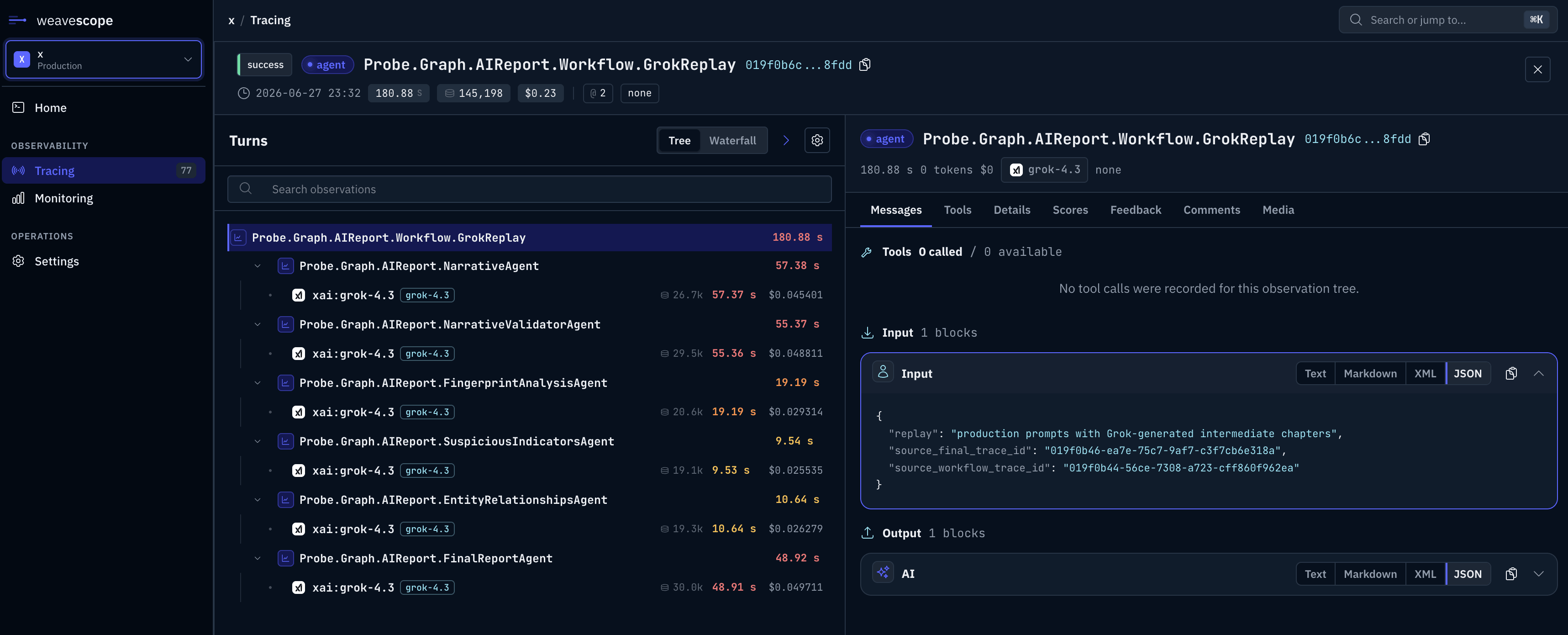
Configure WeaveScope once:
config :beam_weaver,
  weave_scope: [
    endpoint: "https://app.weavescope.com",
    api_key: System.fetch_env!("WEAVESCOPE_API_KEY")
  ]
Then attach trace identity and custom fields at call sites. Put IDs and
dimensions you want to filter by in fields; keep extra, non-indexed context in
metadata.
def run_report(report, user) do
  input = %{
    topic: report.topic,
    sources: report.source_urls,
    audience: report.audience
  }

  MyApp.Agents.ReportAgent.invoke(input,
    trace: [
      name: "report.workflow",
      user_id: user.id,
      thread_id: report.id,
      execution_mode: "production",
      fields: %{
        account_id: user.account_id,
        project_id: report.project_id,
        report_id: report.id,
        plan: user.plan,
        source_count: length(input.sources)
      },
      metadata: %{trigger: "scheduled_report"}
    ]
  )
end
Core Capabilities
| Capability | What BeamWeaver Provides |
|---|---|
| Agents | Module-defined agents and runtime-built agents with tools, middleware, structured output, memory, and HITL interrupts. |
| Graph workflows | LangGraph-style state graphs with reducers, commands, subgraphs, checkpoints, pending writes, and durable execution. |
| Deep agents | Planning tools, TODO state, virtual filesystems, skills, subagents, async subagents, context engineering, and summarization. |
| Models | Provider adapters, model profiles, parameter validation, prompt caching, streaming, structured output, token usage, and cost metadata. |
| Tools | Typed tools, injected runtime arguments, tool nodes, tool middleware, shell/filesystem tools, and tool-call tracing. |
| Retrieval | Document loaders, text splitters, embeddings, vector stores, retrievers, record managers, and indexing flows. |
| Persistence | ETS and Ecto-backed memory, checkpoints, caches, record managers, and vector stores. |
| Observability | Local run trees, typed event streams, telemetry, redaction, and native WeaveScope export. |
Supported Providers And Models
BeamWeaver ships checked-in model profiles for current provider families and permissive fallback profiles for future compatible IDs. Use explicit provider prefixes when a model name is ambiguous.
| Provider | Supported examples |
|---|---|
| OpenAI | openai:gpt-5.5, openai:gpt-5.5-pro, openai:gpt-5.4, openai:gpt-5.4-mini, openai:gpt-5, openai:gpt-4.1, openai:text-embedding-3-large, openai:text-embedding-3-small |
| Anthropic | anthropic:claude-opus-4-8, anthropic:claude-opus-4-7, anthropic:claude-opus-4-6, anthropic:claude-opus-4-5, anthropic:claude-sonnet-4-6, anthropic:claude-sonnet-4-5, anthropic:claude-haiku-4-5, anthropic:claude-fable-5, anthropic:claude-mythos-5 |
| Google Gemini | google:gemini-3.5-flash, google:gemini-3.1-pro-preview |
| Moonshot/Kimi | moonshot:kimi-k2.7-code, moonshot:kimi-k2.7-code-highspeed, moonshot:kimi-k2.6, moonshot:kimi-k2.5 |
| xAI | xai:grok-4.3, xai:grok-4.20-0309-reasoning, xai:grok-4.20-0309-non-reasoning, xai:grok-4.20-multi-agent-0309, xai:grok-build-0.1, xai:v1 embeddings |
| Z.ai | zai:glm-5.2 |
| Test models | Fake chat and embedding models, plus replay transports for deterministic provider tests. |
Inspect the exact profile set in your checkout:
mix beam_weaver.models.profiles
Install
Add BeamWeaver to your application:
def deps do
  [
    {:beam_weaver, "~> 0.1.6"}
  ]
end
Configure only the providers you use:
config :beam_weaver,
  openai: [api_key: System.fetch_env!("OPENAI_API_KEY")],
  anthropic: [api_key: System.fetch_env!("ANTHROPIC_API_KEY")],
  google: [api_key: System.fetch_env!("GOOGLE_API_KEY")],
  xai: [api_key: System.fetch_env!("XAI_API_KEY")],
  moonshot: [api_key: System.fetch_env!("MOONSHOT_API_KEY")],
  zai: [api_key: System.fetch_env!("ZAI_API_KEY")]
Quickstart
Start with the module DSL for application code. The DSL keeps the agent's model, prompt, tools, middleware, memory, and harness-style capabilities in one module, so a reader can see what the agent does without chasing a runtime options map. It also makes the common path much easier: adding planning, prompt caching, conversation compaction, overflow recovery, filesystems, or subagents is a declaration instead of custom orchestration code.
defmodule MyApp.Agents.SupportAgent do
  use BeamWeaver.Agent

  alias BeamWeaver.Agent.Middleware
  alias BeamWeaver.Core.Message

  name "support.reply"
  description "Answer customer support questions with account context."

  model "openai:gpt-5.4-mini", temperature: 0.2, timeout: 30_000
  system_prompt "Answer support questions clearly. Ask for missing details."

  # Agent harness capabilities are regular declarations.
  prompt_caching true
  compact_conversation true
  overflow_recovery true

  middleware do
    use Middleware.TodoList, tool_name: "write_todos"
    use Middleware.ToolCallNormalization
    use Middleware.StructuredOutputRetry, max_retries: 2
    use Middleware.ModelRetry, max_retries: 2, initial_delay: 100, retry_on: :transient
    use Middleware.ToolRetry, max_retries: 1, on_failure: :continue
    use Middleware.ToolCallLimit, run_limit: 8, exit_behavior: :end
    use Middleware.ToolSelection, deny: ["internal_admin_tool"]
    use Middleware.PII, detectors: [:email, :credit_card], strategy: :redact
  end

  def run(question, user) do
    __MODULE__.invoke(%{messages: [Message.user(question)]},
      trace: [
        name: "support.reply",
        user_id: user.id,
        execution_mode: "support_reply",
        fields: %{account_id: user.account_id}
      ]
    )
  end
end
Use BeamWeaver.Agent.build/1 when the agent shape is dynamic or generated from
configuration:
defmodule MyApp.DynamicSupportAgent do
  alias BeamWeaver.Agent
  alias BeamWeaver.Core.Message

  def run(question, user) do
    model =
      BeamWeaver.Models.init_chat_model!("openai:gpt-5.4-mini",
        temperature: 0.2,
        timeout: 30_000
      )

    {:ok, agent} =
      Agent.build(
        name: "support.reply",
        model: model,
        system_prompt: "Answer support questions clearly."
      )

    Agent.invoke(agent, %{messages: [Message.user(question)]},
      trace: [
        name: "support.reply",
        user_id: user.id,
        execution_mode: "support_reply",
        fields: %{account_id: user.account_id}
      ]
    )
  end
end
Observability With WeaveScope
Tracing is local by default. Add WeaveScope credentials when you want run trees,
model calls, tool calls, token usage, costs, errors, and custom fields in the
WeaveScope UI. BeamWeaver automatically uses the queued WeaveScope exporter when
both endpoint and api_key are configured. Use trace: on agent, graph,
runnable, model, or tool calls to attach application identity such as user_id,
thread_id, execution_mode, and indexed custom fields.
Documentation
Start here:
- Getting Started
- Thinking In BeamWeaver
- Workflows And Agents
- Deep Agents Quickstart
- Models
- Tracing
- Going To Production
Core guides:
- Agents
- Graph
- Tools
- Messages
- Middleware
- Structured Output
- Event Streaming
- Persistence
- Memory
- Retrieval
- Filesystem
- Sandboxes
- Subagents
- Human-In-The-Loop
Provider guides: