AssemblyLine


AssemblyLine makes handling complex job processing a painless process that will leave you wondering why you were worried about it in the first place.
Configuration
Usage
Installation
Let's say you have the following simple dependency graph:
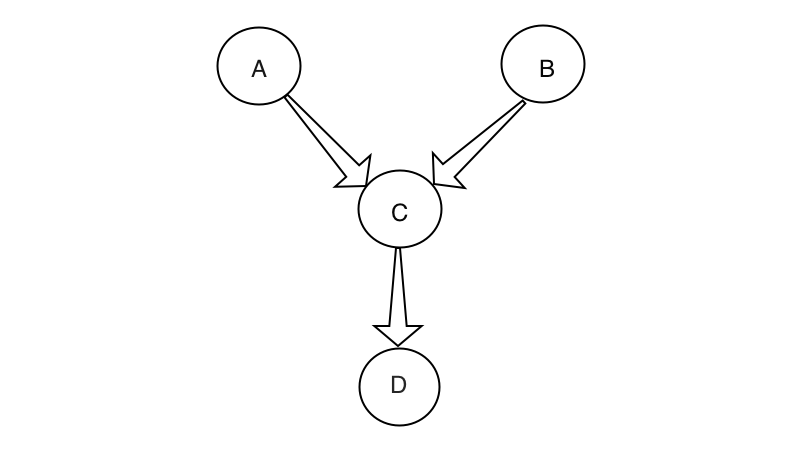
The nature of that structure could simply be reflected by the following list: [[a, b], c, d]. That is to say each element in the outermost list is a requirement for the next element in the list. If multiple nodes are requirements of another node but not of each other then they can be grouped together in their own list.
In order to process the above graph with AssemblyLine you simply need to pass the following structure to a new Server.
[
  [
    %Job{task: :a, args: [arg1, arg2]},
    %Job{task: :b, args: []}
  ],
  %Job{task: :c, args: [arg1]},
  %Job{task: d, args: []}
]
Configuration
AssemblyLine has a couple of configuration options. One of which is optional the other is required:
check_intervaljob_executor
check_interval
The check_interval is optional and defaults to 1 second. This governs how often the Handler module checks for a response from the Tasks it spawns.
The Handler will check until all Tasks have responded, independent of the check_interval however a shorter interval will allow you to update progress information or give other feedback to users more quickly.
job_executor
The job_executor value is required. The Handler module will call the perform/1 function on this module for each job to be executed.
Usage
There are three main 'pieces': The Server, the Handler and the Job.
The Server
next_for/1 - returns the current job set
iex> Server.next_for :my_queue
[%Job{task: :a, args: [arg1, arg2]}, %Job{task: :b, args: []}]
get_completed/1 - returns a set of completed jobs for the queue
iex> Server.get_completed :my_queue
%MapSet{%Job{task: a, args: [arg1, arg2], result: 200}}
complete_current_set/1 - pops the head off the job list for the queue
iex> Server.next_for :my_queue
[%Job{task: :a, args: [arg1, arg2]}, %Job{task: :b, args: []}]

iex> Server.complete_current_set :my_queue
iex> Server.next_for :my_queue
[%Job{task: :c, args: [arg1]}]
complete_job/2 - removes the job definition from the current set in the queue and adds the job to the finished list
iex> Server.complete_job :my_queue, %Job{task: :a, args: [arg1, arg2], result: 200}
iex> Server.next_for :my_queue
[%Job{task: :b, args: [arg1], result: nil}]

iex> Server.get_completed :my_queue
%MapSet{%Job{task: :a, args: [arg1, arg2], result: 200}}
finished/1 - Shutsdown the job queue
iex> Server.finished :my_queue
:ok
The Handler
start_all/1 - initiate the processing of a job queue
iex> Handler.start_all :my_queue
:finished | {:incomplete, [%Job{},]}
process/2 - processes the queue recursively until a job fails or all jobs finish
iex> Handler.process :my_queue, [%Job{}, %Job{}]
:finished | {:incomplete, [%Job{},]}
The Job
struct - holds information about the task, it's parameters and the outcome
%Job{task: term, args: list, result: term}set_result/2 - assigns a value to the result attribute
iex> Job.set_result %Job{task: :a, args: [arg1], result: nil}, 200
%Job{task: :a, args: [arg1], result: 200}
``